Choosing a Homeschool Curriculum While Living Overseas

Key Take-Aways
- Protect the core. Math, linguistics, science, real life skills and physical development matter more than flashy extras.
- Think about a long-term plan, such as future university or credentials, or directing your kids to be self-sufficient business owners instead.
- Build a simple, flexible system that you can stick to. Complexity breaks under the pressure of international mobility.
Choosing a homeschool curriculum overseas can be an overwhelming task for any expat father.
Doing it while navigating shipping delays, time zone shifts, and legal ambiguities adds a layer of stress that often leads to decision paralysis.
However, the decision becomes much clearer when you stop looking for the perfect book and start building a portable, sustainable system aligned with your long-term family goals.
In this short guide, I’ll tell you how to choose a homeschool curriculum while living overseas, and how I personally handle it.
Start With the End in Mind: Higher Education Pathways
Common wisdom, and most of the theory on this matter, espouses that you should direct your homeschool curriculum based on where your child will apply for university.
Admissions requirements vary wildly by region, and your homeschool curriculum overseas choice should facilitate a smooth entry into those systems.
To me, this is a flawed way of looking at it, because it flows from a potentially invalid premise: it assumes your child is going to university or college and that this is best for them.
That’s a large can of worms to open, so I’ll just say this. Personally, I think modern day universities and colleges are breeding grounds for toxic and harmful ideologies and waste a lot of time and money on bullshit.
I think it’s extremely outdated advice to want to put your kids in higher education. Yes, 50 years ago this was the best way to get ahead in life, but in the 2020s? Hell no.
If you want your child to have a good job and be a drone, a compliant tax-paying citizen, then yes, you should pursue this path.
However, if you want them to be independent business owners and providers of jobs in the future, then going to college/university might not be the best way forward in 90% of the cases … not counting highly specialized career paths like surgeons.
That being said… your mileage may vary and you probably disagree with my point of view, and you want your kids to go to college/university, so I’ll proceed with that in mind.
Thus, planning backward from university requirements prevents painful, expensive academic adjustments as you adapt education as your child grows older.
Curriculum choice is, in that case, a strategic investment in their future.
Recognized International Pathways
- Advanced Placement (AP): These are college level courses recognized widely in the U.S. and Canada. If you aim for North American universities (for your kid’s sake, I really hope you don’t), an online homeschool curriculum that includes AP-aligned coursework is a strong choice.
- A-Levels / IGCSE: This is the gold standard for UK, European, and Commonwealth university entries. Choosing overseas homeschooling programs that follow the British National Curriculum provides a clear, globally recognized transcript.
- International Baccalaureate (IB): While difficult to do entirely through independent homeschooling, some distance learning providers offer IB-aligned frameworks for highly mobile students.
- Accredited U.S. Diploma: Many international homeschooling families use an accredited umbrella school to issue a high school diploma that is recognized globally, so your kids can work at McDonald’s wherever you are.
Understand Legal Requirements and Compliance
The laws surrounding overseas homeschooling programs are a patchwork of national regulations.
Some countries require strict registration and approved curricula, while others have specific guidance on home education that applies even to temporary residents.
Legal Compliance Checklist
- Country of Residence: Check if the local Ministry of Education requires registration or annual testing.
- Passport Country: Determine if your home country requires you to follow their education laws while abroad.
- Visa Impact: Ensure your residency visas for the family do not require proof of traditional school enrollment.
- Testing Access: Confirm that local centers allow private candidates for exams like the SAT, ACT, or IGCSEs.
Ignoring these requirements can create administrative hurdles during visa renewals or when trying to build long-term stability in a new country.
Focus on the Core Subjects
Alright, now that we’ve got the legalities and the theory down, let’s delve into how you should approach a homeschool curriculum if you actually value your kids’ education and development.
Upon browsing through “official” curricula and the like, you may quickly discover that these are rife with, for lack of a better word, nonsense.
Civic duties, moral lessons, arts and crafts, religion, singing and such.
Expressing themselves artistically and learning moral lessons are of course important in life, but my point is that this is something they can a) develop on their own in their free time and b) pick up from their parents naturally.
It’s not something you should spend time on during your homeschooling.
In my opinion, any homeschool curriculum worth its salt focuses on 5 pillars:
- Mathematics
- Linguistics (reading, writing, multiple languages etc.)
- Science (biology, geography, history etc.)
- Real life skills (finances, household chores, technology use, how the world works etc.)
- Physical education (motor skills, stamina, strength and self defense)
If your kids have a strong basis in those 5, they’re well equipped to move on to more complex and deeper issues once they grow older.
Even more, if you handle it right, focusing on those 5 pillars virtually ensures that they will be able to handle life.
Without this basis, however, you end up with functional adult retards that can barely read and write, don’t know where their country is, believe in all kinds of superstition, can’t provide for themselves and become a drain on society.
That’s not what I want for my kids.
Structured vs. Flexible Programs
Your global education curriculum options generally fall into two categories. The right choice depends on your daily family routine and how you balance your professional life.
| Program Type | Ideal For… | Key Features |
| Highly Structured | Parents managing remote work and travel. | Daily lesson scripts, automated grading, and clear checklists. |
| Highly Flexible | Families who travel frequently or have unpredictable schedules. | Thematic units, self-paced mastery, and parent-led instruction. |
| Hybrid | Parents who want to structure their workday efficiently. | Online math/science with physical books for literature and history. |
The wrong curriculum is often the one that fights against your family’s natural energy and mobility.
Personally, I’m going for a hybrid approach:
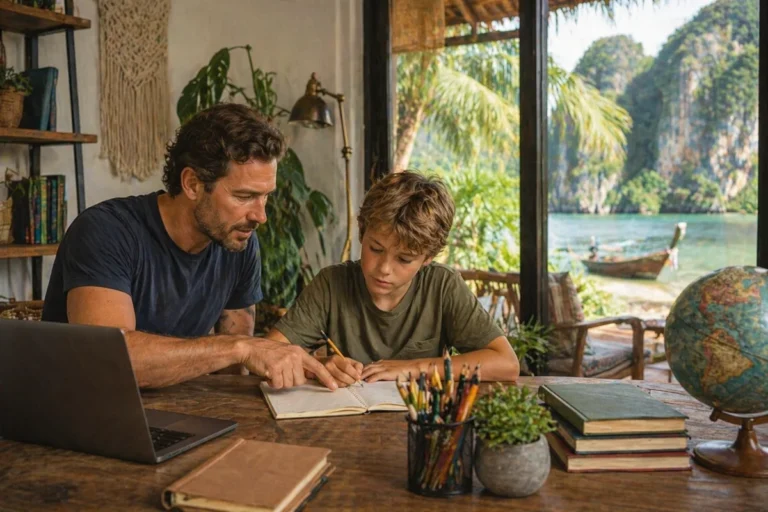
- Every morning for 5 days per week, before breakfast, before we do anything else, I instruct my kids in one or more of the core pillars. I loosely follow guide books which are at least a year ahead of their age, or just general goal posts for end-of-year results and work backward from there.
- They get assignments based on what we learned that morning, which they have to complete during the day. They also get things to study, which their mom tests in the afternoon.
- Once per week, they get a big test, going over everything we covered that week. If they hit a certain %, they get a reward and the next day off. If not, they have to spend the next day revising and learning from their mistakes.
- With regards to PE, I take them swimming at least once a week in a pool (sometimes to natural environments like the ocean or rivers). They also go to kickboxing classes twice a week. In the future, this will be expanded with (probably) gymnastics and/or going to the gym with myself or their mom.
Digital vs. Physical Materials: Logistics in the Expat Life
We’re living in the 21st century, so there are plenty of ways to handle your logistics. While an online homeschool curriculum is convenient, it is beholden to local infrastructure.
Conversely, heavy textbooks can become a liability during a cross-border move.
- Digital Advantages: No shipping costs, instant updates, and a school in a backpack feel. This is often the most cost-effective way to manage education while moving.
- Physical Advantages: Zero eye strain, works during power outages, and encourages deep focus.
- The Expat Hybrid: Many seasoned travelers use tablets for supplemental research and math, while keeping physical copies of their primary phonics and writing workbooks.
Again, I take a hybrid approach, with some very, very strong caveats.
- I strongly believe that irresponsible and unguided tablet, smartphone and general screen use contributes HEAVILY to mental problems with children and teenagers. I think that parents who give their kids tablets and just leave them to their own devices with access to the internet and social media, are in fact guilty of child abuse. As such, my kids have no gadgets of their own.
- Of course, they do need to learn how to use such devices, we’re not Amish. So while the youngest is practicing how to write and spell, the eldest is on an old laptop, learning how to type in Word. Sometimes their mom uses a language app while the kids watch.
- Once they grow older, I’ll expand this into proper, full school-day lessons on how to use technology – always supervised.
Using quality educational apps is something that can take a big load off your plate, so definitely consider it if it fits into your homeschool curriculum path!
Curriculum for the Multilingual Household
If you are creating a bilingual home environment, your curriculum choices for expat families must account for second- or third-language literacy.
Immersion in a foreign country is one of the most important ways to improve literacy, but it does require some assistance.
Integrating Language into the School Day
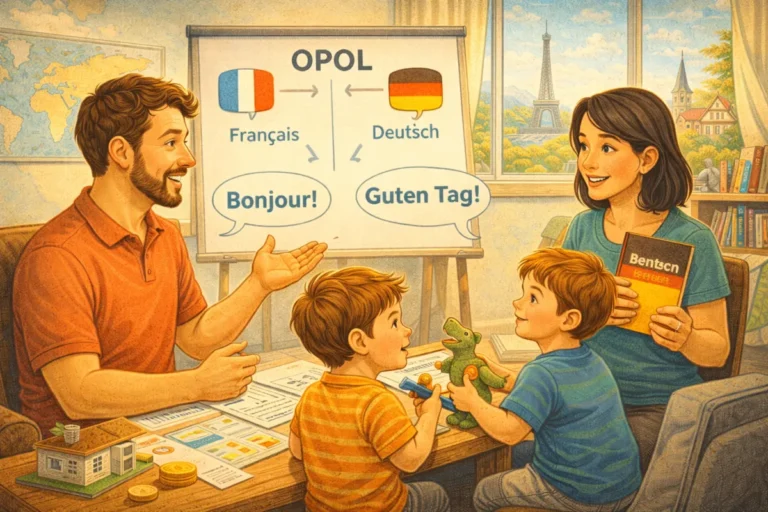
- The OPOL Supplement: Use the One Parent One Language method alongside a formal language curriculum.
- Focus on Language: Treat language as a core subject. Reading, writing, spelling and speaking should all be practiced daily, for every language you want your kids to be fluent in. Repetition is very, very important. Do not neglect this!
- Dual-Track Literacy: Teach reading in both English and the other language simultaneously to maximize the window where kids naturally acquire multiple languages.
I’ve talked about this topic quite a lot, so I’ll quickly summarize how we handle our bilingual (and in the future trilingual) kids.
- The family speaks in English language #1, our common tongue, the native tongue of the kids
- The kids and I speak in language #2 when the mom isn’t present. They also read to me in this language every day, which has helped their fluency greatly.
- Within the next few months, I’ll add Spanish (language #3) to our homeschool curriculum. It’ll be purely theoretical at that point, but when we move to Paraguay, they’ll be immersed in it every day, and we’ll ramp up the exposure and lessons immensely. They’ll be getting older, so the window in which they can rapidly absorb a new language is shrinking, unfortunately.
Quality Over Volume
The biggest mistake I’ve seen expat fathers make is overcompensating for the lack of a school by piling on too much work.
I’ve been guilty of this too, thinking they were falling behind, when in reality they were far ahead.
It’s understandable, because you logically would assume that a full week of 8 to 9 hour school days vastly outshines your meager few hours of home schooling.
But don’t forget – quality of education is more important than quantity. And a schedule that leads to parental burnout is never the answer.
Signs of Curriculum Overload
- School days consistently drag past 4 PM without breaks.
- Resistance to learning is high across all subjects.
- There is no time for socialization with other expat children.
- You are neglecting your own work or mental health to finish the list.
My advice?
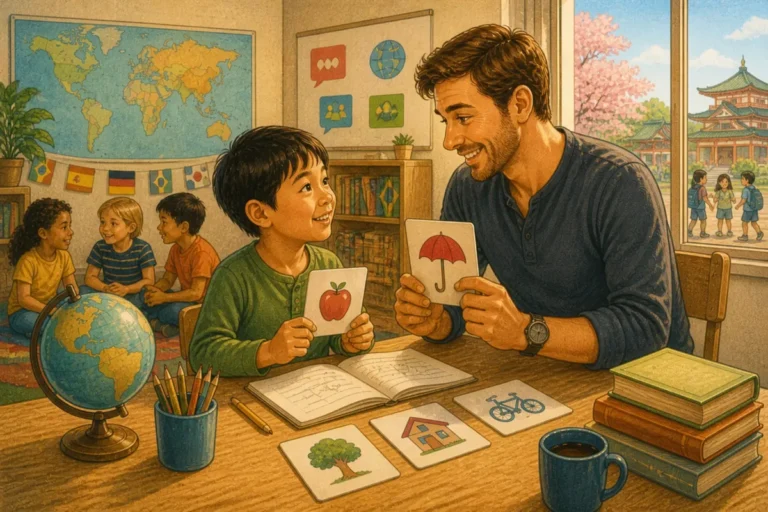
- Focus for a few hours per day on mastery in the core pillars, rather than a surface level scan of ten different subjects.
- Dedicated private tutoring of a subject, followed by (semi-supervised) self-study where they learn to understand the topic on their own, gives your kids a much more effective education
This is much better than dropping them off in the morning at school, where they’re receiving 8 hours of subpar education at best, harmful instructions at worst.
Remember: a few hours dedicated to subjects that MATTER, coupled with self-study and personal attention, is always better than a long day full of nonsense.