🏠 Creating a Bilingual Home Environment Abroad


TLDR
- Children develop strong bilingual skills when both languages are used consistently and meaningfully at home.
- Quantity and quality of language input directly influence vocabulary and grammar development.
- Emotional connection and daily routines anchor a minority language long term.
- Spoken fluency develops naturally through interaction, but literacy requires intentional support.
- A clear family language strategy prevents dominance of the community language abroad.
Living abroad changes the language equation overnight. One day your child is surrounded by your native language. The next, the grocery store, the playground, and eventually school all operate in something else. It can feel like your home language is slowly shrinking while the community language expands.
That shift is normal, but it is also manageable. A bilingual home doesn’t happen accidentally; it grows out of deliberate but relaxed habits that shape daily life. The good news is that children are neurologically prepared to acquire more than one language from an early age.
What they need is steady exposure, meaningful interaction, and emotional consistency. Here is how to build a successful multilingual household while navigating the real challenges of raising children abroad.
🗺️ 1. Start With a Clear Family Language Plan
Before anything else, decide what you want your linguistic outcome to be. Do you want full fluency in both languages? Conversational ability in one and literacy in another? Academic competence across the board? Your strategy depends on your long-term goals.
Research in bilingual development consistently shows that children’s proficiency reflects the amount and type of exposure they receive. According to studies on dual-language acquisition, clarity helps you stay consistent when life gets busy.
Common Multilingual Home Strategies:
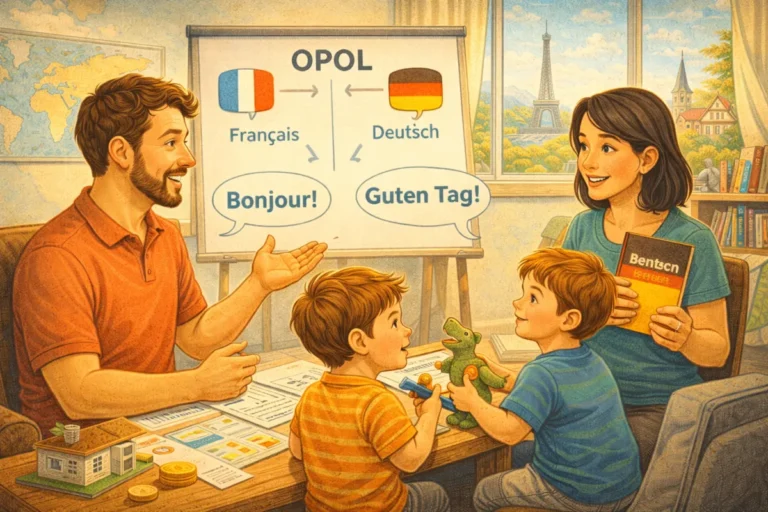
- OPOL: One Parent One Language, where each parent sticks to a specific language.
- mL@H: Minority Language at Home, where the non-community language is used by everyone inside the house.
- Context-Based: Specific languages for specific daily routines.
🎭 2. Make Language Functional, Not Theoretical
Children do not retain languages because they are told they are important; they retain them because they use them. If your home language exists only in corrections or instructions, it weakens emotionally. If it exists in jokes, stories, and daily conversation, it strengthens naturally.
When creating a bilingual environment, talk about real things. Discuss the day. Cook together and name ingredients. Ask for opinions. Language thrives in dialogue, not performance. When it becomes part of family life rather than a lesson, children internalize it without resistance. This is a core part of the bilingual lifestyle for expat families.
🛡️ 3. Protect the Minority Language Early
In many expat contexts, the community language quickly becomes dominant once formal schooling begins. Research shows that school language often accelerates vocabulary growth due to academic exposure. If the home language doesn’t maintain daily conversational depth, children may shift toward the community language in replies.
How to create a bilingual home that resists erosion:
- Consistency over intensity: 30 minutes of deep interaction is better than 4 hours of passive TV.
- The “Home-Gate” Rule: Once you cross the threshold, the minority language takes over.
- Active Modeling: If they reply in the community language, acknowledge the content but reply in the minority language.
📖 Resource: If you are still in the planning phase, checking a complete guide to moving abroad can help you time your move to coincide with key language development milestones.
🔄 4. Understand That Mixing Is Normal
If your child blends languages in a sentence, that’s typical bilingual development. Young children often draw from whichever language provides the fastest word retrieval. This reflects vocabulary distribution across languages, not confusion.
Over time, as exposure balances and vocabulary grows, children separate systems more cleanly. Pressuring them to “choose one” mid-sentence rarely helps. Continued modeling does. It’s better to focus on how children naturally become bilingual rather than forcing strict separation too early.
📱 5. Quality Interaction vs. Screen Exposure
Media can support language exposure, but it cannot replace live conversation. Studies in early language development emphasize “contingent interaction”—the back-and-forth exchange between child and caregiver. Passive listening contributes far less than interactive communication.
| Input Type | Impact Level | Engagement Strategy |
| Direct Conversation | High | Discuss feelings, plans, and ideas. |
| Shared Reading | High | Ask “what happens next?” in the target language. |
| Educational Apps | Moderate | Use online learning tools for kids together. |
| Passive Video | Low | Watch together and narrate the action. |
📚 6. Build Literacy Deliberately
Spoken language emerges naturally through exposure. Reading and writing do not. Literacy requires repeated exposure to print, phonological awareness, and practice. Without a homeschool curriculum or intentional support, children may remain fluent speakers but limited readers.
A Simple Bilingual Routine for Kids:
- Bedtime Reading: Exclusively in the minority language.
- Audiobooks: Paired with printed text to build word recognition.
- Identity Writing: Writing short letters or postcards to relatives.
- Research: Using free vs. paid resources to find interesting topics in the home language.
🤝 7. Use Extended Family and Real Reasons
Grandparents and cousins are powerful anchors for raising multilingual children abroad. When children associate a language with meaningful relationships outside the nuclear family, motivation increases.
Create real reasons to use both languages:
- Travel: Visits to your home country make the language essential.
- Socialization: Seek out expat communities that share your language.
- Traditions: Celebrate cultural holidays that are uniquely tied to the language.
💡 Expert Tip: Language tied to identity lasts. Use video calls not just for “hello,” but for shared activities like reading a story together.
⚖️ 8. Keep Correction Gentle and Sparse
Overcorrection discourages risk-taking. Bilingual children refine grammar over time through repeated exposure. Constantly interrupting to fix minor errors can reduce willingness to speak—one of the common mistakes expat parents make.
Instead, model correct usage naturally. If your child says a sentence imperfectly, respond with the correct structure embedded in your reply. Language grows through confidence, and maintaining a positive language immersion at home requires a supportive atmosphere.
🏁 Conclusion: A Long-Term Vision
As an expat father building a life overseas, your focus is likely on the long term. Bilingual competence expands educational options and preserves cultural heritage. According to research, bilingualism is linked to enhanced executive control and cognitive flexibility.
However, those outcomes depend on sustained exposure. A bilingual home is not built in a year; it is built in thousands of small conversations. By maintaining a steady structure and building long-term stability, you give your children a gift that lasts a lifetime.
For more help on the logistics of your move, look into how expat families balance travel and education to ensure your bilingual goals align with your lifestyle.