🗣️ Common Mistakes Expat Parents Make With Language


TLDR
- Kids do not get confused by two languages, but inconsistent exposure slows development.
- The biggest failure is relying on school to maintain the family language.
- Mixing languages is normal and should not be constantly corrected.
- Spoken fluency develops naturally, literacy does not and needs structure.
- Social usefulness determines which language children keep long term.
When families move abroad, language becomes the center of everything surprisingly fast. You picture logistics, housing, maybe healthcare. Then your five-year-old answers you in another language and suddenly the topic feels personal.
Most expat parents want bilingual children. Very few plan the mechanics of how that actually happens over years instead of months. The result is a set of predictable expat parents mistakes. These aren’t dramatic failures, just small misunderstandings repeated daily until one language quietly fades.
I have made several of these myself, and almost every long-term expat family I know has run into these language mistakes expat parents often overlook.
🛑 Mistake 1: Assuming Kids Will “Naturally Stay Bilingual”
Children naturally learn the language they need most, not the one you value most. If your child attends school in the local language, plays with neighbors in that language, and consumes media in that language, it becomes dominant.
The home language does not disappear immediately. It slowly simplifies. Shorter sentences. Limited vocabulary. Avoidance of complex topics.
The “Efficiency” Shift:
- Brain Effort: The brain invests energy where it receives the most meaningful input.
- Social Reward: If the child can get what they want using the community language, they will.
- Reinforcement: Without deliberate effort, exposure becomes occasional and symbolic rather than functional.
Exposure must be consistent to avoid language learning mistakes. This is a major challenge for any expat father trying to maintain a heritage connection while managing work, parenting, and travel.
🏫 Mistake 2: Outsourcing Language to School
A surprisingly common belief is that one environment can carry one language while home carries the other automatically. For example, local school handles the community language and home maintains the family language without effort.
In practice, school exposure dominates because it occupies more waking hours and includes peer interaction, emotional events, and problem-solving. This is one of the common mistakes expat parents language choices lead to.
| Context | Why School Wins | Why Home Struggles |
| Duration | 6-8 hours daily | 2-3 hours of active talk |
| Peers | High emotional reward | Low social pressure |
| Complexity | Academic/Problem solving | Routine/Casual talk |
School can build a language. It rarely preserves a minority one on its own. Children need full-range usage, as discussed in how children naturally become bilingual.
🗣️ Mistake 3: Correcting Every Mixed Sentence
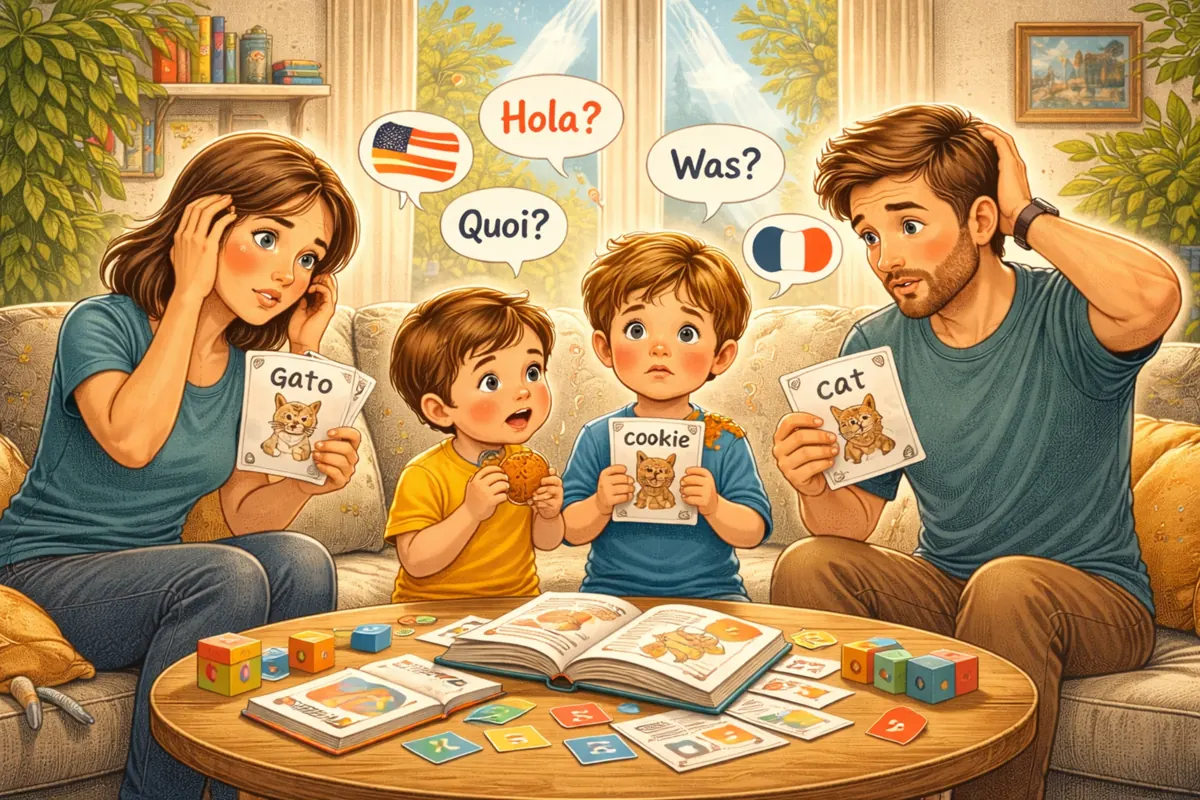
Language mixing worries parents. A child starts a sentence in one language and finishes in another, and the instinct is to correct immediately. This is a primary example of raising bilingual child mistakes.
Mixing is not confusion. It reflects vocabulary availability. Children choose the word that comes fastest while their brains are organizing two systems.
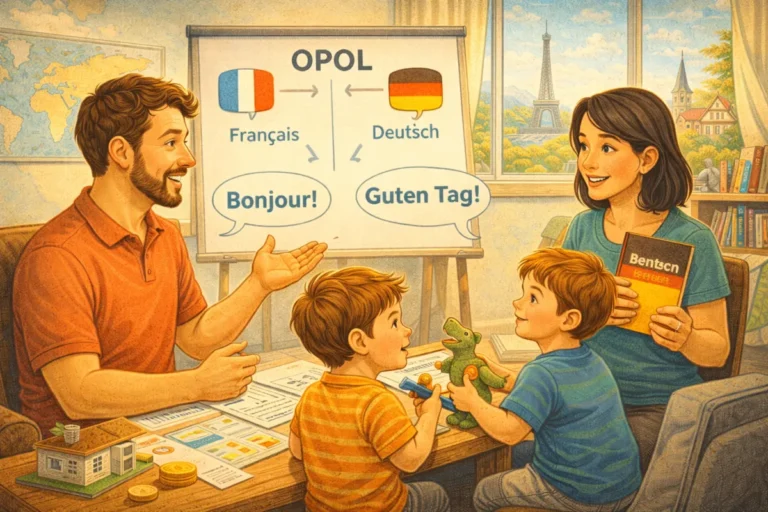
Frequent interruption can reduce willingness to speak. A more effective approach is modeling, which is a core part of the OPOL method explained for expat families.
📚 Mistake 4: Forgetting Literacy Requires Teaching
Many parents feel reassured when their child speaks both languages fluently. Then around age eight or nine, they notice reading exists only in one language.
Spoken language develops through interaction. Reading and writing require explicit exposure to print and guided practice. This is among the most frequent expat language teaching errors.
Key Takeaway: Without literacy, a language becomes socially limited and tends to fade in adolescence. Writing should be purposeful: letters, journals, and instructions work better than isolated exercises.
🛠️ Mistake 5: Treating Language as a Subject Instead of a Tool
If a language appears only during lessons, children classify it as schoolwork rather than communication. Motivation drops quickly. Languages survive when they solve real problems: planning trips, cooking together, or learning hobbies.
I once noticed my child could describe a game strategy in one language but not the other. The missing vocabulary wasn’t academic; it was experiential. Using online tutors vs. self-teaching for bilingual kids can fill gaps, but real-world use is king.
Research from UNICEF regarding native language education confirms that utility drives retention.
🤝 Mistake 6: Ignoring Social Identity
Children eventually choose the language that gives them belonging. This is one of the expat language pitfalls that becomes visible in preteen years. If friends and humor exist in one language, that language becomes emotionally dominant.
- Peer Interaction: Sports teams or clubs in the minority language.
- Social Weight: Extended visits where communication depends on that language.
- Belonging: Maintains language better than obligation.
This social integration is key to how kids naturally acquire multiple languages abroad.
🔄 Mistake 7: Switching Family Language Too Easily
Many parents gradually adapt to the child’s stronger language for convenience. It feels helpful at first—you want smoother conversation. But every switch removes necessary exposure. This is a common part of the language missteps for expat families.
Consistency matters more than perfection. Even imperfect sentences from a parent provide valuable structure. If you need more support, consider the best online language learning platforms for expat children.
⚖️ Mistake 8: Expecting Perfect Balance
True balanced bilingualism is uncommon worldwide. Most bilingual people have domain strengths shaped by environment. Expecting identical knowledge sets is a common way to make raising bilingual child mistakes.
Reducing pressure improves retention. When children feel evaluated constantly, they avoid the weaker language. Parents should also consider if they need to learn the local language to model the learning journey.
🏁 Conclusion
Most expat parents mistakes with language are not caused by difficulty but by small daily patterns that unintentionally favor one language. Children follow usefulness, belonging, and repetition. When both languages provide real value across different parts of life, they remain.
You do not need complex programs or strict rules. You need structure, patience, and environments where both languages matter. Bilingualism is less like a subject you teach and more like a culture you maintain inside the family. If it lives in everyday life, it stays.