🌍 When to Adjust Language Strategy for Growing Kids Abroad


TLDR
- Language strategy for expat kids must evolve as cognitive, social, and academic demands change.
- Early childhood exposure works differently from school-age language development.
- Signs like language resistance or academic gaps indicate it’s time to adjust language learning.
- Combining structured learning with real-life immersion produces the strongest bilingual outcomes.
- Flexibility, not rigidity, is what keeps long-term bilingual development on track.
Raising bilingual kids abroad sounds straightforward in theory. Speak two languages, live in a different country, and things should just click into place. In reality, it’s a moving target.
What works at age three often falls apart by age eight. What seemed like a solid plan during preschool years can suddenly feel limiting once your child starts thinking, learning, and socializing more independently.
Many parents realize that raising children abroad, the real challenges are often found in these quiet transitions rather than the big moves.
If you’re building a long-term family life abroad, your language strategy isn’t something you set once and forget. It needs to evolve as your child grows. The good news is that the need to adjust isn’t a sign of failure; it’s actually a sign that your child’s cognitive world is expanding.
According to experts at Linguistic Society of America, language acquisition is a dynamic process that thrives on varied environmental input.
📊 Evolution of Language Needs by Stage
| Life Stage | Primary Learning Method | Main Linguistic Focus | Parental Role |
| Early Childhood (0-5) | Intuitive Absorption | Vocabulary & Basic Syntax | The Primary Model |
| School Age (6-12) | Formal Literacy | Reading, Writing & Logic | The Educational Guide |
| Teen Years (13+) | Social Identity | Slang, Nuance & Ownership | The Supportive Peer |
👶 Early Childhood: The Era of Pure Absorption
During the first five or six years, consistent exposure is the most important factor. Kids in this stage can develop strong listening and speaking skills in multiple languages without ever sitting through a formal lesson.
They are biological sponges, picking up phonemes and grammatical structures simply by existing in a rich linguistic environment.
Simple systems work wonders during this phase:
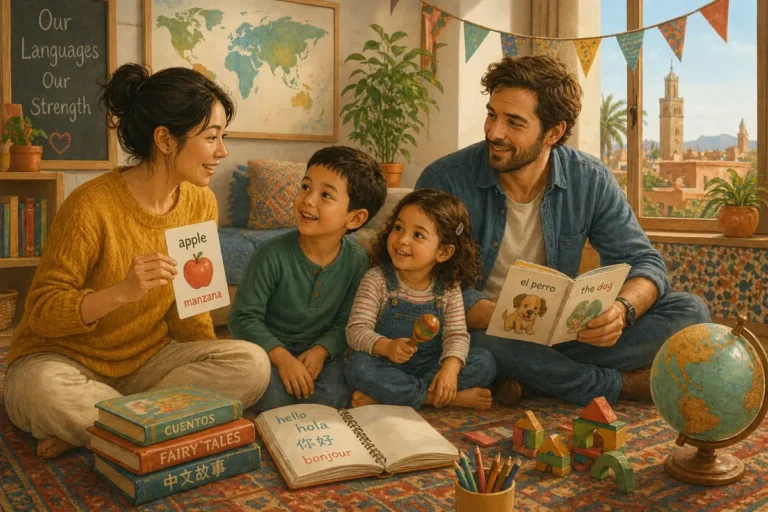
- Home Sanctuary: Parents speaking their native language consistently.
- Community Play: Daily interaction with the local language through play.
- Routine-Based Learning: Books, songs, and bedtime rituals.
At this stage, many families find success with the OPOL method explained for expat families. The goal is familiarity and comfort. However, this phase has a quiet expiration date.
Once literacy becomes the primary vehicle for learning, passive exposure alone starts to fall short. You cannot “absorb” the ability to write a complex essay just by hearing your parents talk about dinner.
📖 The School-Age Shift: When Gaps Begin to Show
Around ages six to nine, something fundamental changes. Kids are no longer just learning to speak; they’re learning to read, write, and think abstractly in a language. This is where many expat families notice a significant imbalance.
This is often when to focus on second language literacy more heavily. A child might speak one language fluently but struggle to read an age-appropriate book in it.
Or they may understand everything at home but hesitate to express complex ideas because their vocabulary is limited to “household” terms.
If one language isn’t being developed across all domains, speaking, reading, writing, and comprehension, it will gradually weaken. This is why changing language approach as kids grow is vital. You are transitioning from supporting “playground language” to supporting “academic language.”
📖 Read Also: How children naturally become bilingual without formal schooling
🚨 5 Signs It’s Time to Adjust Your Strategy
You don’t need formal testing to know when something’s off. The signs tend to show up in the friction of everyday life.
- The Avoidance Reflex: If your child resists speaking one language or switches immediately to the dominant environment language, it indicates a lack of confidence.
- Academic Friction: Struggling to follow lessons, read texts, or complete writing tasks. This is an invitation for adjusting bilingual plan as child ages.
- The “Silent Period” Returns: If a child who was once talkative becomes quiet in a specific language environment, they may be overwhelmed by the increasing complexity of the conversation.
- Social Withdrawal: Avoiding peers who speak the minority language because they feel “less than” or unable to express their true personality.
- Translation Reliance: If your child constantly asks you to translate concepts they should know, their “thinking” language has shifted entirely to the other side.
⚙️ Tweaking Input vs. Increasing Structure
When issues appear, the instinct is often to double down with “more of the same.” But effective parenting requires knowing which lever to pull.
- The Exposure Lever: If your child understands but struggles with output, they need more meaningful interaction. This means more storytelling, more playdates, and more real-life usage.
- The Structure Lever: If literacy or academic language is the issue, “more talking” won’t fix it. You need structure. This is where reading programs, writing exercises, or formal lessons play a role.
In our experience, simply “speaking more” didn’t solve the problem once our kids hit school age. We had to embrace adapting education as your child grows older by introducing deliberate, daily reading time in the minority language. This small shift in structure made a noticeable difference in their confidence within months.
🏫 The Role of Formal Learning (Without the Burnout)
Structured learning often gets a bad reputation in expat circles, especially among those leaning toward alternative education. However, research published by Harvard Graduate School of Education suggests that intentional literacy instruction is the bridge between conversational fluency and professional-level proficiency.
- Consistency Over Intensity: 20–30 minutes three times a week is vastly superior to a three-hour Saturday “cram session.” ⏲️
- Strategic Tools: Don’t feel you have to be the teacher for everything. Utilizing the best online language learning platforms for expat children can take the pressure off the parent-child relationship.
- The Literacy Link: Reading and writing do not develop automatically. They require “eye-to-page” time that conversation cannot replace.
🎧 Teen Years: From Tool to Identity
As children move into adolescence, language becomes more than a tool, it becomes a part of their identity. Teens may lean toward one language based on friendships, pop culture, or personal preferences. At this stage, forcing a language will almost certainly backfire.
Instead, optimizing language development for older kids means moving toward autonomy. A successful language learning plan for teens focuses on:
- High-Interest Content: YouTube, podcasts, or music in the target language.
- Social Connection: Opportunities to use the language with peers, not just parents.
- Practical Ownership: Let them manage tasks in that language, such as ordering food while traveling or researching a hobby.
Supporting long-term identity development for third culture kids means accepting that their “heart language” might not always be yours, but ensuring they still have the keys to both.
✈️ Travel as a Strategy Accelerator
One unique advantage of the expat life is mobility. Travel isn’t just a vacation; it’s a high-intensity language lab. Spending even a week in an environment where the minority language is the only way to communicate creates immediate necessity.
Short, immersive experiences often produce gains that months of home-study cannot match. It forces the brain to move from “passive recognition” to “active production.” You can see the neurological gears shifting as they realize their words have real-world consequences.
🛑 Avoiding the “All or Nothing” Trap
The biggest mistake parents make is treating language strategy as binary, either we are “strict” or we “give up.” In reality, the strongest outcomes come from a blend.
- Exposure builds intuition.
- Structure builds precision.
- Social Interaction builds confidence.
- Academic Work builds depth.
If one element is missing, the system becomes fragile. Think of it less as choosing a single method and more as adjusting a “mix” over time. As highlighted by Bilingual Kidspot, the goal is functional bilingualism that serves the child’s actual life, not an abstract ideal of perfection.
🏁 Conclusion: The Long Game
There’s no perfect language strategy that lasts from toddlerhood through graduation. And that is a good thing. It means your child is growing, evolving, and interacting with the world in more complex ways.
Pay attention to the signals. Don’t be afraid to add structure when the “natural” way hits a plateau.
Stay flexible, keep the pressure low but the consistency high, and you will give your child one of the most significant advantages possible: the ability to navigate multiple cultures with ease.