📈 How Expat Families Track Educational Progress Without Schools


TLDR
- Alternative Systems: Expat families outside traditional schools rely on structured tracking systems instead of grades and report cards.
- Methodology: Progress is measured through portfolios, skill benchmarks, and regular informal assessments.
- Frameworks: International standards help maintain academic direction and comparability for future transitions.
- Consistency: Maintaining a routine in tracking matters more than the specific tool or method you choose.
- Holistic Growth: Real-world learning outcomes play a central role alongside academic milestones.
When you step away from traditional schooling, one of the first questions that hits you is surprisingly practical: how do you actually know your child is progressing?
There are no report cards, no parent-teacher meetings, and no standardized classroom benchmarks handed to you every term.
At first, that can feel like stepping into the dark. However, over time, most families realize that education tracking for expat families doesn’t disappear outside of school; you just have to track it more intentionally.
🚫 Moving Beyond Grades and Standardized Labels
Traditional schools rely heavily on grades, test scores, and age-based expectations. These systems are designed for large groups, not individual learning paths.
When you’re raising children abroad, those structures are no longer automatically present. This might sound risky, but it also removes a layer of limitation.
You’re no longer forced to measure your child against a fixed timeline. Instead, you can focus on actual understanding and long-term homeschool progress tracking.
🎯 Using Learning Objectives Instead of Year Levels
One of the most effective ways families manage education without school tracking is by focusing on specific objectives rather than grade levels.
Most established education systems publish clear expectations for what students should know in subjects like math and reading. You don’t need to follow them rigidly, but they provide a helpful structure.
| Traditional Question | Progress-Based Question |
| Is my child in grade 4 math? | Can my child multiply multi-digit numbers? |
| Did they pass the reading test? | Can they summarize a complex story? |
| Are they at the right level? | Are they applying skills in real contexts? |
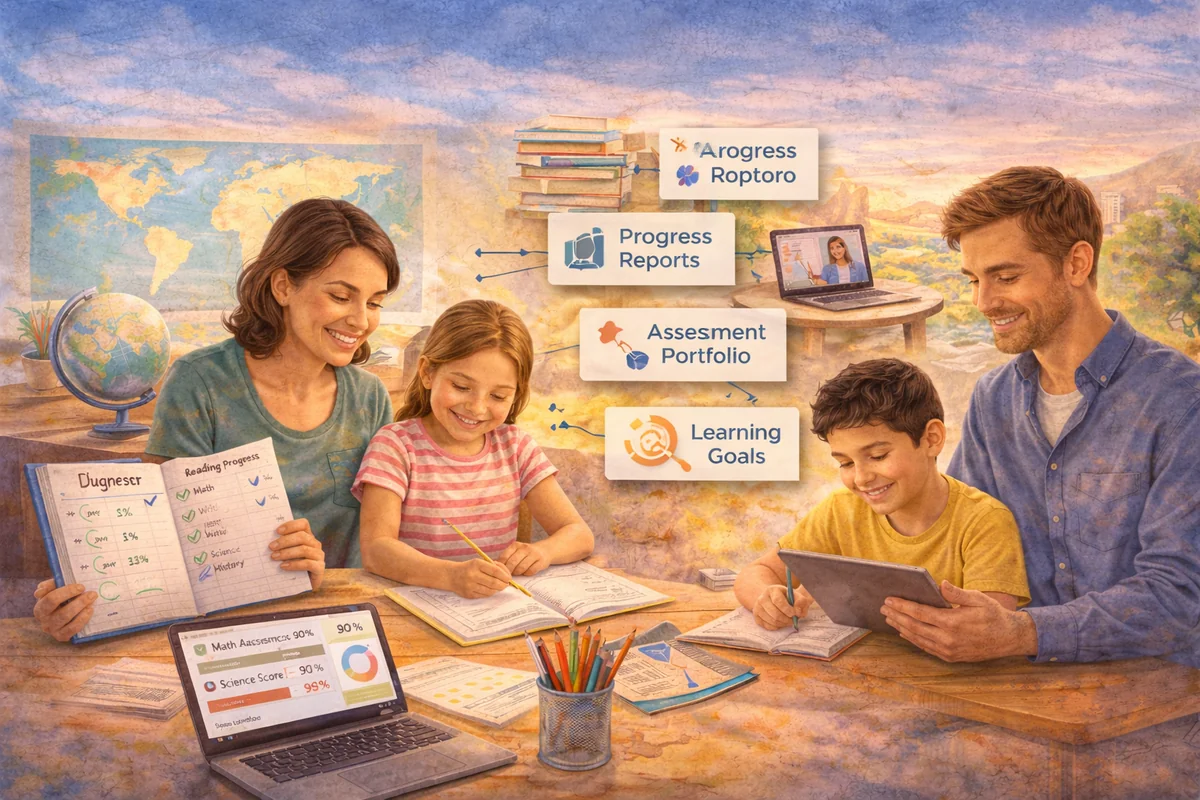
📂 Portfolios: A Real Record of Progress
Portfolios are one of the most widely used tools for monitoring learning at home. And for good reason: they work.
A portfolio is simply a collection of your child’s work over time, including:
- Writing samples and math exercises.
- Photos of hands-on projects.
- Videos of your child explaining a concept.
The power of a portfolio is that it shows progress visually. When you are in the daily routine, measuring learning without formal school can feel slow, but a portfolio makes the growth obvious.
🗣️ Regular Informal Assessments
You don’t need formal exams to assess learning. In fact, many families rely on regular, low-pressure check-ins.
This might look like asking your child to explain a concept in their own words or observing how they apply knowledge in real situations.
These informal assessment in homeschool expats methods are often more accurate than high-stakes tests because they reflect actual understanding, not just test-taking ability.
📏 Standardized Tests as Optional Benchmarks
Even families who avoid traditional schooling sometimes use standardized tests occasionally. They aren’t a primary measure, but a reference point.
Internationally recognized tests can provide an external benchmark to see how your child compares to broader academic expectations. This is helpful if choosing a homeschool curriculum that aligns with future university goals.
🧩 Tracking Skill Development Across Subjects
Academic subjects are just one part of the picture. Many expat families take a broader view of progress that includes:
- Language Development: Essential for creating a bilingual home environment.
- Critical Thinking: Solving problems in new environments.
- Independence: Managing their own daily learning tasks.
According to research from the National Center for Education Statistics, homeschooling families often prioritize these personalized outcomes.
🔄 The Role of Routine and Consistency
One thing becomes clear quickly: homeschool progress tracking only works if you do it consistently.
It doesn’t have to be complicated. A weekly review or a monthly portfolio update is usually enough. Without that rhythm, it’s easy to drift and lose sight of how much your child is actually achieving.
🚀 Adapting to Different Learning Speeds
One of the biggest advantages of education without school tracking is flexibility. Kids don’t all learn at the same pace.
When you handle the assessment in homeschool expats yourself, you can adjust in real time. There’s no pressure to “keep up” with a class, leading to a much deeper understanding of the material.
🌍 Real-World Learning as a Measurement Tool
Expat life naturally creates opportunities for real-world learning. Travel and cultural immersion are significant educational experiences.
To record educational progress unschooled, ask yourself:
- Can your child handle transactions in another language?
- Can they navigate a new city with basic guidance?
- How well are they adapting as they grow older?
📂 Documentation for Future Transitions
If your child eventually transitions into a traditional school or university, you will need organized records.
This is where structured education tracking for expat families becomes essential. Portfolios and written summaries serve as evidence of learning for admissions officers.
👨🏫 The Parent’s Role: Guide, Not Inspector
I’ve learned that measuring learning without formal school isn’t about constantly testing your child. It’s about understanding where they are and helping them move forward.
If it turns into micromanagement, kids disengage. A supportive approach where you observe and guide works much better for long-term identity development.
🛠️ Tools for Monitoring Learning at Home
| Tool Type | Purpose | Frequency |
| Digital Journal | Quick daily notes on wins | Daily |
| Work Folder | Collecting physical samples | Weekly |
| Mastery Checklist | Tracking specific math/reading skills | Monthly |
Export to Sheets
🔄 When to Adjust Your System
No tracking system works forever. As your child grows, their needs change. What worked at age seven won’t necessarily work at age twelve.
If your current method of homeschool progress tracking feels like a chore or isn’t giving you clarity, don’t be afraid to change it. Flexibility is your greatest asset.
🌟 Conclusion
To record educational progress unschooled is not about replacing report cards with something equally rigid. It is about building a system that actually reflects how your child learns.
With clear objectives and consistent documentation, you can create a reliable picture of growth. It takes effort, but it provides a level of clarity that traditional systems often miss.
You aren’t guessing if your child is doing well, you can see it in their work and their confidence every day.