Online Tutors vs Self-Teaching for Bilingual Kids

Key Take-Aways
- Digital apps and other programs certainly help in creating a large, passive vocabulary, but you need input from live native instructors to turn that passive knowledge into active, confident conversational skills.
- Automated mobile systems make it simple to maintain short, daily learning habits, whereas human interaction introduces structural scheduling and real-time social motivation.
- Early learners require heavy human interaction and playful feedback loops, whereas older children possess the mental focus required for structured independent programs.

My fellow expat dads certainly know this already, but raising well-balanced multilingual children while navigating life in a foreign country introduces a genuinely fascinating mix of cultural advantages and structural parenting choices.
On one side of the coin, your children absorb multiple tongues completely naturally by simply walking through their immediate surroundings.
They hear distinct dialects at the local market, on community playgrounds, during brief taxi rides, and across busy restaurant tables. It’s great! Smooth, free education.
On the other side of the coin, raw environmental exposure alone is rarely enough to build comprehensive literacy skills – but it could, it depends on the child and the exact situation, of course.
What I’ve noticed is that children can often easily understand a local tongue but hesitate when it is time to speak it. This could be temporary (like it was for mine), and they grow out of it as their comprehension grows, or they need an extra push.
Alternatively, they might communicate perfectly in casual street play but possess zero reading or writing comprehension.
So yeah, a structured framework regarding bilingual studies is often required, and something I’d strongly recommend.
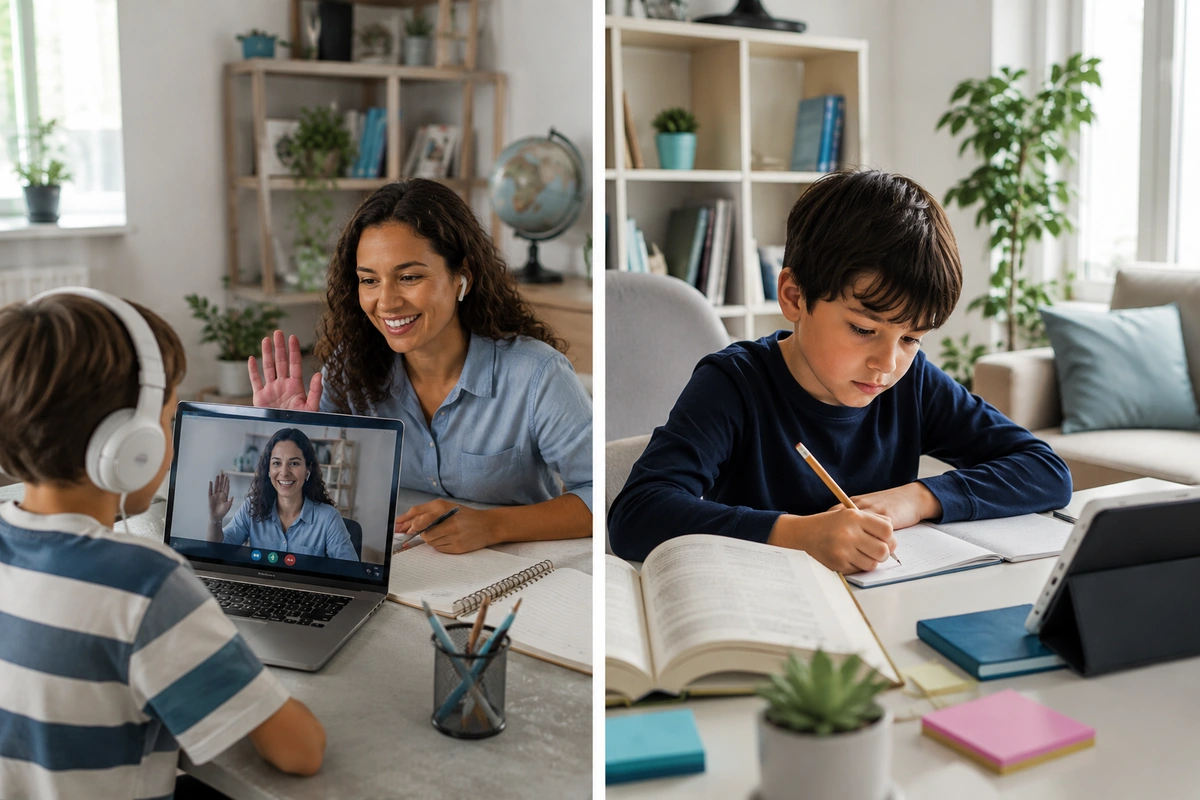
There are, broadly speaking, two main options IF YOU DO NOT WANT TO TEACH THEM YOURSELF: independent, software-driven study paths, or direct collaboration with personal web-based instructors.
Both systems offer immense educational benefits, yet they target completely different areas of a child’s linguistic brain.
But again, all of this is provided you’re not teaching your kids yourself. I’m a big fan of homeschooling and I’m 100% confident I can get my kids to full, native-level bilingualism by daily study, immersion and reading, but if you don’t want to do this, or have no time, then you need to read on.
Gaining a deep understanding of this bilingual learning strategies comparison allows you to construct a stable home system that genuinely supports your child’s multi-lingual journey.
How Children Actually Learn Languages
Before diving deep into a detailed tutoring vs self study for kids analysis, let’s go briefly into how childhood language acquisition actually functions on a psychological level.
- Young minds do not master communication by memorizing dry abstract charts or static verb rules – like us expats dads have to do when learning a completely new language.
- Instead, they absorb linguistic structures through frequent re-exposure (IMMERSION!), active social engagement, and high-stakes, meaningful communication.
Hearing consistent vocabulary across familiar contexts allows their minds to map specific vocal frequencies to tangible real-world concepts.
Speaking then forces them to actively experiment with sentence structures, testing out phonetic boundaries and learning how to piece phrases together on the fly.
The Strength of Self-Teaching Platforms
The global market for independent software systems and mobile language applications has expanded dramatically over the past ten years – as you may expect.
The vast majority of these tools rely on short, highly engaging lesson modules that merge auditory tracking, reading visual cues, and basic pronunciation mimicry into a single interface.
For example, you can use Lingoda as an adult to improve your skills via a handy online app, and likewise there are plenty of apps for your kids.
Many of these programs utilize “specialized spaced repetition algorithms”.
Sounds fancy, and it kinda is! This system tracks a child’s performance and resurfaces specific words right before they are projected to slip out of short-term memory, effectively locking them into long-term retention.
For active international families, the single biggest advantage of choosing a self teaching bilingual path is the unparalleled level of structural consistency it offers.
Because these applications are built around micro-lessons that take between five and ten minutes to complete, they fit into almost any family routine.
This ease of use makes it incredibly simple to maintain continuous, daily practice cycles, which is exactly what kids need to improve their language skills.
Vocabulary and Listening Skills
Independent software systems show incredible utility when it comes to systematic vocabulary expansion.
By linking new terms directly to distinct visual elements, crystal-clear audio files, and brief contextual phrases, these platforms make it simple for your child’s mind to connect definitions with correct phonetic structures.
Consistent listening drills also do wonders for early comprehension. Your children spend their sessions hearing flawless pronunciation delivered by a variety of native voice actors, which systematically trains their ears to distinguish subtle phonemes in the target language.
Comparing Core Learning Benefits
| Learning Asset | Software-Driven Self Study | Live Human Instruction |
| Vocabulary Density | Algorithmic exposure to hundreds of terms | Slower introduction based on conversation |
| Auditory Comprehension | Broad exposure to diverse native voice actors | Concentrated exposure to a specific tutor |
| Schedule Control | On-demand availability across any time zone | Fixed reservation slots requiring planning |
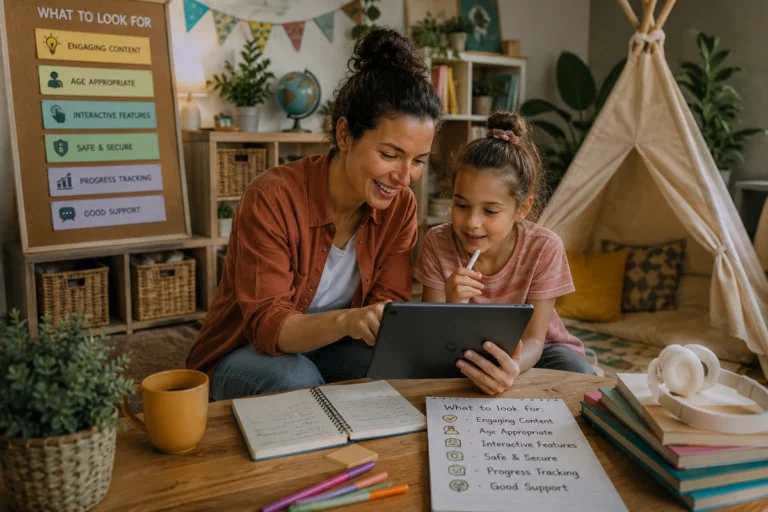
To keep these digital sessions engaging over the long haul, take a look at my parent-focused review on what to look for in online learning tools for kids.
Where Self-Teaching Tools Fall Short
Independent software designs excel at systematic repetition (like a robot), but they fall pretty damn short when it comes to authentic social interaction.
Learning to recognize a word on a screen or translate a static sentence requires a completely different cognitive pathway than engaging in a natural, spontaneous conversation, as I’m sure you’re aware of if you’ve ever studied another language.
Real-world communication demands that a child decode unpredictable questions, adjust their sentence structures on the fly, and interpret fluid, non-scripted vocal cadences.
While many programs attempt to simulate these dynamics using automated voice recognition software or pre-written chat trees, these features cannot truly match the depth of real human dialogue.
Without regular opportunities to use their speech actively, children run the risk of becoming entirely passive learners.
They develop the ability to understand everything they hear, yet freeze up the moment they are asked to speak in public.
This exact conversational bottleneck is where investing in online tutors provides an incredible advantage.
Parents who want to bypass these structural roadblocks can explore my strategic roadmap on creating a bilingual home environment abroad.
Why Many Families Combine Both
In daily practice, and in my experience, the most successful multilingual households rarely choose one approach over the other.
Instead, they build a highly effective hybrid system that blends both methodologies into a single routine.
Independent platforms are used to handle daily vocabulary expansion and listening practice, while live tutors provide the real-world speaking practice and custom feedback needed to round out those skills.
You could be that tutor, of course, or your partner, if the language you want to teach your kids is one you’ve mastered.
This combination ensures children get both regular repetition and live interaction, the two core pillars of successful language development.
- The Daily App Ritual: Ten minutes of independent app practice every morning keeps vocabulary fresh.
- The Weekly Live Check-In: One or two live tutoring sessions a week turn that passive vocabulary into fluent conversational skills.
- Reduced Academic Stress: Blending the two approaches keeps language learning fresh and prevents kids from getting bored.
Living Abroad Adds a Third Element
For families living overseas like ours, language acquisition often does not happen in a digital vacuum.
Daily life serves as an incredible, non-stop real-world training ground. Your children are constantly surrounded by the target language at school, on public transit, and across local playgrounds.
(I mean, unless you do homeschooling and walk everywhere, like we do … but the playgrounds are definitely a huge factor!)
When your digital learning tools match up with the language your child hears out in the community, their progress accelerates dramatically.
- Instant Real-World Validation: A new word learned on an app suddenly pops up in a conversation at the park.
- Contextual Integration: A useful phrase practiced with a tutor is used the very next day during a trip to the bakery.
- Authentic Cultural Anchoring: The language transitions from an abstract computer lesson into a practical tool for daily life.
These real-world connections help the language move past theory, turning it into a natural part of your child’s everyday reality.
To ensure your children are adjusting well to their new cultural surroundings, read my parent checklist on the signs your child is thriving abroad.
Conclusion
In summation, both live online tutors and independent study tools play incredibly valuable roles in helping your children grow up multilingual
- Self-teaching applications are fantastic for expanding vocabulary, training listening comprehension, and building reliable daily study habits.
- Live tutors, on the other hand, provide the authentic conversation practice, accent calibration, and human connection that software simply cannot duplicate.
There is absolutely no reason to treat these two paths as mutually exclusive options. For most families raising children in a foreign country, the most effective approach is a thoughtful hybrid model that blends both digital strategies with real-world community immersion.
In the long run, that is exactly the kind of learning that stays with them for life.