Mistakes Parents Make When Choosing Online Education

Key Take-Aways
- Many parents choose online education tools based on popularity or marketing rather than educational structure and long-term learning outcomes.
- One common mistake is prioritizing flashy apps instead of platforms that offer clear academic progression and skill development.
- The most effective online education systems focus on simplicity, consistency, and balanced learning experiences.
If you’re an expat dad like me, and you’ve got some little ones to educate via homeschooling, you’re probably familiar with a few mistakes parents make when choosing online education.
Let’s be honest, online education has completely transformed how expat families approach learning in the modern world.
For many parents raising children abroad, digital resources have quickly become an incredibly valuable asset – for me, they’re not used at all, but let’s put that aside.
The attraction and benefits are definitely there.
Digital platforms allow kids to continue their studies uninterrupted, regardless of where your family happens to live.
A child can easily study mathematics from a beach town in Mexico one year and continue the exact same coursework from an apartment in Thailand the next.
That kind of geographical flexibility is remarkably powerful for a modern expat household. However, the sudden explosion of digital learning platforms has also created a major new challenge for families.
With thousands of options available, falling into common pitfalls in choosing online education has become easier than ever.
Parents often discover these hidden structural issues the hard way after investing time and money. A specific platform looks deeply impressive at first glance, but after a few weeks, the child completely loses interest.
Daily progress slows down to a crawl, or the lesson plans simply start feeling incredibly disorganized.
Most of these difficult household situations come down to a few very predictable online education mistakes.
Understanding these core issues early can save your family a massive amount of time, money, and daily frustration.

Choosing Tools Based on Marketing Instead of Structure
One of the most frequent online education mistakes is selecting a digital platform simply because it looks exciting.
Bright colors, continuous animations, complex reward systems, and flashy user interfaces can make a basic program appear highly engaging.
Many modern learning apps are explicitly designed to feel exactly like video games, which initially attracts young children.
However, visual design choices do not always reflect underlying educational quality or long-term value. In fact, they almost never do.
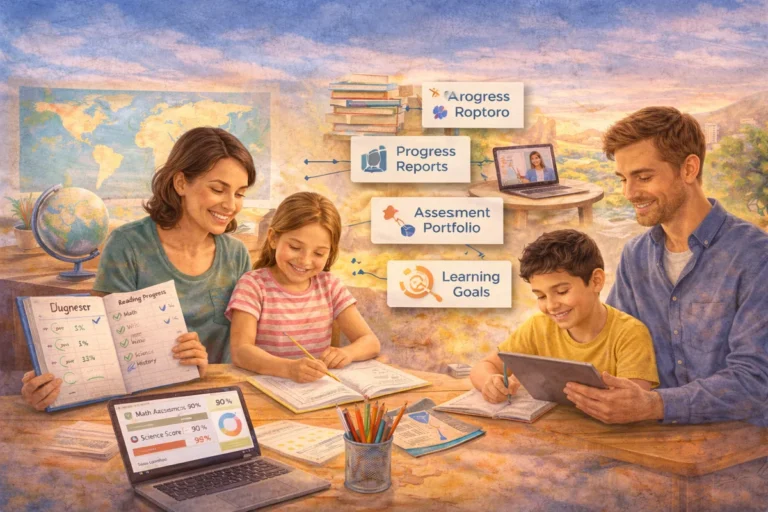
What matters far more is whether the program follows a highly rigorous, clear learning progression.
Strong educational platforms introduce new concepts step by step, which allows your kids to build their actual knowledge base gradually.
Without that clear internal structure, lessons may feel highly entertaining but completely fail to develop any deeper understanding.
Expat parents who focus on curriculum design rather than visual appearance tend to choose tools that deliver substantially better academic results.
If you are currently selecting a core digital learning framework for your family, look over my detailed guide on choosing a homeschool curriculum while living overseas to ensure a strong structural fit.
Trying Too Many Platforms at Once
Another common issue appears when parents try to combine too many disparate digital learning tools at the same time.
With thousands of educational apps available at our fingertips, it is highly tempting to assemble an extensive digital toolkit.
Parents often download one program for math, another for reading, a third for science, and a completely separate one for language learning. Before long, a child might be switching between five or six completely different user platforms in a single week.
AVOID THIS!
While the underlying intention is always positive, making these complex online learning decision errors can quickly overwhelm a young mind.
Children benefit immensely from highly consistent routines and completely familiar navigation systems.
Simplicity matters, and less if often more.
Constantly changing digital platforms can severely disrupt focus and drastically reduce overall learning efficiency.
Many experienced homeschool families eventually simplify their daily approach to protect their peace of mind, and that’s what I’d recommend you do too.
Instead of juggling multiple niche programs, rely on a tiny number of highly reliable tools and use them consistently.
Ignoring Age and Developmental Stage
Not every online learning tool works equally well for every age group or developmental milestone.
Young children generally have much shorter attention spans and benefit from incredibly simple instructions, clear visual elements, and brief activities.
Older children and teenagers can usually handle significantly longer lessons, highly detailed explanations, and completely independent research assignments.
When a digital platform does not match a child’s current developmental stage, household frustration quickly follows.
- If online lessons are far too complex, children feel discouraged and may shut down entirely.
- Conversely, if the lessons are too simple, they quickly lose interest and begin viewing the process as a complete waste of time.
Parents who pay close attention to age recommendations and specific learning styles usually have an easier time identifying functional tools.
Avoiding these common mistakes picking online curriculum requires looking past the target age on the label and testing the actual pacing of the lessons.
Expecting Technology to Replace Parental Involvement
Some parents mistakenly hope that online education platforms will automatically handle the vast majority of the daily teaching work.
This is a huge mistake, and honestly, a very lazy one.
While modern digital tools can certainly support academic learning, they can never replace active parental guidance entirely, even if you utilize advanced systems.
Children need emotional encouragement, contextual explanations, and real-time discussions to fully comprehend what they are studying.
Even the most well-designed platforms benefit immensely from occasional offline conversations about the core lesson topics.
For example, a child studying world geography online will gain a significantly deeper understanding if parents actively discuss countries, unique cultures, or family travel experiences connected to that specific lesson.
This simple interaction completely turns passive screen viewing into active, meaningful engagement.
Parents who stay closely involved in the daily learning process usually see much stronger long-term results.
Overlooking the Importance of Real-World Learning
Another major mistake happens when screen-based online learning becomes the absolute only form of education a child receives.
Digital lessons can teach valuable theoretical knowledge, but many essential life skills develop best through tangible, real-world experiences.
- Complex science concepts become crystal clear through hands-on physical experiments conducted in the kitchen or backyard.
- Foreign language skills improve drastically through real-world conversation rather than just clicking buttons on a screen.
- Cultural understanding naturally grows through direct regional travel, local exploration, and active social interaction within your current community.
Children who spend their entire learning day parked in front of digital screens miss out on these critical development opportunities.
Families who actively balance digital tools with practical experiences often create far richer, more sustainable learning environments.
A short, focused online lesson can easily lead directly to a related physical activity completely outside the digital world.
Conclusion
In summation, online education has opened up remarkable new opportunities for us expat families who choose to live outside traditional schooling systems.
Children can now access world-class structured lessons, explore complex subjects, and maintain consistent academic progress regardless of where their family moves.
But the sheer abundance of modern learning platforms also makes thoughtful, deliberate selection absolutely vital.
Parents who actively avoid common mistakes picking online curriculum tend to build far stronger, more resilient educational systems for their households.
In the end, effective online education is rarely about searching for a perfect, flawless digital platform. It is simply about building a clean, consistent learning routine that helps your children develop genuine curiosity, practical skills, and long-term confidence over time.