📊 How Expat Families Evaluate Education Outcomes


TLDR
- Expat families evaluate education outcomes using a mix of academic progress, skill development, and real-world adaptability.
- Standardized benchmarks can help, but they are often supplemented with personalized learning goals.
- Consistency in tracking progress matters more than the specific curriculum used by the household.
- Language development, independence, and critical thinking are key indicators beyond basic test scores.
- The most effective families regularly review and adjust their educational approach based on concrete results.
When you choose to step completely outside a traditional school system, one specific question comes up very quickly. How do you actually know if your child is learning what they need to succeed in life?
For modern international families, this question is not just a theoretical exercise discussed over coffee. Without quarterly report cards, scheduled parent-teacher conferences, or a fixed academic curriculum imposed by a local school, the full responsibility shifts directly to you.
That sudden shift in accountability can feel incredibly uncomfortable and overwhelming at first. However, over time, many parents realize that managing expat education outcomes does not have to rely on a single, rigid institutional framework. In fact, tracking development usually works significantly better when you look at the whole picture.
📈 Moving Beyond Traditional Metrics
In a conventional neighborhood school setting, student outcomes are almost exclusively measured through letter grades, standardized tests, and the rigid completion of a pre-determined curriculum. While these standard metrics still matter to some extent, they only paint a small part of the picture.
Traditional benchmarks provide a helpful macro reference point and can be highly useful if your child ever transitions back into a mainstream school system later. However, experienced parents rarely rely on these isolated test scores alone when they measure education abroad.
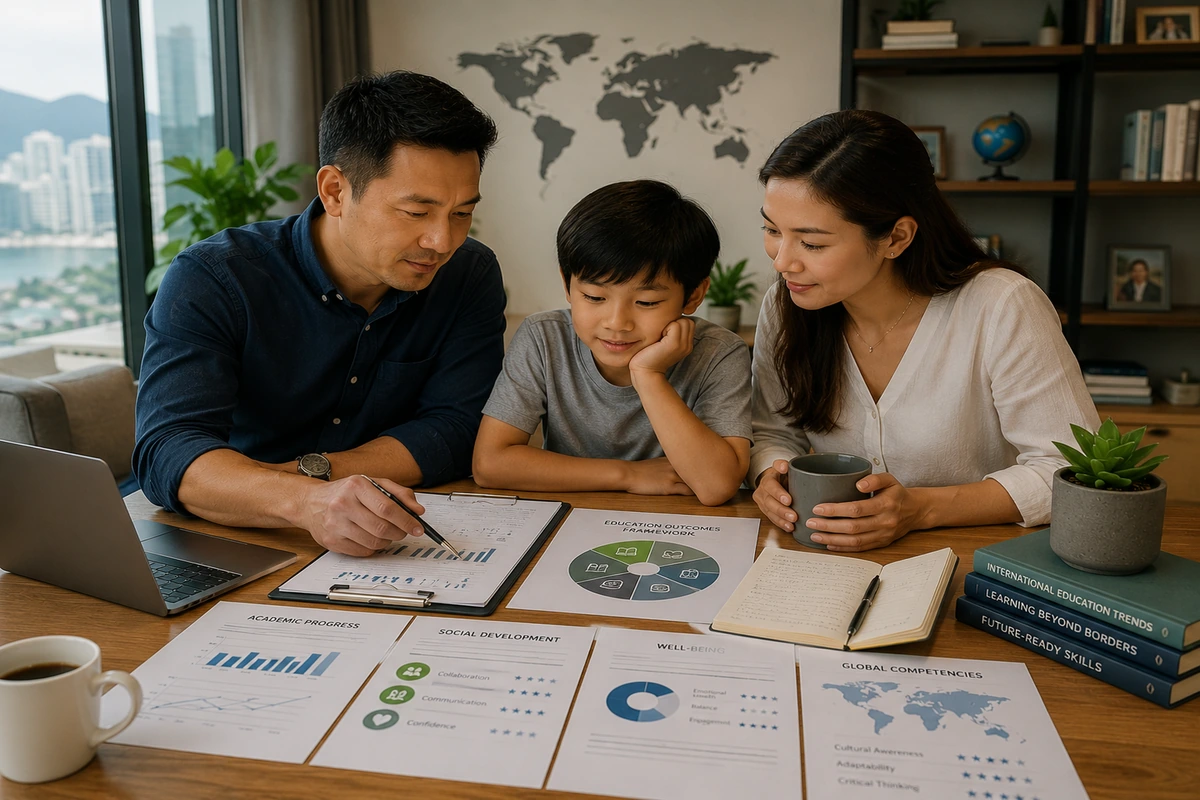
Instead, they tend to systematically combine traditional academic benchmarks with a much broader, healthier set of developmental indicators. This holistic approach includes observing how deeply a child understands foundational concepts, how naturally they apply knowledge to new scenarios, and how easily they adapt to foreign environments.
The mindset shift is subtle but incredibly important for long-term development. You are no longer just asking whether your child managed to pass a written math test this morning. You are asking whether they can actually use that mathematical logic to navigate real challenges in their daily life.
Expert Tip
Do not let test scores blind you to broader developmental delays or leaps. True academic assessment expat families utilize focuses on functional capability, meaning a child can explain why an answer is correct, not just memorize the pattern for an exam.
🧭 Using Standardized Benchmarks as a Reference
Even families who homeschool independently or choose alternative education models often keep a close eye on international standardized benchmarks. These global benchmarks help ensure that children remain roughly aligned with expected peer grade levels in core subjects like mathematics, reading comprehension, and structured writing.
There are many well-established educational frameworks that clearly outline what students typically learn at different ages around the world. While these frameworks are certainly not legally mandatory for traveling families, they can serve as an incredibly useful diagnostic guide.
The real key to long-term success with these tools is maintaining personal flexibility. Rather than following these rigid institutional benchmarks word for word, wise parents use them as low-stress structural checkpoints.
If a child is significantly ahead or noticeably behind in a specific core subject, that reality becomes clear fairly quickly during a casual check-in. This balanced approach keeps your home studies completely grounded in reality without becoming overly restrictive or stressful for the child.
Read More
If you are currently trying to figure out which academic baselines apply to your current living situation, read our comprehensive overview on the legal requirements for homeschooling in different countries to keep your home school fully compliant.
⏱️ Tracking Progress Over Time
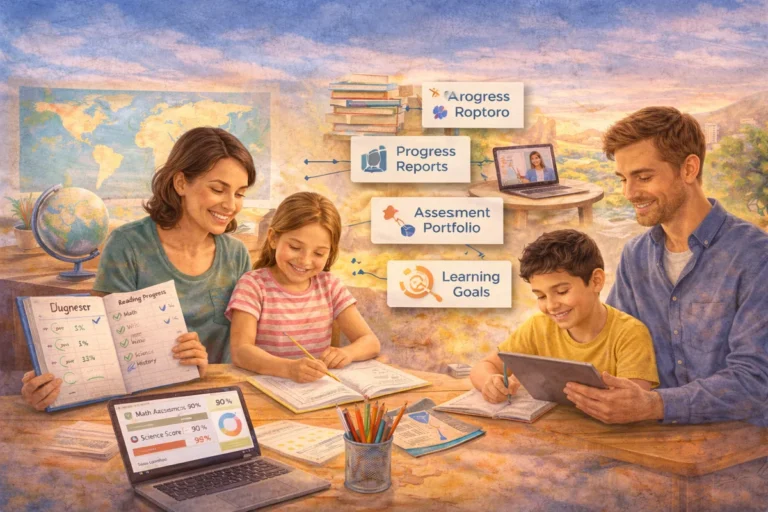
One of the most reliable ways to accurately evaluate expat education outcomes is simple, repetitive consistency. Parents who regularly and quietly document what their children are learning tend to have a drastically clearer picture of overall academic development.
Fortunately, building an effective routine does not require complex software systems or hours of extra administrative work. It can be as straightforward as reviewing completed weekly lessons, noting subtle improvements in reading stamina, or observing how quickly a child solves complex math problems compared to a few months earlier.
Some parents prefer keeping informal digital journals, while others heavily rely on the automated tracking tools provided directly by modern online platforms. What matters most is that this academic progress is made completely visible to the parents over a timeline of months, not days.
Without that consistent visibility, it is incredibly easy to lose track of whether genuine learning is happening or if the child is stuck. If you want to streamline this specific part of your routine, you can learn more about how expat families track educational progress without schools from other parents who do it daily.
- Weekly Portfolio Reviews: Save three pieces of core work every single week to visually compare quality across the quarter.
- Reading Logs: Keep a simple list of books completed to monitor shifts in reading level and vocabulary complexity.
- Audio Recording: Record your child reading or speaking a second language once a month to easily track phonetic progress.
🧠 Looking at Skill Development, Not Just Knowledge
Academic knowledge is only one small component of a truly complete global education. International families often place an incredibly strong emphasis on holistic skill development alongside textbooks.
This broader focus includes actively nurturing critical thinking, creative problem-solving, cross-cultural communication, and personal independence. These specific life skills are undeniably much harder to measure than standardized multiple-choice test scores, but they tend to show up clearly in everyday situations.
A child who can explain an abstract idea clearly to an adult, ask thoughtful questions about the world, or solve a daily problem without parental guidance is demonstrating meaningful progress. Language acquisition is another massive area where traditional education metrics for homeschooling often fall short.
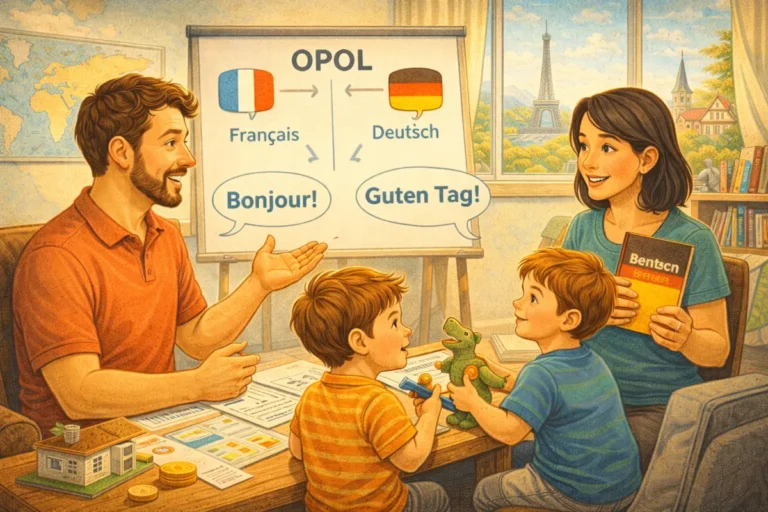
For families raising bilingual or multilingual children, linguistic progress is rarely a perfectly linear journey. However, over time, increased verbal fluency, deep listening comprehension, and rising confidence in multiple languages become undeniable indicators of educational success.
Read More
For a deeper dive into alternative ways of mastering communication, look over our guide on raising bilingual children without formal schooling to maximize language exposure at home.
🌍 Observing Real-World Application
One of the greatest advantages of raising children abroad is the constant, unscripted exposure to real-world learning opportunities. Bustling local markets, complex public transportation networks, diverse cultural interactions, and international travel experiences all provide rich learning environments.
Many proactive families intentionally use these unique everyday situations to evaluate exactly how well their children apply what they have studied in books. For example, a young child using basic math skills to handle foreign currency in a chaotic local market is demonstrating practical, functional understanding.
Similarly, a child confidently navigating a complex conversation in a second language with a neighborhood shopkeeper is showing true applied language ability. Even a teenager launching their own small online business is actively synthesizing skills from mathematics, writing, and digital design.
These real-world moments often reveal far more about actual capability than a standardized worksheet ever could. To make the most of these daily moments, parents can read about how to combine online learning with real-world education to build a more dynamic home schedule.
| Real-World Scenario | Academic Skill Applied | Developmental Milestone |
| Calculating exchange rates | Percentages and mental math | Practical financial literacy |
| Reading local transit maps | Spatial awareness and geography | Independence and critical navigation |
| Translating for the family | Bilingual communication | Advanced social confidence |
🛠️ Adjusting Based on Results
Accurate educational evaluation is only useful to a family if it directly leads to proactive adjustment. Flexible families tend to revisit their broad educational approach regularly to ensure it still serves the child’s needs.
If a specific resource, schedule, or teaching method is clearly not working, they do not hesitate to change it immediately. This might mean switching out a math curriculum, adjusting the daily wake-up schedule, or temporarily focusing more hours on a specific problem area.
The inherent flexibility of alternative education models is precisely what makes assessing learning for expat kids so incredibly powerful. Instead of waiting around for the official end of a rigid school year to make changes, families can respond to academic road blocks in real time.
This rapid responsiveness to data often leads to significantly better long-term academic and emotional outcomes. If you are noticing that your current routine is causing tension, it might be time to read our thoughts on preventing burnout while raising kids abroad to reset your expectations.
❌ Avoiding the Comparison Trap
One major psychological challenge that comes up frequently for alternative educators is the temptation of constant comparison. It is incredibly easy to wonder how your traveling child compares to their peers sitting in traditional brick-and-mortar schools back home.
While some minimal level of macro comparison can be useful for keeping your studies on track, it can also become an incredibly toxic distraction. Every single family’s global journey is entirely different, and living abroad introduces unique lifestyle variables that simply do not exist in standard education systems.
Children moving between countries often develop massive strengths in areas that are completely ignored by traditional education metrics for homeschooling, such as deep cultural awareness, high emotional resilience, and rapid adaptability.
Focusing too heavily on rigid external comparisons can cause you to completely overlook these profound competitive advantages.
Most experienced families eventually learn to shift their focus completely inward. They practice tracking academic progress abroad by measuring their child’s current development solely against their own past performance and personal family goals.
Expert Tip
When feelings of educational anxiety creep in, take a step back and list the unique non-academic skills your child has gained this year, like navigating an airport independently or making friends across language barriers. Those count heavily toward long-term success.
⚖️ Balancing Structure and Flexibility
A very common theme among highly successful international families is the continuous pursuit of structural balance. Too much rigid academic structure can quickly make home learning feel clinical, highly stressful, and entirely devoid of joy.
Conversely, too little structure can easily lead to extreme inconsistency, daily procrastination, and massive hidden gaps in foundational knowledge. Finding the perfect middle ground for your specific household takes time, patience, and trial error.
Some families find success by strictly following heavily structured curricula for core linear subjects like mathematics, while allowing immense flexibility for organic areas like creative writing or regional history.
Others choose to take a more relaxed, interest-led approach while still maintaining short, regular check-ins to verify steady progress.
There is absolutely not a single correct method that works for every child. What truly matters is that the specific system you build provides just enough daily structure to support active learning while leaving plenty of room for spontaneous real-world exploration.
👁️ A Small Personal Observation
After spending a significant amount of time around other global families living this unconventional lifestyle, one clear reality stands out above everything else. The parents who feel the most genuinely confident about their children’s education are not necessarily the ones buying the most advanced tools or the most expensive international programs.
They simply pay close attention to the child in front of them every single day. They actively notice how their children think, how they approach unfamiliar problems, and how they emotionally respond to new cultural challenges.
They ask deep questions, foster slow conversations, and stay completely involved in the day-to-day learning process. It is a deceptively simple approach to education, but it requires deep consistency. And that quiet consistency makes all the difference in the world over time.
🧱 Building a Practical Evaluation System
If you are currently trying to create your own personalized framework for tracking education metrics for homeschooling, it does not need to be elaborate. You can easily build a highly effective system around a few timeless elements.
Keep clear track of basic academic progress in core subjects using simple, measurable portfolios. Actively observe how your child naturally applies that textbook knowledge in everyday, unscripted situations outside the house.
Pay close attention to holistic skill development, placing a high value on clear communication, personal independence, and daily problem-solving. Review these gathered observations regularly as a couple and do not be afraid to make small adjustments when needed.
- Step 1: Establish clear, highly realistic learning goals for the next six months of study.
- Step 2: Schedule a low-stress monthly review session to look over progress tracking data together.
- Step 3: Intentionally design weekly real-world challenges that force your child to use their academic skills in public.
This practical combination provides a beautifully well-rounded view of real learning without becoming an overwhelming administrative burden for busy parents. For a broader look at how this fits into your global lifestyle, read our guide on how expat families build long-term stability to harmonize your schedule.
🏁 Conclusion
Evaluating education outcomes as an international family is far less about finding a single perfect test metric and much more about building a clear, consistent observational process.
Traditional measures like tests and grade levels certainly still have their place, but they work best when balanced with broader real-world observations.
By focusing heavily on visible progress over time, practical real-world application, and holistic skill development, families can gain a profoundly deep understanding of how their children are actually growing.
The immense flexibility of life abroad is precisely what makes this customized approach possible. When executed thoughtfully, this style of evaluation often leads to a significantly more practical, complete, and resilient education than traditional schooling could ever deliver alone.