Raising Bilingual Children Without Formal Schooling


Key Take-Aways:
- Raising bilingual kids is easily achievable through consistent home exposure rather than just formal classes.
- Creating a language-rich environment at home is the most effective way to build fluency – in other words, “immersion”.
- Social interaction and high-interest media are vital for maintaining minority language motivation.
- As a parent, you must see yourself as a facilitator of natural learning, rather than a teacher.
- Long-term success depends on structure and consistency, not intensity.
Many expat families quickly realize that formal schooling isn’t always the way to go. You might be traveling a lot, living in a country with very expensive international schools, or simply choosing a different rhythm of family life.
I’ve been there – or heck, I AM there. I’ve chosen home-schooling for my children and so far it’s been working out great.
But can you raise bilingual kids without school? Can you teach your child a second or even third language without them receiving formal education in it?
The short answer is yes, but it doesn’t happen accidentally; it requires a deliberate environment where the language is a necessity, where they are immersed in it.
In this article I’ll explain how raising bilingual children without formal schooling works, and what I’ve learned from my experiences.
How Children Actually Learn Languages
Let’s start with the basics: how do children learn a language? It’s comparable to how you and I would learn a new language, but they have it easier, if you set up the right environment.
Young children learn language mainly through interaction and consistent use, not just instruction. Conversation, play, storytelling, and real communication are what drive vocabulary and grammar development: natural language learning, in other words.
For example, you can tell your kid that “cat” is “gato” in Spanish, and they might or might not remember it, but if they hear it being shouted out loud by the neighbor’s kid every day … that’s a word they’ll never forget.
Structured lessons and devoted study help us older learners a lot, but early fluency grows strongest from use.
This is why children in multilingual households often speak multiple languages long before they can read.
The brains of multilingual kids categorize sounds and patterns based on repetition across meaningful situations. Negotiating for toys, helping mommy cook or listening to you, their expat dad, read a story in another language, builds their grasp of said language faster than any set of flashcards.
Without school, raising fluent children without classes means you must recreate exposure density through frequency rather than intensity. Five minutes every single day beats an hour-long session once a week.
Expat Dad Tip: Understanding usually comes months before speaking. If your child follows instructions but doesn’t answer back yet, don’t worry, this silent period is a normal developmental stage. For my kids, it’s oddly enough the eldest who went through silent periods more than the youngest, who took up talking back to me in my native tongue much faster. Every kid is different, so give them time!
How To Teach Children Languages At Home
I’ve noticed a curious thing: the surrounding language becomes dominant much more rapidly than you’d expect, even if they don’t speak it fluently yet.
If your child plays daily with local kids, that language becomes emotionally primary, even if you speak another tongue at home – of course, depending on many factors, such as the length of exposure at home vs at the playground, and so forth.
Without deliberate effort, the family language weakens gradually over time – unless it’s the language also spoken in daily life outside. You may notice shorter sentences, mixed grammar, or an avoidance of complex topics during dinner.
The solution is not formal lessons, but rather functional AND REPEATED, REGULAR use. I cannot stress enough the importance of consistent immersion when it comes to natural language learning.
You need regular situations where the home language is the only effective tool for problem-solving or planning.
If you are struggling with the shift, it helps to understand common mistakes expat parents make with language. Identifying these early prevents the gradual erosion of the minority tongue.
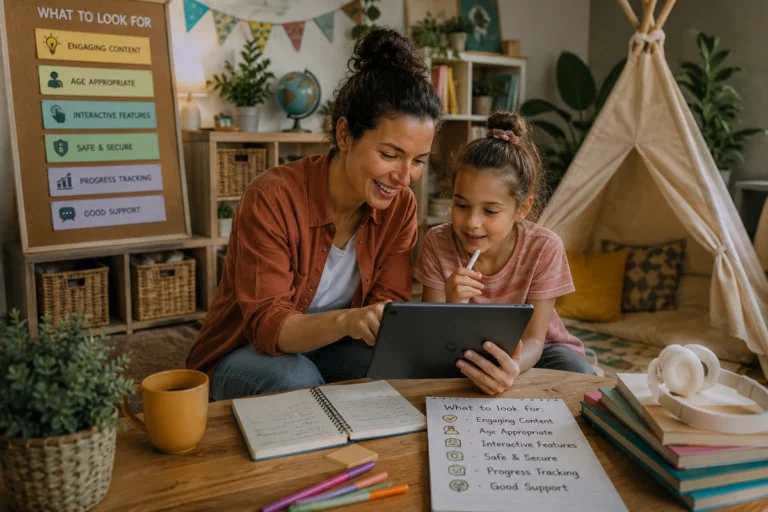
Also, we’re living the 21st century, so if you’re incapable, too busy or just need some help, consider technological help, like a language/online learning app.
I’ve checked them out, and they can be extremely valuable because they’re created to drive engagement from your kids. They implement gamification, so the kids learn while having fun… which means they’ll be highly motivated to keep going.
My personal home situation: my approach to how to teach children languages at home
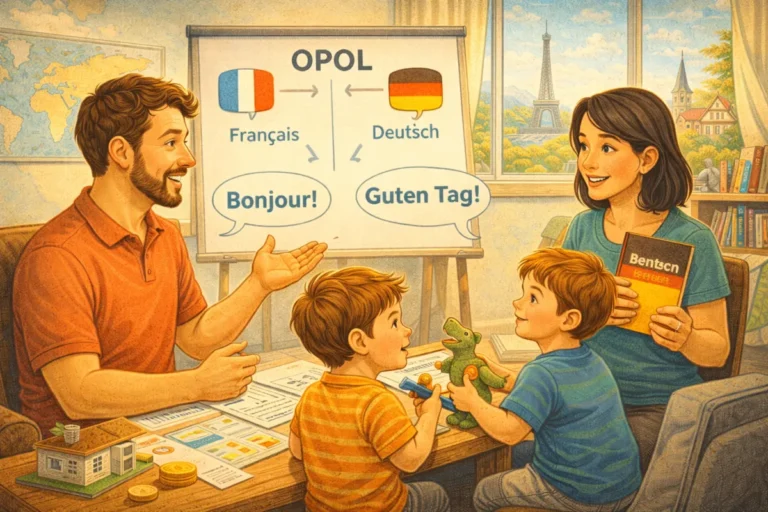
To be clear, you can have multiple home languages. For example, my family and I speak English primarily, but this is not my native tongue nor of my partner.
We come from different countries (neither of which we live in), so we chose to use English as the communal language, and the language we raise our kids in – for obvious reasons.
During the day, or whenever the family is together, we speak English, but when it’s just me with the kids, we speak my language – which is their second language.
And every night, they read to me in my language, which I found is immensely useful in growing their understanding.
In fact, a couple of weeks ago, there was a noticeable break-through with my youngest. Up until recently, she was struggling with reading in my language at a decent level.
Speaking was fine, impressively so even, but reading was noticeably difficult. Different sounds, a bit of dyslexia, never having learned proper reading at school, and so on, made it a chore to get through. To be fair, she’s only 6, but still.
And then, out of nowhere, something seemed to click and over the course of a month or so, she improved dramatically – she’s now reading almost fluently in my language a full two official levels higher than the level she was struggling with earlier this year.
I have no explanation for it, apart from the fact that even when it was a struggle, we persisted and as much as possible stuck to our daily routine, even while traveling through over half a dozen countries (it’s been a busy year!).
I’d expected gradual development, and that was definitely there, but I didn’t expect a NOTICEABLE jump in such a short time. It’s like a growth spurt in language development.
The next step will be for all of us to tackle Spanish, a language we’re immersed in every day, but which only I can speak at a very basic level, so it’ll be a massive challenge to add this language to our family’s repertoire so the kids become trilingual.
Literacy Does Not Develop Automatically
Spoken fluency often develops naturally, but reading and writing usually do not. Schools normally handle literacy through systematic print exposure, so when this falls away, us parents must intentionally step into this role.
Start with consistent reading aloud to your children. The theory is: children exposed to daily reading develop phonemic awareness earlier, which supports later independent reading success.
I can personally vouch for this from my own experiences. I’ve been reading to my kids for many years now, and I try to keep it fun.
I started with reading in English, and then moved on to my language, which definitely helped their understanding of both languages.
So yeah, the language you read in does not have to match the dominant spoken language, but it must be a regular part of the routine. Writing should follow later and ideally be tied to purposeful tasks like grocery lists or texts to relatives.
Community Is Not Optional
A language without peers quickly becomes academic and dry. For a language to “stay alive”, children need relationships that exist exclusively in that second tongue.
Sports, hobby clubs, and neighborhood games ensure the language is tied to identity rather than just parental authority. This becomes even more critical as children move toward adolescence and prioritize social efficiency.
I’ve not yet noticed this personally in our life, because they’re fluent in their native tongue and in their interactions with me, we speak my first and their second language. However, I fully expect (and bank on) this effect to be extremely valuable when we move on to Spanish.
For traveling families, even temporary communities can still be highly effective in this regard. Three months of daily play in a specific language often outweighs a full year of occasional, dry lessons.
I’ve noticed this tremendously when visiting my relatives. When my kids were suddenly immersed to multiple people speaking language, as opposed to just me and the occasional movie, their understanding grew tremendously.
The Rhythm Framework: Structuring Your Week
Forget the rigid classroom bells; success without school is about living your multilingual expat life with purpose and direction.
You don’t need a curriculum as much as you need a predictable flow that naturally triggers language use.
Think of your week and days in terms of linguistic anchors rather than lessons.
For example, mornings could be strictly for the minority language during breakfast, while afternoons are for community interaction in the local tongue.
This is how I plan to structure it in the near future:
| Time Slot | Linguistic Focus | Activity Type |
| Morning | Native tongue (fluid) | Family discussions, breakfast, chores and home schooling |
| Afternoon | Third language (basic development) | Playgroups, parks, hobbies and random activities |
| Evening | Secondary language (maintenance + mastery) | Bedtime stories, both being read to by me, and reading to me |
Building this flow is easier when creating a bilingual home environment abroad that supports your goals.
When the home is physically and socially set up for the language, you spend less time enforcing and more time just living.
To keep the household organized, implement daily routines that work for expat families.
A solid routine ensures that language exposure isn’t forgotten when life gets busy or travel plans change.
For us, at the moment this simply means home schooling in the main language in the morning and secondary language reading (both ways) in the evening. Soon, we’ll add third language development in the afternoon via local social contacts.
The Teenager Pivot: Identity & Autonomy
As children hit adolescence, the “because Dad says so” phase ends. You may lament it, and while I’m kind of dreading its arrival, we all know children NEED to go through this part of their life.
Teenagers are biologically driven by social efficiency, meaning they might very well ditch a language if it doesn’t serve their “social status” or future goals.
To keep them engaged, you have to transition the language from a family rule to a personal tool. This is the time to involve them in high-level tasks like travel logistics or even managing work, parenting, and travel by letting them lead discussions in the second or third language.
If the language feels like a bridge to their interests, like gaming or writing, they will fight to keep it. It becomes part of their unique identity as a “Global Citizen” rather than a chore they did as a kid.
It is also vital to keep an eye on long-term identity development for third culture kids. When they feel proud of their multilingual heritage, the language becomes a badge of honor rather than a point of friction.
How I handle this
Personally, the pride in being multilingual is exactly the kind of attitude we are actively developing right now.
The first, and weakest way, is by telling them explicitly, like where in the world they could live with their language stack, how being multilingual develops their brains like nothing else, and so forth.
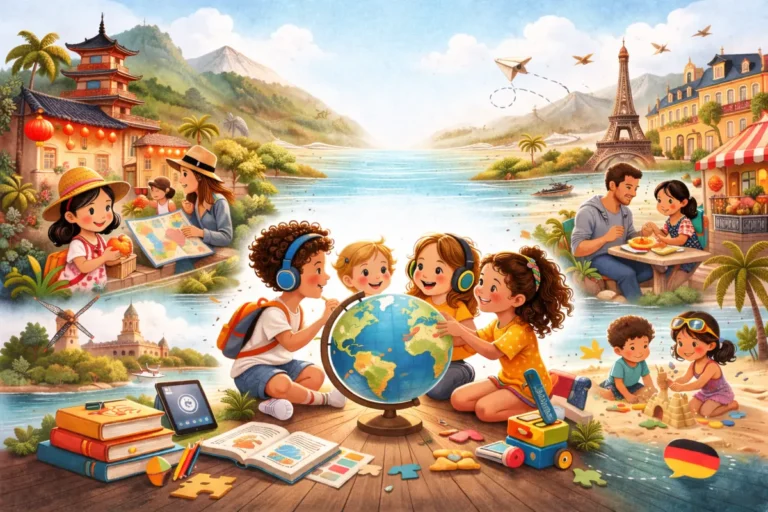
And then also by showing them indirectly, mostly through traveling – an advantage us expat parents have.
A few months ago, we were traveling through Europe, and while I’m by no means fluent in them, I can converse in at least a basic level in roughly 5 languages spoken there.
So while we were traveling from country to country, hopping from language to language, the kids saw that I could easily switch and get by wherever we were, while they had to resort to their two languages… which wasn’t sufficient.
They were able to see with their own eyes the value of being multilingual, how it opened doors for us, how I could deal with any situation in the local language.
I’m pretty sure this left an impact on them, because they talked about it many times once we got back, and my eldest has been showing an increasing interest in learning more languages. An excellent sign, one I’m very keen to explore further.
The end-goal? Self-taught language children, meaning your kids are eager to dive into learning another language. Your job is to provide them with the tools: books, courses and so on, and then let them learn.
The Success Metric: Thriving vs. Perfection
One final tip I can impart on my fellow expat dads: stop looking for identical vocabulary proficiency in both languages; even us bilingual adults rarely have it, right?
Real success in my eyes is functional independence: the ability to navigate any life situation with confidence and a bit of effort.
Instead of testing their grammar, look for the signs your child is thriving abroad. Are they making friends? Can they solve a problem at the local market?
If they can use the language to get what they need, you have an excellent basis. All you need to now is stay consistent and build upon it, and before you know it, you’ll have raised bilingual children without formal schooling.
You are not just teaching words; you are gifting them a wider world and a more flexible brain. Stay consistent, stay patient, and let the environment do the heavy lifting.
It won’t always be easy, but it’ll be worth it. And to me, the journey is extremely satisfying and enjoyable.
Seeing your kids grow up to be multilingual adults, capable of living in dozens of countries across the globe if they so desire, is one of the best parts of being an expat dad.