Best Online Homeschool Curricula for Expat Families

Key Take-Away
- Online homeschool curricula provide us globally mobile families with structural stability that easily survives international moves or nomadic travel.
- Investing in a comprehensive K through 12 pathway allows growing children to continue their schooling smoothly without changing platforms.
- A well-tailored educational plan seamlessly blends rigorous core tracks with open slots for language mastery and deep cultural immersion.
Living abroad with your children fundamentally transforms your perspective on traditional education.
Local schools can be absolutely fantastic in certain countries, but they also introduce rapid adjustments for a newly arrived family.
Language barriers, structural curriculum mismatches, and the reality of frequent relocations make long-term academic mapping incredibly complicated for an expat father trying to steady the family ship.
That is exactly why independent home-based learning has become an increasingly popular route for nomadic parents.
It’s what we’ve embraced as well in our family, and to great success. If you have the time to spend 1-2 hours per day on your children’s future, I cannot recommend homeschooling enough.
But what if you don’t have time to take care of everything yourself? Or maybe you just don’t want to, or don’t feel like you’re capable of it?
Then an online homeschool curriculum is something you should consider.
It offers something that standard brick-and-mortar schools simply cannot guarantee, which is absolute continuity.
When your children log into their personal dashboard from a beach house in Mexico, a high-rise in Thailand, or a village in Portugal, the fundamental interface and learning rhythm stay entirely unchanged.
For parents actively designing an intentional life overseas, that single point of predictable consistency removes massive amounts of underlying domestic pressure.
Still, not every digital platform fits the unique, fluid dynamics of an international lifestyle.
Some packages remain incredibly rigid and mimic stressful classroom schedules, while others provide beautiful pockets of freedom that pair perfectly with international exploration.
Understanding what truly separates an elite global online curriculum from frustratingly clunky software is the key to building a resilient home environment.

What Makes an Online Curriculum Work for Expat Families
Before purchasing any specific package, it is essential to identify the precise technical features a globally mobile household requires.
True educational stability sits at the absolute top of the list because parents need an underlying structure that survives multiple border crossings.
Flexibility is the next non-negotiable piece of the puzzle since flight schedules, spontaneous field trips, and massive time zone adjustments are standard parts of the journey.
A rigid daily calendar with fixed live attendance hours quickly creates friction when you are figuring out the logistics of a family move overseas without burning out.
Finally, official academic credibility becomes an essential factor as your kids enter their teenage years. Parents naturally want ironclad proof that their teenagers can confidently apply to global universities or re-enter traditional classrooms later if plans change.
Personally, I think universities and colleges are a waste of time and money these days (unless you’re going for a very specialized career like medical school), but it’s still something to keep in mind.
Complete K-12 Pathways
Opting for comprehensive K through 12 online learning courses homeschool families trust means you can avoid the headache of swapping providers every few seasons.
Your kids can seamlessly transition from early childhood phonics all the way to complex high-school calculus within a single cohesive system.
This steady structural path makes long-term educational forecasting incredibly straightforward for parents.
The core lesson layouts remain familiar, the grading criteria do not shift unexpectedly, and children develop highly independent study habits that remain solid during relocations.
- Familiar Interface: Kids skip the frustrating learning curves of new software after moving.
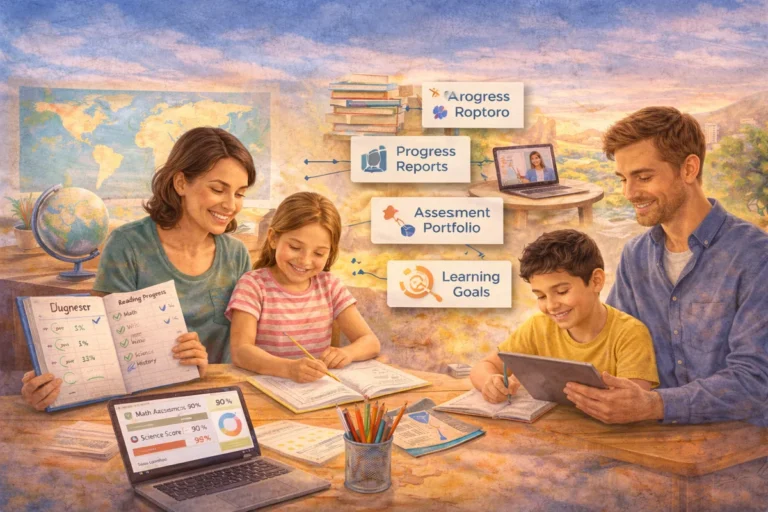
- Unified Progress Logs: Cumulative portfolios make proving educational growth to local authorities easy.
- Curriculum Synergy: Advanced concepts build directly on specific elementary lessons taught years prior.
Maintaining a single foundational framework dramatically reduces the common mistakes many parents make with distance learning packages chosen on a whim.
It gives you a clear birds-eye view of their complete developmental timeline so you can catch learning gaps early.
Self-Paced Learning Platforms
Not every household thrives under a tightly regulated institutional model, which is why customizable self-paced learning platforms are so popular.
It’s what I would recommend too.
These specific programs deliver fully recorded lectures, interactive digital workbooks, and automated grading dashboards that free parents from heavy administrative duties.
The true beauty of utilizing a self-paced online homeschool curriculum lies in its unmatched daily adaptability.
Children can complete their assignments at whatever hours align with the household peak energy levels rather than conforming to fixed morning roll calls.
| Phase | Activity | Target Goal |
| First Part | Morning Cultural Outing | Real-world immersion and local interaction |
| Second Part | Afternoon Core Lesson Modules | High-focus academic dashboard completion |
| Third Part | Evening Review and Tracking | Parent metrics audit and loose reflection |
This specific setup works wonders when you are navigating the unique hurdles of relocating to Thailand or managing major time zone shifts.
It gives quick learners the freedom to blast through easy topics in a few days while allowing extra space for tough subjects.
Subject-Based Learning Systems
A modular strategy is another fantastic path where parents purposefully reject all-in-one packages to build a highly customized educational puzzle.
You might use a specialized platform for mathematics, a dedicated writing app for language arts, and an immersive portal for science.
While this specific method demands a bit more parental coordination, it delivers unmatched control over the learning experience.
It prevents you from getting stuck with a massive all-in-one platform where the reading material is fantastic but the math modules are incredibly boring.
- Custom Skill Matching: You can easily mix a fourth-grade reading level with a second-grade math book.
- Bilingual Openings: It creates open calendar slots to incorporate localized language acquisition tools.
- Resource Optimization: Families can easily discover how to mix free and paid tools to save money without dropping quality.
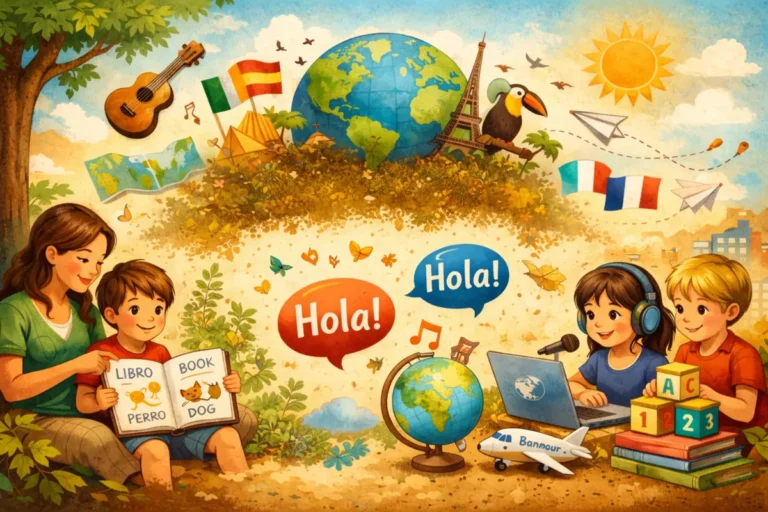
This tailored approach is particularly valuable when you want your children to achieve true fluency in a foreign tongue.
It allows you to utilize natural language acquisition strategies alongside core digital courses without overloading your child’s weekly schedule.
A Small Personal Observation
After watching dozens of internationally mobile families experiment with various educational styles, one distinct pattern stands out clearly.
The households that thrive over the long haul are the ones that prioritize simplicity and consistent routines over complex setups.
They avoid the temptation of constantly switching their core curriculum every time a flashier digital platform launches online.
Instead, they pick a lesson plan and commit to mastering its specific workflow for the academic year.
Once your kids understand exactly how their digital portal operates, the entire daily learning cycle becomes incredibly smooth.
You can easily adjust your weekly calendar, but maintaining a steady educational foundation is what prevents chronic childhood stress during major international moves.
Conclusion
In summation, the evolution of modern digital learning platforms has opened up incredible new horizons for families choosing a location-independent lifestyle.
With a high-quality global online curriculum in place, your children can access a world-class education regardless of where your career or passions take you.
The most effective programs provide complete academic pathways, customizable self-paced modules, robust progress tracking, and professional teacher support.
These tools give you the exact educational continuity required to build long-term family stability while exploring the globe.