🧠 How Children Naturally Become Bilingual Without Formal Schooling


TLDR
- Children become bilingual through natural exposure and interaction, not formal lessons.
- The amount and consistency of language input shape each language’s development.
- Bilingual children may lag in individual language measures but develop total language knowledge similarly to monolinguals.
- Social and emotional contexts help languages become meaningful, not just heard.
- Early dual exposure enhances phonological discrimination and later language abilities.
You may have met families who live abroad and suddenly their child is speaking two languages without ever attending formal school. It almost looks like magic. One day they’re babbling in one language, and months later they’re switching between two in quick conversation.
What’s going on under the surface is less mystery and more biology, environment, and daily connection. Kids don’t need classrooms to achieve independent language acquisition if the conditions around them already include meaningful use of more than one language.
The brain’s language learning design makes this possible, especially in early childhood.
As an expat father, recognizing this power can change how you view your child’s education. Let’s explore how this happens naturally, in ways you can recognize, support, and feel confident about as a parent.
📈 Language Input Shapes Development
The most consistent finding in research on children bilingual learning is that the quantity and quality of language exposure matter for how well they develop each language.
Children who hear one language more often tend to build stronger skills in that language. But that doesn’t mean they lose the other; it just reflects differences in exposure levels.
One large review of bilingual development found that relative exposure predicts children’s vocabulary sizes and grammatical skills in each language. This is important because it means bilingual acquisition isn’t about “switching languages on and off.”
It’s about consistent use over time in different contexts: home, play, and family conversations. This is why creating a bilingual home environment abroad is more effective than any textbook.
| Exposure Level | Impact on Vocabulary | Impact on Grammar |
| High Exposure | Extensive expressive range | Faster pattern recognition |
| Moderate Exposure | Strong receptive understanding | Slower production speed |
| Low Exposure | Context-specific “pockets” | Functional but simplified |
🧬 The Brain Is Designed to Absorb Language
From birth, children are equipped with a remarkable capacity to pick up sounds and patterns from their environment. This is how children become bilingual naturally.
In the earliest years, infants are sensitive to a wide range of phonetic sounds from any language. Over time, with repeated exposure, they tune into those patterns more firmly.
Importantly, this natural learning process is not an active study effort from the child. They are simply living and interacting. The meaning of language use (play, requests, and emotions) makes natural bilingual development kids experience intuitive rather than instructional.
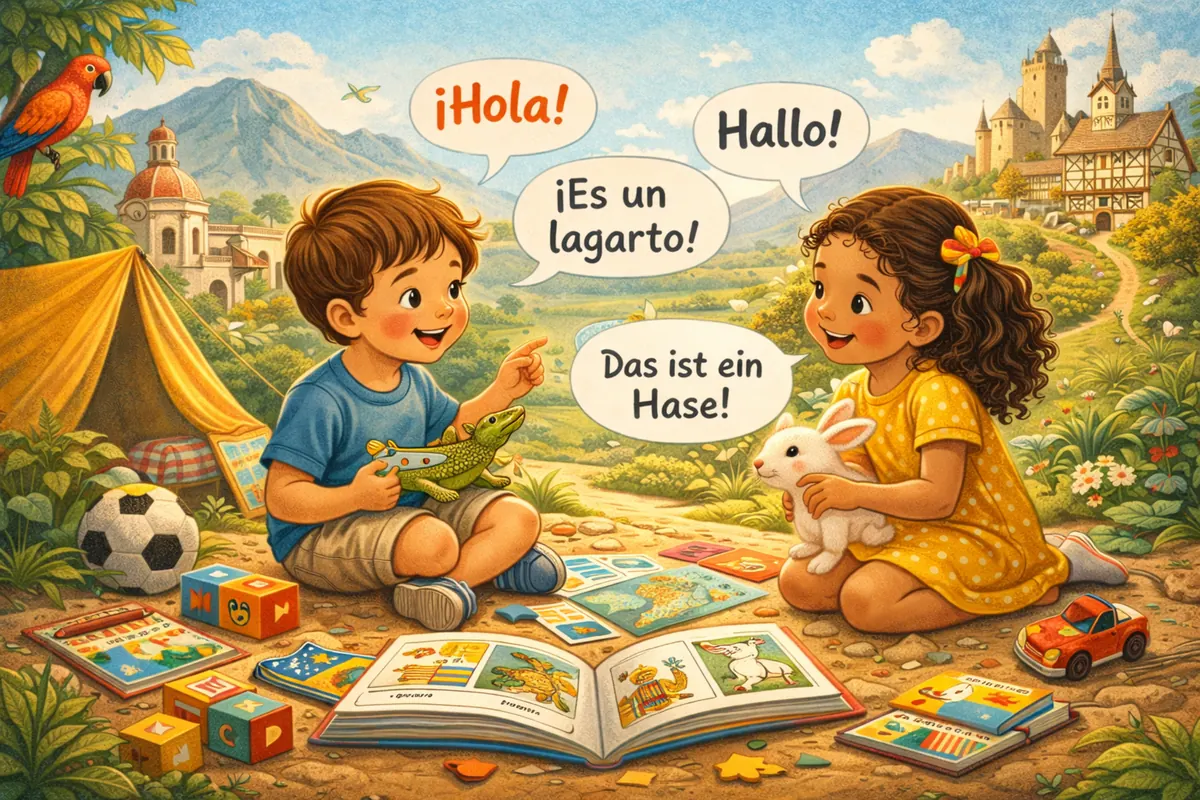
This often happens alongside how kids naturally acquire multiple languages abroad through simple playground interactions.
⚖️ Bilingual Growth Is Distributed, Not Deficient
When we measure bilingual children’s abilities in each language separately, it’s common to see what looks like a “delay” compared to monolingual peers. For instance, they might have a smaller vocabulary in one language at a given age.
Key Takeaway: When researchers add together knowledge across both languages, bilingual children’s total language knowledge often equals or surpasses that of monolingual children.
This reflects the fact that bilingual input is distributed across two systems. A child might know words for social routines in one language and school-related vocabulary in another.
This is a common point of confusion that leads to common mistakes expat parents make with language. Their combined communicative ability is robust; it’s just parceled differently.
🗣️ Social Interaction vs. Formal Instruction
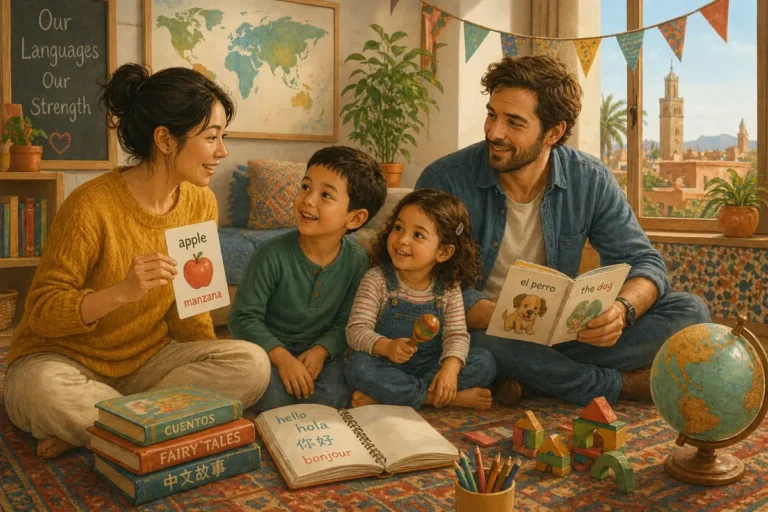
Children learn language not by memorizing vocabulary lists, but through social interaction. When they negotiate play, comfort a friend, or tell a story, they use language in ways that matter. Those real-world conversational contexts are what drive unschooled language development.
Neighbors, grandparents, playmates, and caregivers become a child’s first and most powerful teachers. In a multilingual environment at home, kids adapt naturally because they aren’t practicing language; they’re using it to solve real problems.
This is particularly evident in raising bilingual children without formal schooling, where the community provides the “curriculum.”
⚡ Sensitive Periods and Early Competence
Research indicates that early exposure to multiple languages supports phonetic sensitivity. Unschooled children languages acquisition during infancy helps them distinguish sounds that adults often miss. This makes later language learning easier and more flexible.
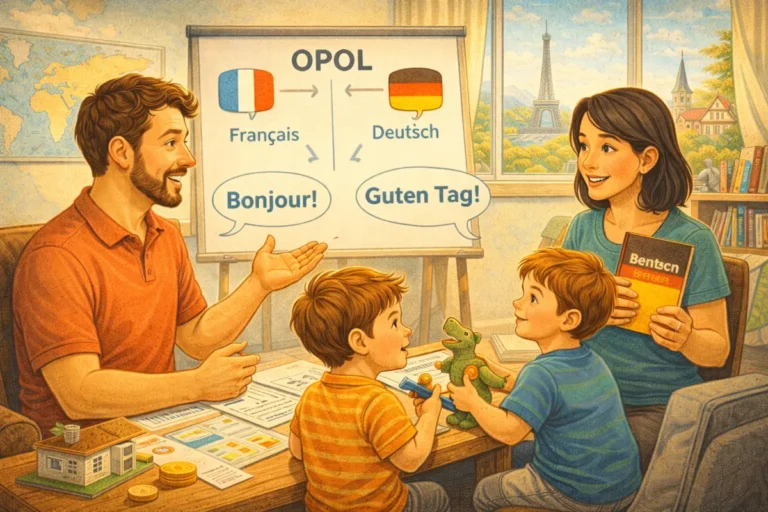
Children who grow up hearing two languages from a young age often outperform monolinguals on certain cognitive tasks, such as switching systems or managing attention. This is a key reason many families look into the OPOL method explained for expat families to ensure early, consistent exposure.
🔄 Why Bilingual Children May Temporarily Mix Languages
Bilingual children often mix languages in the same sentence. Rather than confusion, this reflects efficiency. They pull the word from whichever language is stronger for that moment. This is a normal part of natural bilingual development kids go through.
- Efficiency: Using the most accessible word.
- Context: Some concepts may only have been learned in one language.
- Transition: Mixing typically decreases naturally as vocabulary grows in both systems.
Understanding this phase helps parents avoid language learning mistakes like over-correcting, which can discourage a child from speaking the minority language altogether.
🏠 The Role of Family and Environment
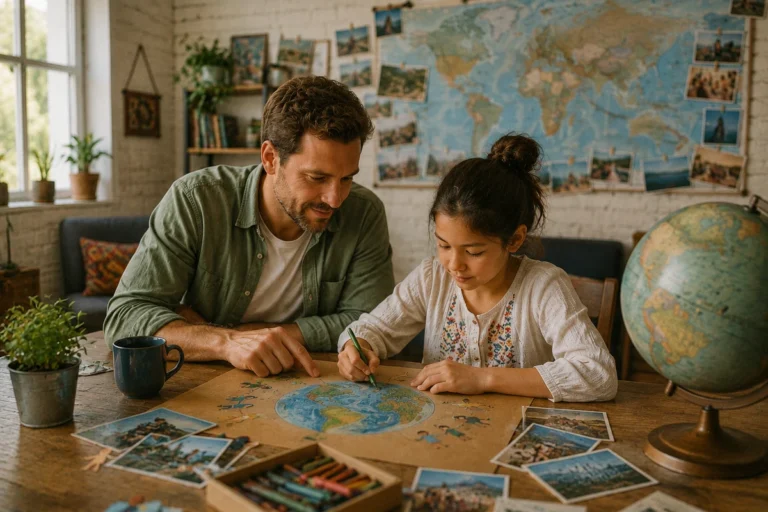
Consistency and emotional connection matter more than structured schooling. Families that maintain a multilingual environment at home give children daily opportunities that classrooms try to create artificially.
What Actually Helps:
- Dialogue: Regular storytelling and deep conversation.
- Peers: Interaction with children who speak the other language.
- Media: Shows and play that involve both languages without pressure.
- Routine: Using daily routines that work for expat families to anchor language use.
Children aren’t “learning” languages; they are integrating them into their identity, a process critical for long-term identity development for third culture kids.
📖 Literacy and Speaking Are Distinct
One important fact for expat families: spoken fluency and literacy are not the same thing. While kids picking up language without school is common for speaking, reading and writing require deliberate practice.
This doesn’t mean you need a classroom, but you may need to look at choosing a homeschool curriculum while living overseas to bridge the literacy gap.
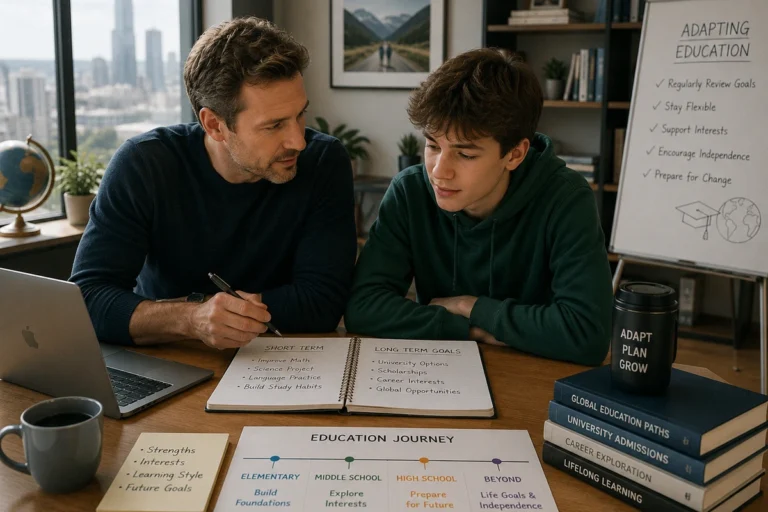
This distinction is vital as parents learn when to adjust language strategy for growing kids abroad. Speaking may be “natural,” but reading is a cultural skill that requires exposure to print.
🌍 Real-Life Patterns and Personal Experience
Across many communities, the pattern of children bilingual learning remains the same:
- Combined vocabulary rates match monolingual peers.
- Skill strength follows the frequency of exposure.
- Social and emotional contexts make language functional.
I remember a family friend whose child moved with them to a new country. At first, the child barely spoke the community language. Six months in, he was chatting with neighbors in perfect local phrases. There were no textbooks. It was simple immersion: daily, social, and needed.
Just as a family must follow an essential guide to building an emergency fund to ensure stability, you must invest consistent “time deposits” into language.
For nomads, calculating an emergency fund for your specific lifestyle is critical, and the same logic applies to language: you need a surplus of input to handle the “emergencies” of complex conversation.
✅ Conclusion
How children become bilingual naturally is a testament to the brain’s adaptability. It’s not the classroom that matters most; it’s conversation, connection, necessity, and consistency. When kids hear both languages regularly and use them socially, the brain organizes both systems naturally.
If you’re raising children abroad and facing real challenges, take heart. Science shows that unschooled children languages acquisition is not an accident. It is the biological result of a rich, supportive environment. Give them the exposure, and their brains will do the rest.