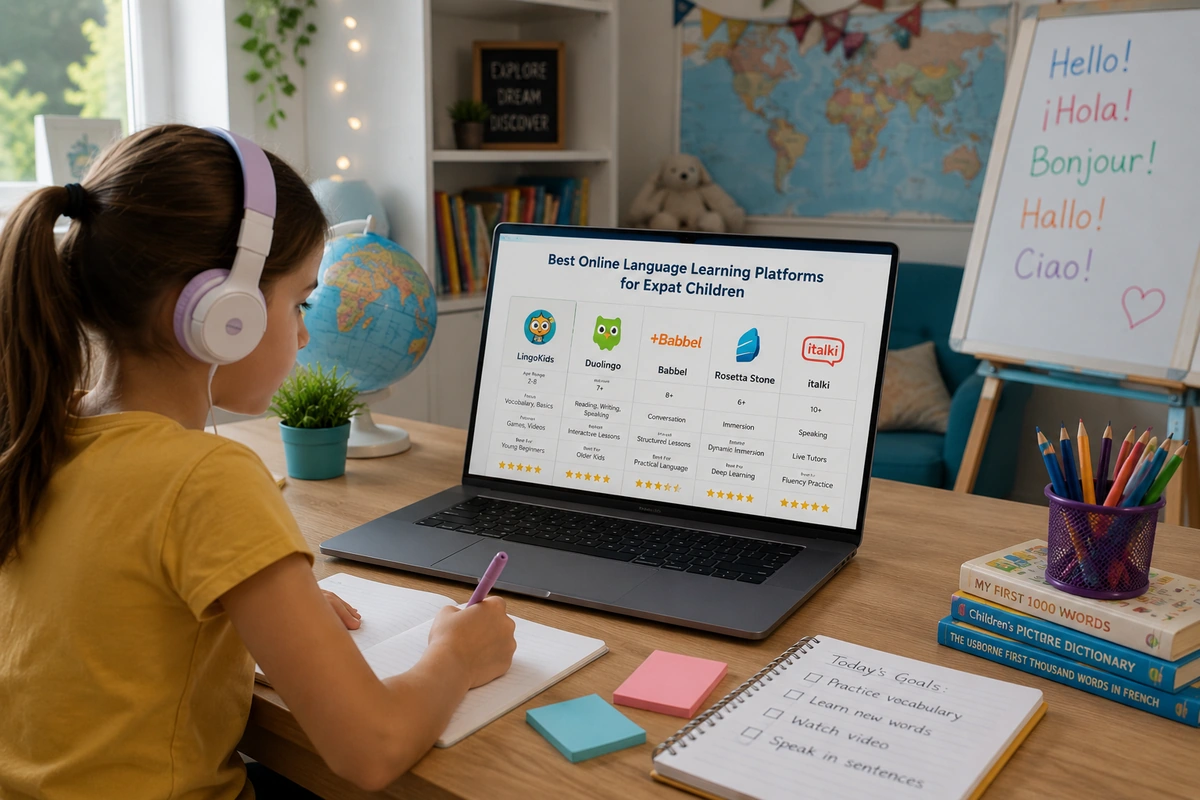
Best Online Language Learning Platforms for Expat Children

Key Take-Aways
- Combining real-world immersive exposure with dedicated online language learning tools creates the ultimate balanced linguistic blueprint.
- Maintaining brief daily training cycles yields vastly superior retention metrics compared to sporadic, lengthy study marathons.
- The most effective top language platforms for children successfully synthesize real-time speaking, active listening, and text reading.
One of the most incredible, hidden advantages of raising a family in a foreign country is that learning a second language transforms into an indispensable tool for everyday life.
Your children encounter the local tongue at the neighborhood grocery store, within public parks, along busy streets, and frequently right at your own dinner table.
That specific level of organic environmental immersion possesses immense psychological power, and it is, in my opinion, one of the best and fastest ways to grasp a language: full immersion.
However, it’s not perfect. Casual environmental exposure on its own does not automatically construct an organized, grammatically precise linguistic foundation, and you as the expat dad will often have to do some additional work – depending on the age of your kids.
In my experience, if they’re young (say, younger than 5-6), language acquisition is fast, natural and surprisingly easy. However, after that initial “language sponge” period, when they’re 7-8, they seem to need more attention and proper study.
And that’s where today’s topic comes in.
Combining real-world exposure with premium top language platforms for children achieves significantly better outcomes than relying strictly on just one method.
You get the best of both worlds, so to speak.
The right digital platform introduces systematic vocabulary acquisition, logical grammar parameters, and focused speech mechanics in ways that casual daily interactions are sometimes hard pressed to replicate.
Over the years, I have watched families test practically every prominent language program on the market, tracking exactly which ones deliver results and which ones fail to engage young minds.
In this guide I’ll talk about the best online language learning platforms for expat children, but if you need one for yourself as an expat dad, I can recommend this one:

Why Online Language Platforms Work Well for Expat Kids
Children growing up outside their home territories occupy a truly extraordinary intellectual environment.
Because they are constantly surrounded by varied cultural inputs, their brains possess a heightened level of neurological flexibility.
This is particularly evident during the early childhood years when natural language acquisition occurs most effortlessly. Like I said, until they’re about 5-6, but of course every kid is different.
Dedicated educational language tools online work beautifully because they capture this high adaptive potential and inject deliberate structural organization into the child’s daily routine.
Instead of navigating completely random phonetic exposure, your kids follow an organized curriculum that incrementally matches new phrases to tangible concepts.
The Science of Spaced Repetition
Many top-tier digital designs lean into advanced spaced repetition systems.
Sounds fancy, but it’s pretty straight-forward.
This technique strategically resurfaces challenging words right before a child is mathematically projected to forget them, converting transient short-term memory into permanent cognitive storage.
- Incremental Progression: Lessons expand in vocabulary density only after your child demonstrates total mastery over the basic building blocks.
- Contextual Anchor Points: New vocabulary words are linked to vivid animations, memorable audio clips, or interactive multi-sensory tasks.
- Low Friction Integration: High-quality software breaks complex syntax rules down into bite-sized, accessible chapters.
This precise pairing of rich real-world exposure and structured online language courses for kids produces incredible long-term results, and it’s the way to go to help them acquire multiple languages abroad.
From my experience, children who dedicate even fifteen focused minutes each morning to a language platform display immense communicative leaps within a matter of months.
Duolingo: Gamified Language Learning
I’m sure you’ve heard of Duolingo – perhaps you’ve even used it yourself at some point.
Duolingo stands out as one of the most ubiquitously deployed software options in the modern language ecosystem.
You can learn about forty distinct languages, the platform relies heavily on highly gamified, rapid-fire exercises to demystify complex grammar systems.
Because individual lesson units require only a handful of minutes to complete, it remains a highly accessible entry point for busy expat kids.
What this means, is that you can perfectly fit it into your own specific schedule, or even on the go during travel when you’re raising bilingual children without formal schooling.
Lingokids: Designed Specifically for Young Children
When dealing with early childhood development, traditional text-heavy applications are rarely effective – especially if you’ve made the mistake of giving your kids access to a smartphone or tablet at a young age and they’re now hopelessly addicted to instant gratification.
Lingokids was explicitly engineered to address this exact developmental reality, tailoring its entire interface to early learners between the ages of two and eight.
However, and this might make it pointless for a large part of my audience, the application focuses its curriculum primarily on English development, deploying a rich universe of animated songs, narrative stories, and tactile vocabulary games.
Rosetta Stone: A Long-Established Language Program
And finally, we’ve got my favourite: Rosetta Stone.
I think it’s a perfect name, and this program has occupied a dominant position in the educational software industry for multiple decades – and for good reason.
The cornerstone of its methodology is absolute, uncompromising immersion-style learning.
The software strictly forbids direct translation mechanics. Instead, it forces the child’s brain to link foreign words and spoken phrases directly to high-definition imagery and real-world scenarios.
This cognitive pathway teaches the brain to think directly inside the new language, completely bypassing the clunky, exhausting mental process of internal translation.
Choosing the Right Platform for Your Child
Let’s be honest: there is no single, magical application that fits perfectly into every single expat household.
The selection process requires a nuanced evaluation of your child’s specific age profile, baseline temperament, and overarching educational goals.
Your child’s physical age is always the primary gatekeeper.
Younger learners require highly visual, vibrant, game-based language learning apps kids to stay focused, while older teenagers usually crave real-world utility, structured grammar roadmaps, or live conversation with native speakers.
You must also take your child’s unique personality into account.
- The Competitive Student: Thrives in high-energy app environments fueled by daily leaderboards, point systems, and continuous streak counts.
- The Social Learner: Gains momentum by building an authentic connection with an online tutor or participating in small group peer classrooms.
- The Autonomous Study Profile: Prefers quiet, highly organized, linear software paths that allow for independent study. Fortunately, both of my kids are in this category, so my homeschooling consists mainly of my explaining something in the morning, and then giving them the rest of the day to process it and study it themselves.
In my extensive experience helping international families navigate these transitions, the most effective strategy is almost always a hybrid approach, unless your kids fall strongly into one category and respond extremely negatively to X or Y.
- A short, daily mobile app session efficiently builds a rich baseline vocabulary pool.
- A weekly session with a live tutor transforms that passive vocabulary into active conversational skills.
- Finally, real-world interactions at the local playground tie everything together into true, lifelong fluency.
Consistency Beats Complexity
If you look closely at the families who successfully raise multi-lingual children abroad, one core truth becomes blindingly obvious: consistency matters infinitely more than the specific platform you choose.
Dedicated, daily ten-minute practice windows yield vastly superior results compared to a massive two-hour cram session once a week.
Linguistic development is an inherently cumulative process. Foreign words seal themselves into the permanent pathways of a child’s brain only through continuous, low-stress re-exposure over an extended period.
I make it a PRIORITY for my kids and I to have our one hour homeschooling session in the morning and one hour bilingual reading practice in the evening.
This may not sound much, but imagine how much you can get done with 350+ hours of focus on a language per year, with kids who are primed to absorb it.
Maybe don’t imagine it, because I can tell you for a fact that the results are astounding. They have made huge leaps forward in virtually every subject, because we FOCUS on it, and we do so every day.