🏡 How Expat Families Build Long-Term Stability


TLDR
- Legal and Structural Anchors: True expat family stability relies heavily on securing permanent residency pathways and organizing cross-border tax compliance.
- Predictable Routines: Establishing highly integrated stable routines abroad protects children from cumulative cognitive overload and deepens structural security.
- Multi-Currency Security: Intentional financial planning for expat families removes systemic vulnerability through robust international emergency capital.
- Educational Continuity: Maintaining consistent learning frameworks across borders prevents academic fragmentation throughout critical adolescent development.
- Deep Local Integration: Prioritizing genuine relationship networks transforms a temporary deployment into a deeply rooted, lifelong family narrative.
Living abroad with your family almost always begins with a profound sense of adventure. You encounter fresh languages, unique foods, unfamiliar school structures, and natural landscapes that still feel slightly unreal. In the early months, this lifestyle can feel very much like an extended vacation.
But as the years pass by, your internal questions change focus. You stop asking whether you can manage to live in this new country, and you start asking how you can build a truly predictable, highly secure future right here.
For parents raising a household overseas, long-term expat planning does not produce results automatically. It demands systematic, intentional decisions across multiple specific operational areas: residency legalities, international financial structures, continuous education, home dynamics, and community integration.
When these diverse elements line up properly, your international journey transitions from a temporary experiment into an incredibly durable lifestyle.
📑 Start With Legal and Residency Stability
The bedrock foundation of any stable life abroad is total legal clarity. Without a predictable administrative status, creating roots overseas becomes incredibly difficult because your household remains perpetually vulnerable to changing political landscapes.
Most nations require foreign nationals to maintain explicit documentation to justify their stay. Certain jurisdictions offer smooth, structured transitions to permanent residency status after a designated timeline, while others provide multi-year visas strictly linked to professional investments, local corporations, or independent income metrics.
Prioritizing Administrative Continuity
Experienced fathers focusing on building stability while moving prioritize residency categories that grant multi-year security over short-term tourist extensions. This long-term mindset yields massive operational advantages:
- Schooling Consistency: Reduces the risk of sudden educational disruptions for your kids, keeping them aligned with local peers.
- Friendship Preservation: Allows your young children to form long-term social attachments without the fear of a sudden forced departure.
- Administrative Access: Unlocks streamlined paths to establish local bank accounts, enroll in regional healthcare networks, and sign stable long-term housing leases.
Navigating these initial operational steps is critical; parents can secure this baseline by mastering the fundamentals of how to get residency visas for your family abroad to protect their legal perimeter.
💼 Build Reliable Income That Works Internationally
Achieving complete financial security for expat families requires a slightly different approach than managing money inside your home country. Many modern households sustain their lifestyle through remote employment pipelines, location-independent consulting, or global webmaster portfolios.
When you are managing international schools, cross-border rent, and multi-currency logistics, volatility is your greatest enemy. Wildly fluctuating monthly revenues create continuous cognitive load.
Relying on highly predictable, secure earnings allows you to deploy capital strategically instead of operating in a permanently defensive mode.
Navigating Global Tax Obligations
A major component of your long-term expat planning involves uncovering exactly how international tax systems treat your corporate earnings.
Certain jurisdictions tax individuals strictly based on physical presence, whereas countries like the United States enforce global taxation based on citizenship regardless of where you rest your head.
- Physical Presence Metrics: Track your annual residency days closely to avoid accidental tax dual-exposure.
- Corporate Structure Alignment: Organize your business entities to match local laws, ensuring your business protects your personal family assets.
Read More
Fathers looking to establish an ultra-resilient, location-independent revenue framework can study our practical guide on how to build a location-independent income stream.
💰 Create Robust Financial Buffers
Real financial resilience is one of the single most reliable indicators of sustained expat family stability. While unpredictable market corrections happen all over the globe, living outside your passport country introduces an array of complex, unique hidden variables.
Sudden currency devaluations, abrupt changes to regional visa requirements, unexpected global relocation overhead, or severe medical issues can easily spark immediate, heavy cash demands.
To counter this vulnerability, experienced families implement aggressive financial planning for expat families by holding multiple months of living capital inside highly secure, globally accessible accounts.
Structuring Your Safety Assets
Relying entirely on local regional banks can backfire if currency controls or political shifts restrict your immediate access. True security means diversifying where your cash reserves sit.
| Financial Safeguard | Operational Function | Long-Term Family Benefit |
| Offshore Cash Reserves | Holds highly stable capital in major global financial centers | Insulates family wealth from sudden localized bank failures |
| Global Medical Cover | Specialized international protection for remote workers | Eliminates major out-of-pocket exposure during emergency transits |
| Multi-Currency Pools | Matches savings accounts to your actual lifestyle expenses | Shields household budgets from severe exchange rate swings |
Removing systemic fragility from your wealth architecture ensures that sudden external challenges remain minor logistical tasks rather than turning into catastrophic financial events.
Expert Tip
To build an impenetrable cash shield that protects your household from foreign banking disruptions, explore our tactical guide on how to build an emergency fund while living abroad.
⏰ Establish Predictable Family Routines
Young children adapt exceptionally well to shifting cultural environments when their immediate domestic sphere remains intensely consistent.
Comprehensive developmental psychology literature continuously proves that maintaining highly stable routines abroad directly reinforces your children’s emotional regulation, sleep quality, and behavioral patterns.
When daily expectations are perfectly clear, children can step outside their front door with massive confidence. This structural anchor becomes even more vital when living in a foreign nation.
Combating Cognitive Overload
Deciphering complex foreign social norms, navigating a second language, and adapting to unfamiliar environments can place an immense cognitive strain on a child’s mind. Stable home schedules serve as a psychological sanctuary.
- Morning Anchor Rituals: Keep your early awake sequences identical to ground the family before anyone steps outside.
- Shared Table Commitments: Dedicate fixed times for meals to talk through your children’s experiences and process cultural observations together.
- Evening Decompression Windows: Implement a repeatable wind-down pattern to signal emotional safety and ensure restorative rest.
In a dynamic expat household, these quiet domestic cadences are the invisible framework holding the entire family system together.
Read More
If you want to discover how to align your professional business goals with calm domestic structures, check out our field-tested breakdown on preventing burnout while raising kids abroad.
📚 Protect Educational Continuity
Securing a predictable academic path is frequently the most pressing concern for parents mapping out long term goals for expat families. Children require consistent, structured intellectual progression, especially as they approach secondary schooling and university eligibility.
Many modern families opt for internationally accredited institutions or globally recognized programs that allow for seamless transitions across borders. Other parents lean heavily into alternative learning models to maintain continuity in expat life independent of local state infrastructure.
The Power of Detailed Academic Portfolios
If your lifestyle includes moving across borders every few years, maintaining impeccable digital and physical academic portfolios is an absolute requirement.
- Detailed Transcripts: Keep verified records of all completed coursework, standardized testing milestones, and language evaluations.
- Curriculum Mapping: Maintain comprehensive syllabi to demonstrate your children’s academic alignment with global standards to future universities.
Ultimately, absolute flexibility is highly beneficial, but keeping a definitive structural backbone ensures your children’s long-term educational milestones are fully protected.
For parents who want to decouple their children’s education from localized state schools, check out our operational roadmap detailing the complete legal requirements for homeschooling in different countries.
🗣️ Encourage Bilingual and Cultural Development
One of the absolute greatest gifts of raising a family overseas is giving your children natural exposure to multiple languages and complex cultural systems.
Extensive scientific research focused on language acquisition proves that consistent dual-language immersion dramatically enhances a child’s cognitive flexibility and global empathy.
However, developing deep fluency requires structured, everyday execution. It cannot be left to chance.
Core Components of Home Language Immersion
- The Home Environment: Implement explicit language methods, such as assigning one language to each parent, to keep usage perfectly balanced.
- Social Integration: Foster deep host-country peer friendships outside of school hours to build conversational comfort.
- Local Activities: Enroll your children in neighborhood community sports, regional art clubs, and local recreational groups.
Families who successfully cultivate true bilingualism build these language practices directly into their everyday household architecture. Language stops being an abstract academic task and becomes a living tool for connection.
Read More
To understand how your children can naturally achieve deep linguistic fluency without traditional classrooms, read our breakdown on how children naturally become bilingual without formal schooling.
🤝 Build an Active Local Community
True expat family stability is never built solely on legal paperwork and financial wealth. It requires deep, meaningful human connection.
Severe social isolation remains one of the most prominent hurdles that international families encounter. Being separated by oceans from your extended family can create intense emotional exhaustion during high-pressure seasons. Building a reliable local support network is what bridges this gap.
- Neighborhood Footprints: Spend time in local public spaces, frequent local shops, and learn the names of your immediate neighbors.
- Club and Interest Groups: Join regional recreational organizations, athletic associations, or cultural groups to find shared interests.
- Expat Peer Alliances: Connect with other seasoned international families who intimately understand the unique psychological realities of moving across cultures.
Over time, these intentional human investments form a vital social safety net that transforms a foreign territory into a real, welcoming home.
If you are starting completely from scratch in a brand-new city, discover how to build your network with our field guide on how to build an expat social circle from scratch.
⚖️ Balance Flexibility With Structure
The desire for massive personal freedom is a primary driver behind why many ambitious fathers choose the expat path. The ability to pivot your business, explore unique travel routes, and design an alternative lifestyle is incredibly liberating.
However, true long-term durability requires explicit boundaries. Children thrive when their personal freedoms operate inside a highly reliable structural framework.
- Intentional Exploration: Travel is incredibly educational, but maintaining your basic morning and evening rhythms while in transit keeps children emotionally regulated.
- Professional Separation: Remote careers grant immense liberty, but setting strict, definitive working hours prevents your business from consuming vital family time.
Treat your personal flexibility as a precise professional tool rather than your default household setting. When deployed intentionally, it elevates your family life instead of destabilizing it.
Read More
Fathers seeking to balance heavy travel logistics with excellent child development can read our tactical breakdown on how expat families balance travel and education.
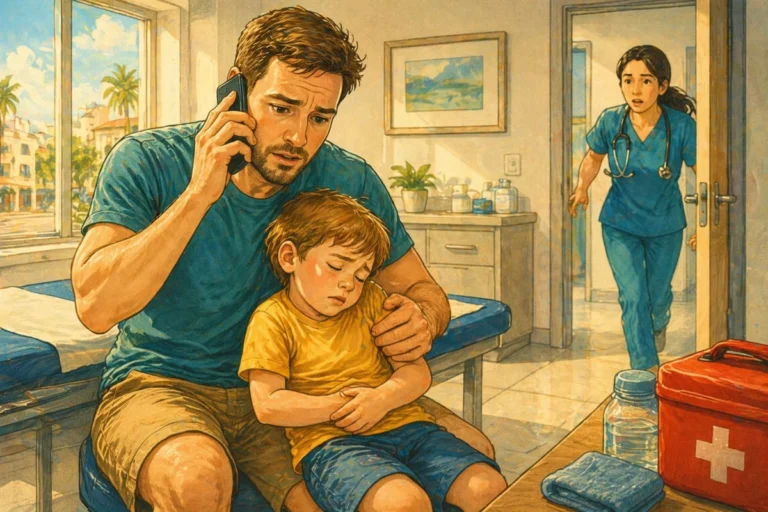
🏥 Take Care of Physical and Mental Health
A family’s long-term survival abroad depends entirely on protecting the physical and psychological well-being of every single member.
Living overseas means adjusting to new environmental parameters, navigating unfamiliar healthcare systems, and learning how to evaluate regional medical facilities.
Thriving families eliminate this stress early by securing reliable coverage and establishing relationships with trusted, English-speaking local doctors long before any medical emergency occurs.
Cultivating Mental Resilience
The underlying psychological strain of cultural adaptation and the distance from long-term friends can impact parents and children alike. Prioritizing physical activity, regular open family check-ins, and consistent outdoor movement keeps your household emotionally balanced.
- Proactive Doctor Screenings: Locate and interview reputable regional medical clinics as soon as you complete your move.
- Emotional Literacy Check-ins: Dedicate quiet moments to listen to your kids’ feelings about their cultural adjustments.
Sustainable families build these specific healthy habits into their schedules early to prevent hidden anxiety from turning into severe burnout.
Expert Tip
To build an incredibly robust medical backup plan for your household, look over our comprehensive guide on what to do in a medical emergency abroad with kids.
⏳ Think in Decades, Not Months
The single most profound shift that distinguishes successful, long-term international families from short-term travelers is their core mindset. Short-term nomads map out their lives in blocks of months; durable expat families plan their lives across decades.
This fundamental mental shift completely rewrites how you approach daily decision-making. Your real estate choices, educational paths, language targets, and international wealth structures are approached with an eye toward multi-decade durability rather than fleeting convenience.
- Real Estate Strategies: Prioritize neighborhoods that offer long-term community integration over transient tourist zones.
- Deep Financial Design: Frame your investments around multi-decade growth models that withstand changing tax residencies.
When you deliberately plan with a ten-year horizon, you naturally construct family systems designed to last.
Read More
To explore how to design a multi-generational financial strategy while living overseas, study our specialized guide on how to save for your child’s future while living abroad.
🌟 A Personal Observation
After observing countless international families navigate this lifestyle over the years, I have noticed that the happiest households share one defining characteristic: they never treat their current location as temporary.
Even if they know their business or family goals might take them to a completely different continent in five years, they invest heavily in their current community as if they plan to stay for the rest of their lives.
They learn the local nuances. They build deep, vulnerable friendships. They invent beautiful family traditions right inside their current environment.
That single shift in perspective alters everything. A foreign country slowly but surely becomes completely familiar ground.
🏁 Conclusion
Building real, lasting expat family stability is never about entirely removing uncertainty from your life. International living will always throw a few unexpected cultural and administrative variables your way.
Instead, true durability is forged through highly intentional home systems: secure legal status, dependable income architecture, robust multi-currency capital buffers, continuous education programs, predictable family routines, and deep social roots.
When these fundamental components connect cleanly, your international journey ceases to be an unguided experiment. It evolves into a deeply rewarding, highly sustainable way of life.
And for the children who grow up inside that structured environment, the world stops being an intimidating, chaotic place to visit, it becomes a place they deeply understand, value, and navigate with absolute confidence.