Banking Options for Long-Term Expat Families

Key Take-Aways
- Long-term expat families typically maintain a mix of local bank accounts, home-country accounts, and international or multi-currency solutions like Wise.
- Banking access in other countries depends heavily on tax residency, legal residency status, and regulatory compliance requirements.
- International reporting frameworks sometimes require banks to collect and share certain tax information across borders, although this is far from the norm and I’d suggest you avoid this as much as possible.
- Multi-currency accounts reduce conversion costs and help manage exchange rate exposure.
- Stability comes from building a layered banking structure that can survive future relocations.
When I first moved abroad by myself, over a decade ago, I saw banking as a practical task, something I had to do to avoid international transfer fees.
But then, years later, when looking at banking options through the lens of traveling and moving abroad with a family, it had to become a flexible yet durable structure that works seamlessly across different countries and currencies, something I could rely on wherever we were.
So far, I’ve been pretty successful at it, and in this article I’ll share what I’ve learned. Let’s look at what implementing reliable global banking for families actually means.
Understanding the Regulatory Landscape
I wish I didn’t have to do this, because I think governments should mind their own business. Banking should be a private affair and what you do with your money and where you keep it, should be your business and nobody else’s.
But alas, we live in reality, so banking abroad is shaped (at least partly) by international compliance rules.
Over the past decade, the automatic exchange of financial account information has become the standard among many countries.
Modern common banks are legally required to identify their customers’ exact tax residency and must share account information with relevant tax authorities under international agreements.
If you attempt to set up new accounts in a country where you currently reside, financial institutions will often request your tax identification numbers and will ask about any additional tax residencies you hold.
This is called the Common Reporting Standard (CRS), developed by the OECD. Over 120 countries participate in it, and it legally mandates financial institutions to gather customer tax details and automatically share account balances and interest data annually with partner tax authorities.
So yeah, if you set up a bank account in any of those countries, you have to provide a lot of information, and they’ll snitch on your personal information to wherever you hold your tax residency.
You do you, but if you’re like me and you’d prefer to keep a smidge of privacy, you avoid creating bank accounts (with significant assets in them) in those countries.
Now, that being said… where CAN you set up a bank account without this intrusion? Here are some worthwhile countries to consider for your expat banking options, but keep in mind that this information can change, so always check in advance.
- The Philippines
- Cambodia
- Vietnam
- Paraguay
- El Salvador
- Dominican Republic
- Guatemala
Thailand, Armenia and Georgia used to be on this list too, but they’ve since joined the CRS.
The Local Bank Account: Your Operational Base
If you live long term in Latin America or Asia with your family, you will likely need to open a local bank account, or at least want to do so for financial reasons (those foreign transaction fees ATMs charge definitely add up!).
Landlords, utility providers, schools, and government offices often expect domestic bank transfers.
In many countries, digital mobile payment systems are tied directly to domestic accounts. Furthermore, regular local payroll deposits typically require a local account to function, although this is probably not a factor if you’ve got international income.
Opening requirements vary wildly by country. Some countries require legal residency documentation plus an official proof of local address, some even want domestic tax identification numbers.
Others are happy with just your identification, address and proof of funds – it’s how I got my first bank account here in SEA.
Finding reliable, expat-friendly bank accounts isn’t always easy – I’ve had to check a few banks before finding one that was able to accommodate me without extra requirements (like being employed), but it’s often doable.
From experience, a local account is the engine that makes daily life smoother. I’m using mine to receive income via my investments there, to withdraw cash, pay the bills, get load for the phone, and many other things.
All of this would be a major hassle if I only had a bank account from my home country to work with – not to mention it’d cost me quite a lot too.
It is not necessarily where you want to hold large, long-term savings reserves, but it is your vital daily operating engine. Setting up this base correctly is a huge step toward successfully preventing deep burnout abroad caused by administrative friction – trust me on this.
If you’re interested – my next step towards a more robust international banking structure is getting residency in Paraguay and then getting a bank account there. According to my research, it should be very doable.
Maintaining a Home-Country Account
Many long-term expat families keep at least one active bank account in their country of citizenship or previous residence, myself included.
There are many practical reasons for keeping this connection alive, most importantly: freedom and redundancy.
In addition, certain investment accounts require a domestic bank link, pension payments or tax refunds may only be deposited locally, and your credit history is often tied directly to domestic accounts.
(“Credit history” is a US-only thing, a very ridiculous concept to non-US citizens, but yeah, if you’re reading this, you’re an American ánd you have any interest in your credit history so you can borrow money in the future and incur debt… keep that in mind, I guess…)
However, some traditional financial institutions restrict services if you no longer physically reside in the country. I’ve had one bank blacklist me because of that, but policies vary significantly between providers.
In some cases, you must formally update your address to your foreign residence, while in others, non-resident status can limit your access to specific financial products.
Official advice often states that the key to keeping these accounts open is complete transparency. If you choose to maintain an account back home, keep your contact details current and comply with any residency declarations required by the bank.
Personally, and this is just my opinion and what I chose to do, not what I can officially recommend you do, because I don’t know your situation, is just not tell your home banks that you’re not living in your country anymore.
All communication is online anyway, and it’s none of their business, in my opinion. It makes banking for expats a bit more tricky, but nothing unmanageable.
International and Multi-Currency Accounts
There are plenty of international banks and specialized financial institutions which offer robust multi-currency banking solutions that allow you to hold separate balances in several major currencies within one single account structure.
These specific accounts are engineered from the ground up for globally mobile expats.
The advantage here is entirely practical. You can receive income in one currency, hold it safely without immediate conversion, and exchange it when market rates are favorable or when you desperately need liquidity in another currency.
This is pretty damn important for long-term expat families, because exchange rate movements directly affect your real family purchasing power.
If you earn in USD but spend your daily life in Thai baht or Mexican pesos, currency fluctuations matter.
You can alleviate this by having a local bank account, but as we’ve established earlier … Thailand and Mexico snitch on your financial status to other countries, which is something you might want to avoid for whatever reason – maybe for tax purposes, or just for the goddamn principle of the matter.
And thus, we come to international bank accounts designed for multiple currencies. They do not eliminate currency risk entirely, but it gives you a lot more control.
Finding the best banks for expats with multi-currency options completely removes the friction of constant conversions.
You can take this one step further, however.
Digital Banks and Fintech Platforms
And now we get to the really interesting part, the future of international bank accounts: online multi-currency banking solutions, via digital banks.
Over the past decade, digital-first banking platforms and international finance tools have expanded rapidly.
Many provide excellent app-based accounts, physical debit cards, and low-cost currency exchange features.
Their availability depends heavily on your specific country of residence and your regulatory eligibility. In some regions, these platforms operate as fully licensed banks, while in others, they partner with local financial institutions.
For busy expat families like ours, these modern international finance tools can reduce transfer costs and simplify budgeting across currencies. This makes it much easier to handle multi-currency family budgeting without getting buried in administrative tasks.
My personal favourite digital bank
I’m currently using Wise, because it just provides a seamless experience. Looking for the best banks for expats, or global banking for families who travel a lot? Wise has got you covered.
I’ve used Wise back in the day when it was still called TransferWise, to pay Filipino employees in PHP with an American bank account in USD.
Their information was saved (bank accounts plus salary), so all I had to every pay day was click “Transfer”, and they got paid in their local currency, via the company’s American bank account.
Really, really useful. We never had any problems with it, and the costs were negligible.
So yeah, when shopping around for the best digital banks for expats, Wise was at the top of the list, and I’m glad to report that it hasn’t lost any of its usefulness.
An example, perhaps. My local bank account here in the Philippines doesn’t allow international transfers to my European bank accounts, so when I wanted to put some of my PHP in euro, I had to convert it to cash, take it to an exchange office, and get physical euros… not efficient, and I was losing so much value.
Via Wise, I can instantly (and I mean instantly) send money from my PHP account to euro. Can’t recommend it enough for expats.
Teaching Financial Awareness Through Structure
Finally, I want to briefly touch on an area where international banking for expats intersects with my responsibilities as an expat dad.
One unexpected upside of international banking is the unique opportunity to teach your children practical financial literacy.
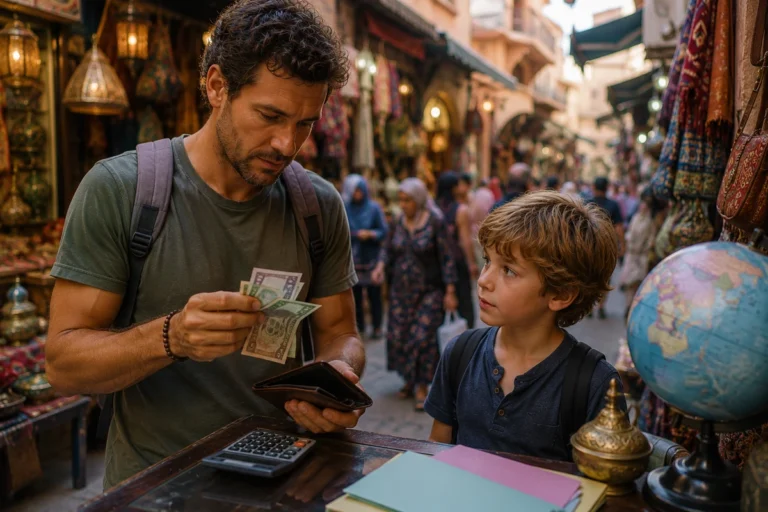
They see different physical currencies, observe exchange rates changing in real time, and learn firsthand that financial systems vary wildly by country.
For fathers building intentional family systems abroad, that is a powerful educational tool. It teaches kids to navigate change confidently, which helps your kids adapt emotionally to new countries by making the mechanics of international life transparent.
Instead of abstract classroom lessons about money (if your school even provides that…), they watch you actively compare fees, manage cross-border transfers, and plan intentionally for long-term stability.
We do home schooling, and I think teaching my kids about money, economics and building a strong financial basis is extremely important (much more than the bullshit they were being thought in schools before we pulled them out, like dancing, social studies, being a good citizen etc.).
As such, I’m currently using Monopoly money and real coins and bills to explain the basics and have them get used to working with money, but soon we’ll move over to digital money and international banking, because, let’s face it, that’s where the world is heading.