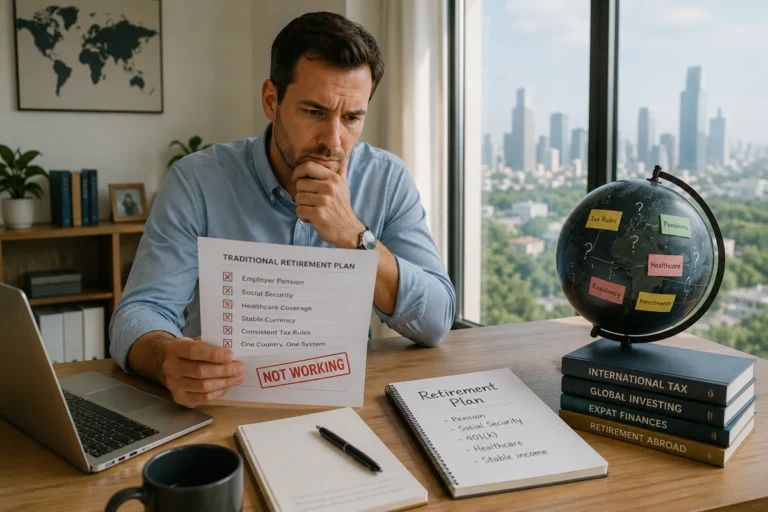
🏦How to Plan Retirement While Living Abroad Long-Term

TLDR
- Retirement planning abroad depends on tax residency, not just citizenship.
- You need to coordinate pensions, investments, and healthcare across countries.
- Cost of living differences can significantly impact your retirement timeline.
- Currency risk and access to financial accounts must be managed carefully.
- Long-term residency and visa rules play a major role in retirement stability.
If you are already living abroad with your family, retirement probably feels like something happening in the background. You are focused on schooling, income, visas, and daily life. Fair enough.
But here is the thing. Living internationally does not simplify retirement planning. It makes it more layered. Not harder necessarily, but definitely something you want to approach with intention.
The upside? If you do it right, retiring abroad can be far more flexible, and often more affordable, than staying in your home country. Effective expat retirement planning is the key to building long-term stability for your future self.
📍 1. Start With Where You Plan to Live
Retirement planning gets clearer once you answer one simple question: where do you see yourself long-term? You do not need a permanent answer, but you do need a working assumption. Different countries have different rules around residency, taxation, and healthcare access.
| Factor | Impact on Retirement |
| Visa Type | Determines if you can stay permanently or need to renew. |
| Healthcare | Availability of public vs. private coverage for seniors. |
| Property | Restrictions on foreign ownership of land or homes. |
| Taxes | Local tax rates on foreign-sourced retirement income. |
Some countries offer specific retirement visas and planning pathways with clear income requirements. This isn’t just paperwork; your legal status affects your ability to stay and manage your finances over time. Families who choose a “base country” early tend to have a smoother transition later on.
⚖️ 2. Understand Your Tax Obligations
Taxes do not disappear when you move abroad; they just change shape. Most countries tax based on residency. If you live there long enough, you are considered a tax resident and must follow local tax residency rules.
- Worldwide Income: Many nations require reporting of all global income.
- Double Taxation: Utilize treaties to ensure you aren’t paying twice on the same dollar.
- Filing Requirements: You may still need to file in your home country, especially if you are a US citizen.
It is worth understanding how different income sources are treated. A solid financial plan for expat retirees accounts for how the host nation views pensions versus rental income.
📜 3. Coordinate Your Pension Systems
If you have worked in more than one country, your retirement may involve multiple pension systems. This is where expat pension planning becomes critical. Many countries have Totalization Agreements that allow you to combine contribution periods to qualify for benefits.
💡 Expert Tip: Check if your home country has an agreement with your host country. Without these, you might not meet the minimum contribution years required to collect a payment in either jurisdiction.
It is also vital to understand what happens to pensions when you leave the West. Accessing these funds usually requires maintaining a valid bank account and confirming your residency status periodically.
📈 4. Build a Flexible Investment Strategy
Relying solely on government pensions is rarely enough. You need retirement savings for expats that remain accessible regardless of your coordinates.
- Portable Accounts: Use platforms that do not restrict access based on your country of residence.
- Diversification: Hold assets across different regions to protect against localized economic downturns.
- Asset-Backed Security: Explore OECD insights on asset-backed pensions for long-term stability.
Investing as an expat requires a simplified approach. A few well-structured accounts you understand is better than a scattered setup across multiple jurisdictions.
💱 5. Plan for Currency Risk
This is one of those things people tend to ignore until it becomes a problem. If your income is in one currency and your expenses are in another, exchange rates will affect your purchasing power.
- Exposure: A 10% drop in your home currency equals a 10% pay cut in your host country.
- Mitigation: Try to align a portion of your income with your primary spending currency.
- Budgeting: Use multi-currency family budgeting to track how fluctuations impact your lifestyle.
You don’t need to predict movements; you just need to avoid being overly exposed to a single currency during your retirement abroad.
🏥 6. Think About Healthcare Early
Healthcare is one of the biggest variables in retiring overseas planning. Public systems may not be accessible to foreigners, or they may have long wait times for the specific care seniors often need.
Healthcare Checklist:
- Public Eligibility: Does your visa allow you to join the national system?
- Private Coverage: Can you find a reliable healthcare plan for your kids and yourself that covers pre-existing conditions?
- Local Access: Do you know how to find English-speaking doctors in your target area?
💰 7. Factor in Cost of Living Differences
One of the advantages of retirement abroad is the potential for lower living costs. In many parts of Latin America and Asia, housing and services can be significantly more affordable.
This can extend your retirement savings for expats and even allow for earlier retirement. However, costs are not static. Inflation and local economic shifts play a role. It is a good idea to base your financial plan for expat retirees on current, realistic local expenses rather than idealized travel blog estimates.
🛂 8. Secure Long-Term Residency
Your ability to stay in a country long-term is not automatic. Retirement visas and planning often involve proof of savings or background checks.
- Visa Stability: Without a stable status, you may lose access to banking and healthcare.
- Residency for Families: If you have children, ensure you have obtained the correct residency visas for the whole household.
📖 Read More: For a comprehensive overview of the moving process, see this parent’s complete guide to moving abroad.
🏦 9. Keep Access to Your Financial Systems
Banking while living abroad can be surprisingly tricky. Some banks restrict accounts if you are no longer a resident of your home country.
Banking Strategies:
- Home-Country Base: Maintain at least one stable relationship in your country of citizenship.
- Local Account: Use specific banking options for expat families to handle daily local transactions.
- Emergency Fund: Always have an emergency fund built up in a highly liquid account.
🔄 10. Revisit Your Plan Regularly
Expat retirement planning is not a one-time decision. Your family situation changes, and kids grow up. Checking in on your plan once a year is usually enough.
Adjust where needed, confirm that your assumptions still hold, and make sure your systems are still working. This is especially important if you are balancing travel and education while your children are young, as your spending habits will shift once they reach adulthood.
🏁 Final Thoughts: Creating Options
Planning retirement while living abroad is about clarity, not complexity. Where you will live, how you will fund your lifestyle, and how you will handle taxes and healthcare are the core pieces.
Take your time with it. Build a system that fits your life. Done right, retiring abroad can offer financial flexibility and a lifestyle that actually aligns with your values. For more detailed steps, you can check out the ultimate nomad retirement planning guide.
Have you already checked if your home and host countries have a pension agreement, or is that next on your to-do list?