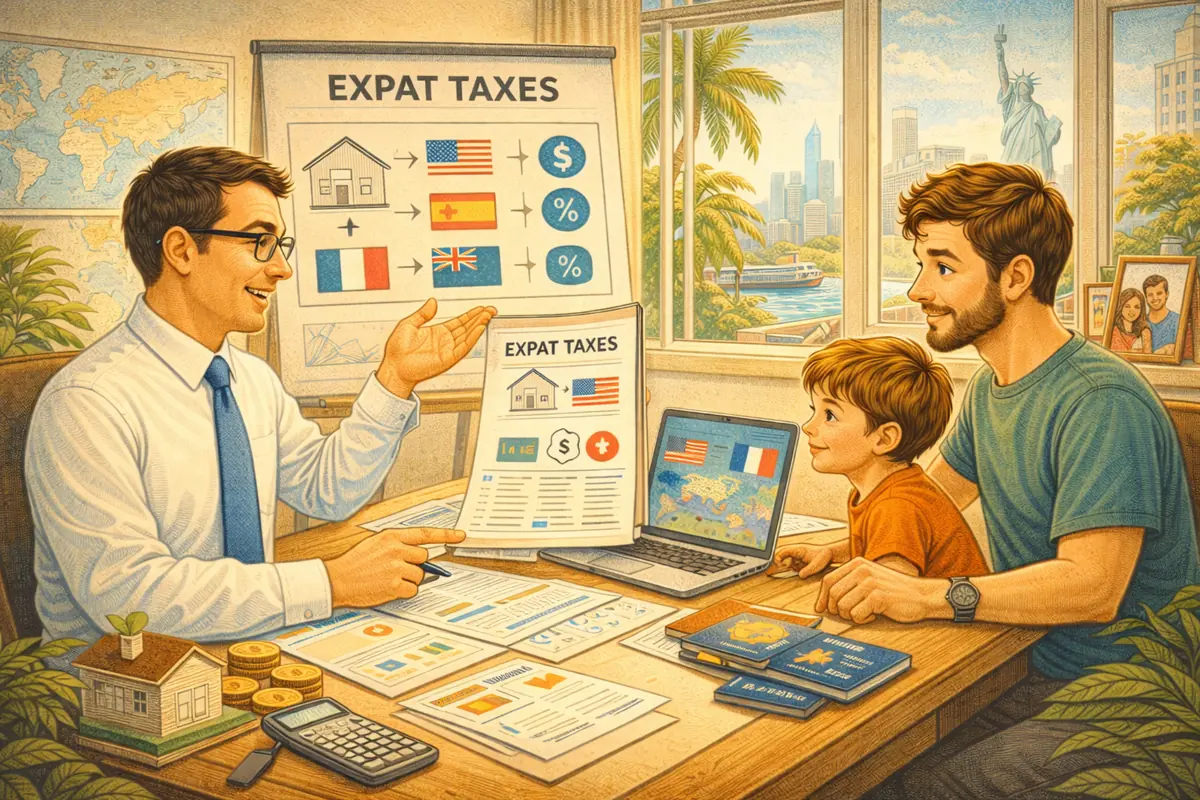
🏦Expat Taxes Made Simple for Families Living Abroad


TLDR
- Expat taxes depend on residency, citizenship, and where your income is earned.
- Filing taxes while living abroad often involves reporting in more than one country.
- Double taxation can usually be reduced through credits, exclusions, or treaties.
- Keeping clear records of income, travel days, and residency status is essential.
- A simple, consistent tax setup helps avoid tax mistakes expats commonly face.
Let’s be honest. The phrase expat taxes alone is enough to make most people put this off for another week. When you are raising a family abroad, you have already got enough on your plate.
Schools, visas, healthcare, and daily routines take up most of your mental energy. Taxes tend to sit in the background until a deadline shows up or a letter arrives.
But here is the reality. Once you understand the basic structure, it is not nearly as chaotic as it first appears. Most families are not dealing with exotic loopholes or obscure rules. They are dealing with a handful of consistent principles that apply almost everywhere.
The goal here is not to turn you into a tax expert. It is to simplify expat taxes so you can make clear decisions and avoid unnecessary stress. Achieving this clarity is part of how expat families build long-term stability.
🌏 The Two Big Questions That Define Everything
Every tax situation abroad comes down to two core questions that dictate your entire strategy.
- Where are you considered a tax resident?
- Does your home country still require you to file based on citizenship?
These two factors shape almost everything else. They determine where you owe taxes, what income is taxable, and how you report it. For most expat families, you will be dealing with at least one country of residence and possibly a second country tied to your citizenship. This is the absolute foundation of any tax guide for expats.
🏛️ Understanding Tax Residency
Most countries tax based on residency. That means if you live there long enough or establish strong ties, you are expected to pay taxes there. This usually involves spending a certain number of days in the country, maintaining a home, or having your family based there.
It is not just about where you sleep. It is about where your life is centered. You can find a deeper tax residency explained for expat families here to help you determine your status.
🛂 Citizenship-Based Systems
Some countries, however, tax based on citizenship. The most prominent example is the United States. This means even if you live abroad full-time, you may still need to file tax returns. This does not always mean paying twice, but it does mean extra reporting. For families, especially those managing multiple income streams, understanding expat tax obligations in this context is critical.
📈 Filing Taxes While Living Abroad: What Actually Happens
In practical terms, filing taxes while living abroad often means navigating a dual-layered system. You file in your country of residence because that is where you live and earn income. Then, depending on your citizenship, you may also file in your home country.
🛡️ Mechanisms to Prevent Double Taxation
The good news is that you are rarely taxed twice on the same dollar. Governments use several tools to ensure you aren’t penalized for living internationally:
- Foreign Tax Credits (FTC): You get a credit for taxes paid to a foreign government, which offsets what you owe at home.
- Foreign Earned Income Exclusion (FEIE): This allows you to exclude a certain amount of your foreign earnings from your home country’s taxable income. For 2026, the FEIE limit is $132,900.
- Foreign Housing Exclusion: This accounts for the often higher costs of living in expat hubs.
So while the process may involve multiple filings, the end result is usually that you are not taxed twice on the same income. It sounds more complicated than it feels once you have done it once or twice.
💰 Understanding Income Types Abroad
Not all income is treated the same by tax authorities. How a country views your money depends on its “source.”
| Income Category | Primary Taxing Authority | Common Expat Examples |
| Employment Income | Where work is performed | Salary from a local or remote job. |
| Business Income | Where business is managed | Freelance work, consulting, or an LLC. |
| Investment Income | Residency/Treaty based | Dividends, interest, and capital gains. |
| Rental Income | Where property is located | Income from a home you kept back home. |
Employment income is typically taxed where the work is physically performed. If you are finding remote work that supports an expat family, that often means your country of residence has the primary right to tax it. Business income depends on where the business is managed and operated.
This can get more nuanced, especially for digital businesses. Investment income may be taxed differently depending on both local laws and international agreements.
🤝 The Role of Tax Treaties and Credits
Tax treaties exist to make life easier, not harder. These agreements between countries determine how income is taxed when more than one country could claim it. They often assign primary taxing rights and provide ways to offset taxes already paid.
You can review the OECD model for tax treaties to see how these standard agreements are structured.
This is a central part of any tax advice for expat families. It is not about avoiding taxes altogether. It is about avoiding unnecessary duplication. For example, if you are investing as an expat, a treaty might lower the withholding tax on dividends from 30% down to 15%.
📅 Keeping Track of Your Days and Documents
This is the unglamorous part, but it matters more than anything else. Most tax systems rely heavily on documentation. That includes how many days you spend in each country, where your income comes from, and what taxes you have already paid.
📂 Your Essential Tax Folder
For families who travel frequently, this becomes especially important. Even small errors in tracking days can affect your residency status. You should maintain digital copies of:
- Travel Logs: Every flight and border crossing date.
- Tax Certificates: Proof of tax paid to the local government.
- Residency Visas: Copies of your residency visas for your family.
- Income Records: Invoices, pay stubs, and bank statements.
A simple habit helps. Keep a running log of travel, store digital copies of key documents, and organize income records by country. It does not take much time, but it makes tax filing for expat parents significantly smoother.
🚫 Common Mistakes Expat Families Make
There are a few patterns that show up again and again. Avoiding these will save you a massive headache during audit season.
- The “Tourist” Fallacy: Assuming that if you don’t have a residency visa, you don’t have tax obligations. Many countries tax you if you stay more than 183 days, regardless of your visa.
- Inconsistent Reporting: Declaring one amount of income in your host country and a different amount in your home country. This is a major red flag for authorities.
- Ignoring Local Rules: Failing to realize that some countries tax your “wealth” or “assets” in addition to your income.
- Poor Record Keeping: Not being able to prove your physical presence, which is required for things like the Foreign Earned Income Exclusion.
If you want to avoid tax mistakes expats commonly face, the best approach is simple: be consistent, be transparent, and keep records.
🛠️ How to Simplify Your Setup
You do not need a complex structure to manage expat taxes effectively. In fact, simpler is usually better.
- Choose a Primary Base: A country where you spend most of your time, where your kids are settled, and where your daily life happens.
- Align Your Finances: Receive income there when possible, pay taxes there, and keep your documentation consistent. Use reliable banking options for expats to avoid account freezes.
- Standardize Reporting: If your home country requires filing, treat it as a reporting layer rather than your primary tax system.
- Automate Budgets: Use multi-currency family budgeting to track your actual cost of living and tax set-asides.
This approach does not eliminate all complexity, but it reduces it significantly. It is one of the most practical ways to simplify expat taxes.
⚖️ When Professional Help Makes Sense
There is a point where doing it yourself stops being efficient. As an expat father, your time is better spent with your family than wrestling with 50-page tax instructions.
Hire a professional if:
- You have multiple income streams from three or more countries.
- You own real estate in multiple jurisdictions.
- You have complex business structures like an LLC or a foreign corporation.
- You are unsure of your residency status in your home country.
The key is finding someone experienced with expat cases, not just domestic taxation. For straightforward situations, many families handle things independently. But when complexity increases, good tax advice for expat families pays for itself. You can find more details in this digital nomad tax guide which covers regional specifics.
👨👩👧👦 Tax Planning and Your Family’s Future
Tax planning is not just about the current year. It is about your family’s long-term trajectory. For example, your tax status can affect your ability to contribute to retirement accounts. If you don’t plan correctly, you might find that traditional retirement planning fails expats because they lose out on tax-advantaged growth.
It also impacts your children. If you are paying for online education and tutors, these costs might be deductible in certain jurisdictions. Always look at the intersection of your family life and your tax returns.
🏁 Conclusion: Keep It Clear, Keep It Consistent
Expat taxes do not have to be overwhelming. At their core, they are built on a few consistent ideas. Where you live, where you earn, and how countries coordinate to tax that income.
If you understand those basics, keep your records organized, and avoid trying to outsmart the system, you will be in a strong position. For expat families, the goal is not just compliance. It is peace of mind.
Because when your tax setup is clear, you can focus on everything else that actually matters. Your family, your lifestyle, and the reason you chose to live abroad in the first place.
Have you already checked the specific tax treaty between your home and host countries, or is that your next step?