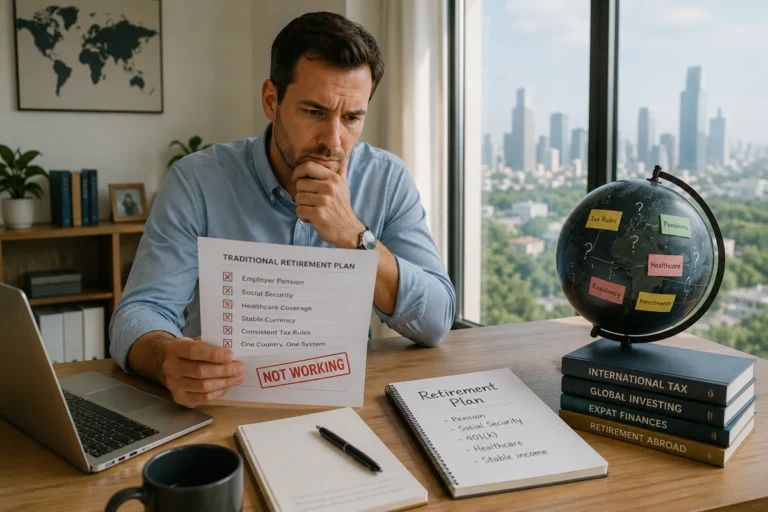
How Expat Families Manage Money Across Multiple Countries

Key Take-Aways
- Expat families manage money across borders by separating tax residency, banking residency, and citizenship obligations.
- Multi-currency banking and careful exchange rate planning reduce unnecessary currency risk.
- Stability and long-term investing success come from building robust financial systems, not reacting to every new country you enter.
Today we’ll tackle one of my favorite topics: international finance.
Living abroad with a family forces you to grow up financially. Fast.
When you earn in one currency, pay rent in another, invest in a third, and file taxes in a fourth (or in none!), you can’t rely on vague budgeting apps or guesswork.
You need structure. You need clarity. And you need systems that survive border crossings.
For families like mine, raising kids in Latin America or Asia while staying (vaguely) connected to their passport country, executing a continuous multi-currency family budget is about building stability across jurisdictions.
To successfully manage your finances across countries, you have to establish some baseline operations that keep your household protected.
Let’s break down how experienced expat families actually handle it.
Step One: Separate Citizenship, Residency, and Banking
The biggest mental shift is understanding that citizenship, tax residency, and banking location are not the same thing.
This separation is the core foundation of successful expat financial planning for families.
You need to understand what you HAVE to do, where you can stay under the radar, where to keep your money in a safe manner, and how you can optimize your finances while broadly staying within a legal framework.
Fortunately, that’s not as hard as it sounds.
- Tax residency is usually determined by your physical presence or your center of economic interest (this is vague enough to exploit). Many countries use day-count tests (usually 183 days per year) or domicile rules to decide whether you owe tax locally on worldwide income. If you spend enough time in a country, you may become a tax resident there even if you hold a different passport, a transition that requires an understanding of basic international tax liabilities to avoid surprises.
- Citizenship-based taxation is rare globally. The United States is the most well-known example (in fact, I think Eritrea of all places is the only other example…), taxing citizens on worldwide income regardless of where they live. That means filing annual tax returns and potentially foreign asset disclosures even if you haven’t set foot in the country in years. I always laugh when I see or hear “Land of the Free” – most Americans don’t realize that in many regards, they’re the least free of all “civilized” nations, but I digress.
- Banking residency is separate again. Some banks restrict services based on where you physically reside, not your nationality. This is why families often maintain accounts in more than one country, provided it’s legal and compliant. It’s what I do, and something I can fully recommend to any and all expat dads out there. When you have bank accounts in 3+ countries, in different currencies, you’re pretty damn safe. It’s a great feeling.
When you separate these concepts clearly, the confusion surrounding international money management starts to disappear.
Multi-Currency Banking as a Core Tool
I’m sure you’ve experienced by now that we expat families rarely operate in a single currency.
You might earn in U.S. dollars, pay school fees in Mexican pesos (don’t do it, opt for homeschooling instead!), and invest in global ETFs denominated in euros.
That’s pretty cool, but exchange rate movements can materially affect your purchasing power, especially when large expenses are involved.
The solution? Multi-currency accounts. They allow you to hold balances in different currencies without converting constantly.
This reduces repeated conversion fees and avoids unnecessary exposure to short-term currency swings, making them essential cross-border banking solutions.
Personally, I use Wise for this – I’ve talked about why in many other articles, but in short, it’s cheap, fast and extremely handy for us multinational nomad dads.
Unfortunately (or fortunately, depending on whether or not you dip into ForEx), currency risk itself is unavoidable in a global life.
Exchange rates fluctuate due to interest rate differentials, inflation expectations, and broader economic conditions.
The key to managing all of this in a beneficial way is not to try to eliminate risk entirely but aligning your assets with your future spending… and of course still try to eliminate risk as much as possible.
If you plan to retire in Thailand, holding at least part of your assets in Thai baht or assets linked to your spending currency can reduce long-term mismatch risk.
On the other hand, keeping diversified global exposure helps avoid concentration in a single local economy.
It’s a balancing act, but it’s a conscious one. Personally, I try to do both, because I strongly believe in diversification and redundancy, but you have to choose your own path.
Taxes Across Borders: No Room for Guesswork
Let’s now tackle what I consider to be the greatest scam ever: taxes.
Loyal readers will probably know by now that I think governments can fuck right off with their legalized, forceful theft, and that they should have ZERO right to take your hard-earned (well, kinda) money.
But alas… we have to live in the real world, and as such, you have to account for taxes.
Many countries tax residents on worldwide income. That includes salary, rental income, dividends, and capital gains.
Double taxation agreements exist between many countries to prevent the same income from being taxed twice, usually through tax credits or exemptions.
However, these treaties don’t eliminate filing obligations. You may still need to report income in both jurisdictions, even if credits offset the final liability.
A massive bore, and unfortunately I cannot tell you in a broad sense of what you should do, or how you should do it, because it depends on where you’re from, where you live, where you earn, etc.
If you are questioning your legal exposure, you can review details on how local authorities handle foreign income to clarify your status.
Compliance Checkpoints
- Track your exact physical residency calendar days inside your host nation.
- Keep clean, separate digital repositories of all international business invoices.
- File mandatory asset disclosures if your cross-border account balances cross local legal thresholds.
If you’re a U.S. citizen, you OF COURSE face additional reporting requirements, such as utilizing the Foreign Earned Income Exclusion framework if you meet the strict qualification tests.
These rules are administrative, not optional. Penalties for non-compliance can be significant. Again, Land of the Free… what a joke.
Families who manage family finance for expats well should do three things:
- Track residency days carefully.
- Keep clean, organized financial records.
- Use qualified tax professionals when crossing borders or changing residency status IF NEEDED.
My Personal Recommendations
If all of this sounds like a massive chore, bore and drain on your finances, you’d be 100% right. But, unless you’re a U.S. citizen… you can avoid a lot of this BS by getting legal residency in a country which doesn’t tax international income.
That means, in a broad sense, that you don’t have to pay taxes on money you earn from abroad (from the point of view of your residency country).
So if you have legal residency in Paraguay (highly recommended) and you earn money online (like I do), you have to pay 0% taxes on it. Yay!
Of course, if you have real estate or other investments in other jurisdictions, you still have to keep those in mind.
Investing While Living Abroad
Here’s the reassuring part: the fundamentals of investing do not change just because you live abroad.
- Diversification still matters.
- Cost control still matters.
- Long-term discipline still matters.
What changes is access and structure.
Many brokerage firms restrict services to non-residents. Certain investment products are limited based on local regulations.
Tax treatment of dividends and capital gains may differ depending on where the account is held, your residency status and what you invest in.
Real estate is an interesting topic – I’ve invested internationally in condos and am generally really happy with this. It provides a local source of income, which is slowly accumulating from across the other side of the world. It builds a tertiary source of wealth, something I can always fall back on when my primary and secondary Bases ever run into trouble.
Retirement accounts add another layer. Tax-advantaged accounts in your home country may continue to exist while you live abroad, but contributions and withdrawals can have cross-border tax implications.
Some countries recognize foreign retirement accounts under tax treaties; others do not. Having total clarity before contributing is essential.
Personally, I think retirement accounts are … complicated. Not in the basic sense, but more in the sense of “should you bother?”.
The returns you get are very low, Western nations will almost certainly collapse within our lifetime, so things like pensions are far from guaranteed and … well, it ties you very strongly to your home nation, which you may not want.
I prefer to put my savings into relatively safe investments, such as global, dividend-yielding ETFs and real estate, because I believe this gives me more bang for my buck, and a better future for my family.
Teaching Kids About Money in a Global Context
One unexpected benefit of managing international money management setups across countries as an expat dad, is the financial education your children receive almost by osmosis.
A perfect addition to your homeschooling setup, and one that I’m very much in favour of and applying to my family.
Kids see exchange rates change, they hear conversations about different tax systems, and they understand that money works differently in different places.
For families like ours, focused on alternative education or independent setups, this becomes a living curriculum.
You can explain why prices vary, why currencies fluctuate, and how global markets connect economies. It turns abstract financial literacy into something tangible.
The Real-World Money Curriculum
This is how I handle the international financial education of my kids:
- Basic Mathematics: Ensure they know how to do addition, subtraction etc.
- General Finances: Teach them the broad scope of your local currency, and then using money to pay for real items in real locations.
- Exchange Calculations: Involving the kids in calculating conversion spreads during grocery trips. For example, how much does item X cost here, and how much would that be back in country Y?
- Cost Comparison: Analyzing why local consumer goods cost more or less than back home. Import, export, self-sufficiency of local products, etc.
- Digital Systems: Explaining how international multi-currency transfers travel between global hubs, and how to use banking apps or Wise.
This practical exposure fits naturally into my daily family life, acting as an extension of our home education routine.
This integrated real-world learning is something I can highly recommend. When you combine digital resources with local experiences, you give your kids a highly practical, hands-on worldview.
Long-Term Financial Independence Abroad
In short, financial independence while living abroad isn’t about geographic arbitrage alone.
Lower cost of living in certain regions can help, but long-term sustainability matters far more than short-term savings.
A globally diversified investment portfolio combined with jurisdiction-aware tax planning (avoid every tax you can!) creates true flexibility.
If one country becomes less attractive due to unexpected policy changes, you’re not financially trapped.
That freedom is incredibly powerful, and one of the main advantages of being an expat dad.
From personal experience, the real freedom isn’t just lower living costs. It’s knowing that your systems continue functioning seamlessly even if you decide to relocate again.
That confidence allows you to protect your family financially, ensuring you can manage the pressures of remote work and parenting without constant background stress.