📦Minimalist Living for Expat Families: A Practical Guide


TLDR
- Minimalist living helps expat families reduce stress, costs, and relocation friction while moving abroad.
- The key is separating essentials from “country-specific clutter” like furniture and excess clothing.
- Kids adapt better when routines and emotional anchors are prioritized over possessions.
- A portable family setup makes visa changes and housing shifts significantly easier.
- Minimalism abroad is about designing a flexible, stable family system rather than just owning less.
Living abroad with a family has a way of exposing everything you thought you “needed.” The longer you stay outside your home country, the more obvious it becomes that most of it is just weight. Boxes, habits, furniture, and emotional clutter all travel with you unless you deliberately stop them at the door.
Minimalist living for expat families is not about aesthetic empty rooms or extreme decluttering. It is about building a life that can move without falling apart. When you have got kids, school changes, and visa renewals in the mix, that flexibility becomes your most valuable asset.
🌎 Why Minimalism Hits Different When You Live Abroad
Back home, excess is just inconvenient. Abroad, it becomes a logistical problem. Shipping costs, storage fees, and visa uncertainty all make “just in case” ownership harder to justify. If you are a minimalist expat family, you quickly learn that what you need to move to another country is significantly less than what you think.
Every object carries hidden weight: financial cost, emotional attachment, and relocation friction. When you start viewing possessions through this lens, minimalism moving abroad stops being an aesthetic preference and becomes a survival strategy for long-term stability.
📊 The Cost of “Clutter” Abroad
| Factor | Impact of Excess | Benefit of Minimalism |
| Relocation | Massive shipping & airfreight bills. | Travel with standard luggage only. |
| Housing | Need for larger, expensive rentals. | Flexibility to live in smaller, central hubs. |
| Flexibility | High friction to change cities/jobs. | Ability to move on 30 days’ notice. |
Expert Tip: Before moving, calculate the “replacement value” versus the “shipping cost” of your furniture. In 80% of cases, it is cheaper to sell locally and buy used items at your destination.
🎒 Start With a “Portable Core” Mindset
The foundation of simple living abroad is your portable core. This is everything your family genuinely needs to function in any country, regardless of housing setup. To understand the philosophy better, it helps to define what is minimalism in a mobile context.
For most families, that includes essential clothing, basic electronics, important documents, and a small number of emotional comfort items. This mindset is the first step for any expat father who wants to manage culture shock without being weighed down.
🎒 The Portable Core Checklist:
- Documentation: Digital and physical copies of birth certificates, visas, and health records.
- Tech: Versatile laptops and universal adapters for managing work and parenting.
- Emotional Anchors: One small box per child for “treasures” like a favorite toy or blanket.
- Education: A lightweight tablet pre-loaded with online learning tools.
🏠 The Big Mistake: Over-Optimizing the First Move
New expat families often over-prepare for their first destination. They rent a large apartment and buy furniture locally, making it harder to declutter for international moves later on. Then life happens: job changes or visa constraints force a move, and you are stuck liquidating a house full of stuff.
A more sustainable approach is to assume your first setup is temporary. This prevents clutter from entering your life and helps prevent burnout.
📖 Read More:
🧸 Children and Minimalism: What Actually Matters
Parents worry that a simple lifestyle for expats means depriving kids of stability. In reality, children do not measure stability in objects. They respond to daily routines and emotional availability.
Kids tend to adapt better when their emotional world is stable, even if their physical environment changes. Embracing living with less as expat parents allows you to focus on raising children abroad rather than managing toy boxes.
🧩 Stability Anchors for Minimalist Kids:
- Consistent Bedtime: The same routine in every new house.
- Digital Library: Access to familiar books and movies regardless of geography.
- Parental Presence: More time spent together because there is less house to clean.
👕 Clothing Systems That Work Across Countries
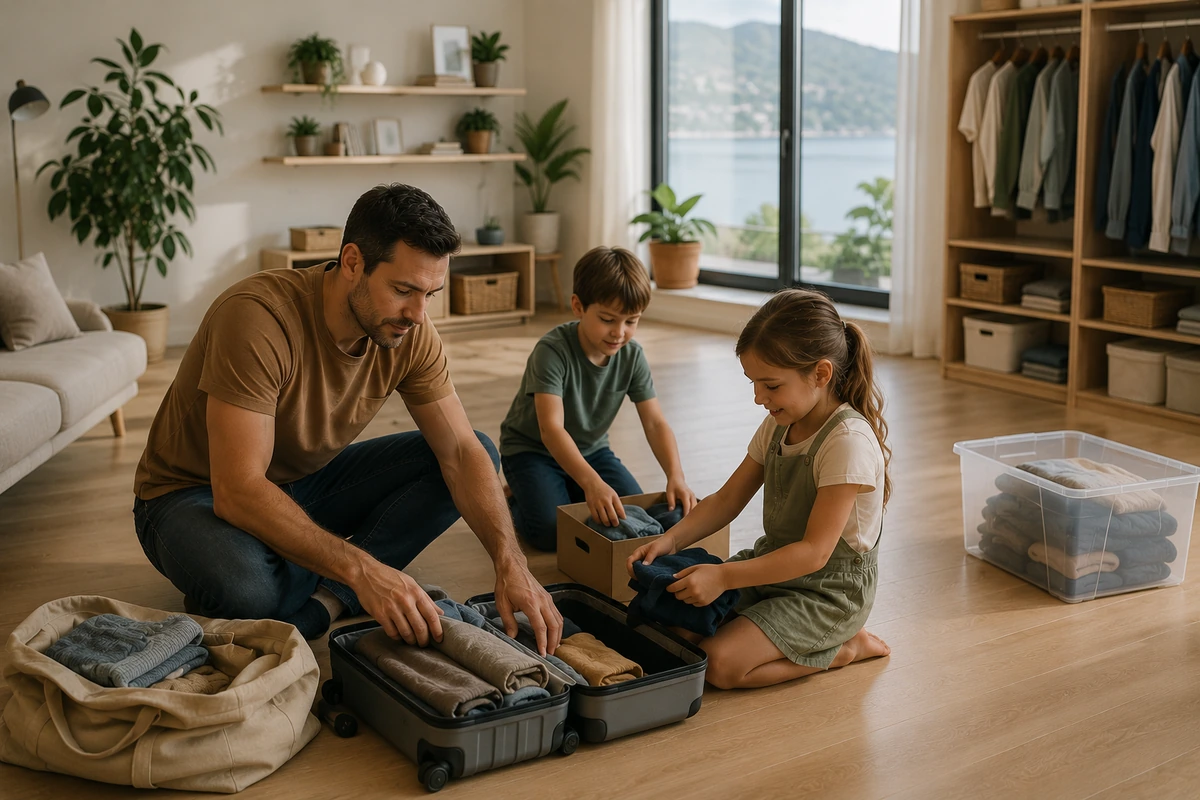
Clothing is a huge source of clutter. Different climates and cultural expectations make wardrobes expand quickly. A practical approach is building modular wardrobes based on layers. Using a digital nomad packing checklist can provide inspiration for high-utility clothing.
👔 Minimalist Packing Tips Families:
- Layering over bulk: Choose items that work in both 15°C and 30°C.
- Color coordination: Ensure tops match multiple bottoms to maximize combinations.
- The Growth Rule: For kids, buy only for the next 6 months, not the next 2 years.
💻 Digital Minimalism Is Just as Important
Digital clutter becomes heavy during transitions. Cloud-based document storage and consolidated communication tools reduce friction. When school records and financial accounts are scattered, every move becomes stressful.
📂 Digital Organization Essentials:
- Cloud Storage: One central, encrypted folder for all family paperwork.
- Banking: International-friendly banking options.
- Taxes: Streamlined records for expat tax simplification.
🏨 Housing Strategy: Smaller, Flexible, Repeatable
A minimalist expat family prioritizes flexibility over size. This often means furnished rentals and shorter leases. It makes it easier to adjust as your family’s needs evolve, such as when you need to structure your workday around new time zones.
Expert Tip: Look for “aparthotels” or serviced apartments for your first 30 days. It prevents you from rushing into a long-term lease for a house that is too big to manage.
❤️ The Emotional Side of Letting Go
Simple living abroad surfaces emotional attachments to “stuff” as stability symbols. Letting go of items can feel personal, but the turning point comes when you realize stability is built in social circles and relationships, not objects.
🛠️ Redefining Stability:
- Routine over Rooms: A morning walk is more stable than a specific dining table.
- People over Property: Prioritize investing as an expat over accumulating local assets.
- Experiences over Extras: Budget for travel instead of new gadgets.
🏗️ Building a Family System That Can Move
The goal of a simple lifestyle for expats is to design a household system that can move without collapsing. When these systems are intentional, relocation stops feeling like a disruption.
📋 Moving-Ready Family Systems:
- Healthcare: A system to quickly find English-speaking doctors.
- Education: The ability to track educational progress on the go.
- Residency: Clear steps for obtaining residency visas for the family.
🏁 Conclusion
Minimalist living for expat families is about removing friction from a life that already has enough moving parts. When you reduce what you own, you increase how freely you can move. By choosing minimalism moving abroad, you create a foundation that holds across countries, not just houses.
What is the one item you thought you needed when moving abroad that ended up just being “weight”?