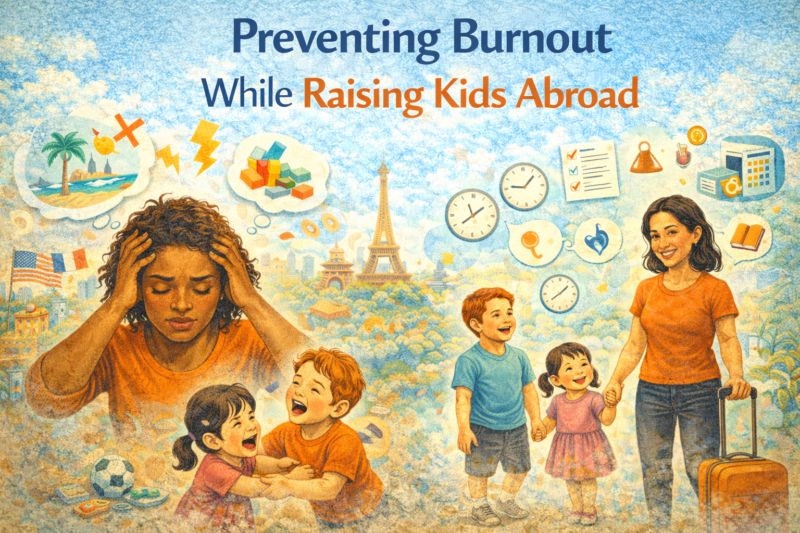
Preventing Burnout While Raising Kids Abroad
TLDR
- Burnout is driven by chronic, unmanaged stress, and expat parenting adds unique pressure points.
- Clear routines, defined work boundaries, and shared family planning reduce mental overload.
- Sleep, physical activity, and social support are strongly linked to lower stress and better resilience.
- Cultural adaptation stress is real, but predictable home structures protect children and parents alike.
- Preventing burnout abroad is about systems, not willpower.
Living abroad with your family can look idyllic from the outside. New culture, new food, new opportunities. But behind the Instagram shots of beach sunsets and colonial plazas, there’s a quieter reality.
You’re managing visas, schools, language barriers, remote work, finances, and parenting. All at once.
Burnout doesn’t arrive dramatically. It builds slowly through chronic, unmanaged stress. Health organizations define burnout as a state of emotional exhaustion, detachment, and reduced effectiveness caused by prolonged stress exposure.
While originally studied in workplace settings, the same mechanisms apply to parenting and expat life.
If you’re raising kids abroad, prevention isn’t optional. It’s strategic.
Understanding the Unique Stress of Expat Parenting
Relocation itself is a known stressor. Research on cross-cultural adjustment consistently shows that moving to a new country requires psychological adaptation. Language differences, unfamiliar social norms, and reduced extended-family support all add load.
Add children to the equation and complexity increases.
You’re not only adapting yourself. You’re guiding your kids through adaptation as well. Monitoring their emotional adjustment. Supporting bilingual development. Navigating new educational systems.
That’s a heavy cognitive and emotional lift.
Acknowledging that reality is not weakness. It’s clarity.
Build Predictable Structure at Home
One of the most effective protective factors against stress is predictability.
Research in child development and family psychology consistently links structured routines with better emotional regulation in children and lower parental stress. When daily rhythms are stable, fewer decisions are required. Decision fatigue drops.
Start with anchors.
Consistent wake times. Regular shared meals. Defined work blocks. Planned learning periods if you homeschool or supplement schooling. Evening wind-down routines.
You don’t need military precision. You need repetition.
In our home, even when the outside environment feels unpredictable, mornings follow the same routine. That stability changes the tone of the entire day.
Protect Sleep Like Infrastructure
Sleep is not just rest. It’s biological maintenance.
Public health research shows that insufficient sleep is associated with impaired concentration, mood instability, and increased stress reactivity. Children require age-appropriate sleep durations for healthy development, and adults are no different when it comes to cognitive performance.
Travel, time zone shifts, late social events, and climate changes can easily disrupt sleep abroad.
Prioritize consistent bedtimes. Limit late-night screen exposure. Seek natural daylight in the morning to reinforce circadian rhythms.
When sleep erodes, resilience follows.
Define Clear Work Boundaries
Remote work and location independence are common among expat families. Flexibility is valuable, but without boundaries, work expands to fill every available hour.
Occupational health research consistently finds that blurred work-home boundaries increase stress and reduce recovery time. Psychological detachment from work during off-hours is linked to better well-being and lower burnout risk.
Set defined start and stop times.
Communicate them clearly to clients or employers when possible. Use physical cues, such as closing a laptop or leaving a specific workspace, to signal transition.
Your children should know when you are fully at work and when you are fully present.
Partial presence drains everyone.
Share the Load Intentionally
Parental burnout research highlights one recurring factor: imbalance.
When one parent carries disproportionate emotional or logistical responsibility, stress accumulates quickly. Clear division of responsibilities reduces ambiguity and resentment.
Schedule weekly check-ins with your partner.
Review school commitments, financial tasks, travel plans, and household logistics. Clarify who owns what. Adjust when needed.
This is not corporate behavior. It’s family governance.
And governance prevents collapse.
Maintain Social Connection
Living abroad often means reduced access to extended family and long-term friends. Social isolation is a known risk factor for psychological stress.
Research consistently shows that perceived social support improves coping ability and reduces stress-related symptoms. That support can come from local friendships, expat communities, or digital contact with family back home.
Be intentional about building community.
Attend local events. Join parent groups. Encourage your children’s friendships. Schedule regular calls with relatives.
Connection stabilizes you.
Move Your Body, Even When You Don’t Feel Like It
Physical activity has well-documented mental health benefits. Regular exercise is associated with reduced symptoms of anxiety and depression, improved mood, and better sleep quality.
You don’t need a gym membership (although I’d recommend).
Walk your neighborhood. Use local parks. Join a community sports group. Explore your city on foot with your kids.
In many Latin American and Asian cities, daily life naturally includes walking and outdoor activity. Lean into that.
Movement is medicine.
Accept Cultural Friction as Normal
Cultural differences can create daily micro-stressors. Administrative processes may move slower than you’re used to. Communication styles may feel indirect or overly direct depending on your background.
Cross-cultural psychology research notes that frustration during adaptation is normal and typically decreases as familiarity increases.
Expect friction. Don’t interpret it as failure.
When you frame challenges as part of adaptation rather than personal obstacles, your stress response softens.
Your kids will model your reaction.
Simplify Financial Systems
Financial uncertainty amplifies stress quickly.
Expat families often deal with multiple currencies, international transfers, and tax obligations across jurisdictions. Complexity alone increases cognitive load.
Create predictable financial routines.
Track income and expenses consistently. Maintain emergency savings appropriate for your location. Stay informed about residency and tax obligations where required by law.
When finances are organized, mental space expands.
Schedule Recovery, Not Just Productivity
One mistake I made early on was scheduling work, school, and travel meticulously but leaving recovery to chance.
That doesn’t work.
Psychological recovery requires intentional downtime. Research on stress physiology shows that the body needs periods of reduced demand to recalibrate. Without them, stress hormones remain elevated.
Schedule low-demand days after travel. Plan unstructured weekends. Protect one evening a week from commitments.
Rest is not indulgent. It is maintenance.
Watch for Early Warning Signs
Burnout rarely appears overnight.
Early signs can include persistent fatigue, irritability, reduced motivation, sleep disruption, and emotional detachment. Recognizing these signals early allows for adjustment before deeper exhaustion sets in.
If you notice sustained changes in mood or functioning, consult a qualified healthcare professional in your location.
Preventive action is easier than recovery.
Model Healthy Coping for Your Children
Your kids are learning not only language and culture abroad. They are learning how adults respond to pressure.
When you set boundaries, prioritize sleep, exercise, and connection, you normalize sustainable living. When you communicate openly about stress and problem-solving, you teach emotional literacy.
Children benefit from observing regulated adults.
That modeling may be one of the most important long-term gifts you give them.
Conclusion: Stability Is Built Daily
Preventing burnout while raising kids abroad isn’t about eliminating stress. That’s unrealistic.
It’s about managing load and your multiple responsibilities as an expat dad intelligently.
Build predictable routines. Protect sleep. Define work boundaries. Share responsibilities clearly. Maintain social support. Move your body. Simplify finances. Schedule recovery.
These are not dramatic strategies. They are daily disciplines.
Expat life can be extraordinary. But it remains ordinary life at its core. When you treat your energy as a resource to manage rather than an infinite supply, you create sustainability.
And sustainability is what allows your family to thrive abroad for the long term.