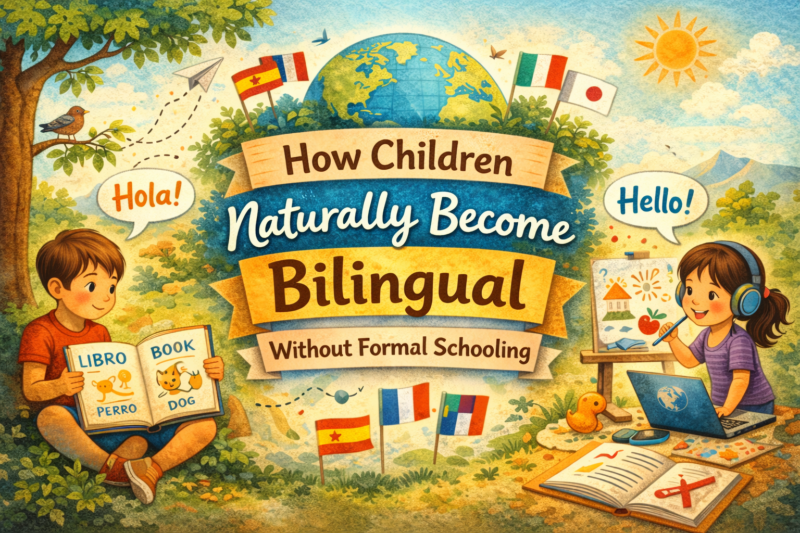
How Children Naturally Become Bilingual Without Formal Schooling
TLDR
- Children become bilingual through natural exposure and interaction, not formal lessons
- The amount and consistency of language input shape each language’s development
- Bilingual children may lag in individual language measures but develop total language knowledge similarly to monolinguals
- Social and emotional contexts help languages become meaningful, not just heard
- Early dual exposure enhances phonological discrimination and later language abilities
You may have met families who live abroad and suddenly their child is speaking two languages without ever attending formal school. It almost looks like magic – one day they’re babbling in one language, and months later they’re switching between two in quick conversation.
What’s going on under the surface is less mystery and more biology, environment, and daily connection. Kids don’t need classrooms to become bilingual if the conditions around them already include meaningful use of more than one language.
The brain’s language learning design makes this possible, especially in early childhood.
Let’s explore how this happens naturally, in ways you can recognize, support, and feel confident about as a parent.
Language Input Shapes Development
The most consistent finding in research on bilingual children is that the quantity and quality of language exposure matter for how well they develop each language.
Children who hear one language more often tend to build stronger skills in that language. But that doesn’t mean they lose the other; it just reflects differences in exposure levels.
One large review of bilingual development found that relative exposure predicts children’s vocabulary sizes and grammatical skills in each language.
For example, a child who hears more Spanish than English will show stronger expressive vocabulary in Spanish than English.
This might sound intuitive, but it’s important because it means bilingual acquisition isn’t about “switching languages on and off.”
It’s about consistent use over time in different contexts that make sense to the child – home, play, family conversations, community interactions, and emotional communication.
The Brain Is Designed to Absorb Language
From birth, children are equipped with remarkable capacity to pick up sounds and patterns from their environment. In the earliest years, infants are sensitive to a wide range of phonetic sounds from any language.
Over time, with repeated exposure, they tune into those patterns more firmly. This neural adaptation is strongest early in life and becomes less flexible with age.
This is why infants can hear subtle distinctions in sounds that adults often miss, and why early dual language exposure can set the stage for native-like pronunciation and grammar in both languages.
Importantly, this natural learning process is not an active study effort from the child. They are simply living and interacting. The meaning of language use – play, requests, emotions, routine actions – makes language acquisition intuitive rather than instructional.
Bilingual Growth Is Distributed, Not Deficient
When we measure bilingual children’s abilities in each language separately, it’s common to see what looks like a “delay” compared to monolingual peers. For instance, they might have a smaller vocabulary in one language at a given age.
But when researchers add together knowledge across both languages, bilingual children’s total language knowledge often equals or surpasses that of monolingual children.
This reflects the fact that bilingual input is distributed across two systems. A child might know words for social routines in one language and school-related vocabulary in another. Their combined communicative ability is robust – it’s just parceled differently.
This pattern also builds an intuitive understanding of language structure. Bilingual children often show balanced development in grammar and syntax even if their vocabulary in each language isn’t identical to monolingual norms.
Social Interaction Works Better Than Formal Instruction
Children learn language not by memorizing vocabulary lists, but through social interaction. When they negotiate play, comfort a friend, express needs, or tell a story, they use language in ways that matter.
Those real-world conversational contexts are what drive natural bilingual development.
This principle is why some children acquire two languages without formal schooling: their daily routines include people who speak different languages. Neighbors, grandparents, playmates, and caregivers become a child’s first and most powerful teachers.
In environments where two languages are genuinely needed – for play, participation, identity – kids adapt naturally. They aren’t practicing language – they’re using it.
Sensitive Periods and Early Competence
Research indicates that early exposure to multiple languages during infancy and early childhood supports phonetic sensitivity and helps children distinguish sounds across languages. This makes later language learning easier and more flexible.
Children who grow up hearing two languages from a young age often outperform monolingual children on certain cognitive tasks, such as switching language systems or managing attention between tasks.
This doesn’t mean they are automatically better at all tasks, but their brains become trained through consistent experience managing multiple linguistic systems.
Remember this: the advantage isn’t magical. It comes from the experience of switching between systems, making choices about which language to use, and regular exposure to both sets of rules and sounds.
Why Bilingual Children May Temporarily Mix Languages
Bilingual children often mix languages in the same sentence, especially early in development. Rather than confusion, this reflects efficiency. They pull the word from whichever language is stronger for that moment, especially if a concept wasn’t encountered in the other language yet.
This mixing typically decreases naturally as vocabulary in both languages grows. It’s not a sign of being hindered or confused – it’s a normal part of bilingual language organization.
In this context, bilingual acquisition is not a matter of juggling two separate systems cleanly. It’s more like weaving two strands into a functional communication network.
The Role of Family and Environment
Consistent exposure, meaningful use, and emotional connection matter more than structured schooling. Families that naturally use more than one language give children daily opportunities that school settings try to create artificially.
Things that help include:
- Regular conversation at home, not just routines but storytelling and dialogue
- Interaction with peers in different languages
- Media and play that involve both languages, without pressure
- Travel or cultural immersion experiences when available
Children aren’t “learning” languages in the classroom sense. They are integrating them into their lived experience.
Literacy and Speaking Are Distinct
One important fact for expat families: spoken fluency and literacy are not the same thing. Children often acquire spoken language naturally through interaction, but reading and writing require exposure to print and deliberate practice.
This means that even though a child can speak two languages easily, they might still need support with literacy in both if you want reading and writing skills to develop broadly.
This doesn’t contradict natural bilingual acquisition – it just reflects the difference between language instinct and a cultural skill.
Real-Life Patterns of Bilingual Development
Across many bilingual communities, researchers observe similar patterns:
- Bilingual children build vocabulary at rates similar to monolingual peers once combined across languages
- Children show stronger skills in the language with more frequent exposure
- Consistent dual exposure builds both expressive and receptive abilities over time
- Social and emotional contexts make language memorable and functional
These patterns hold whether children are in schools abroad, at home with caregivers, or interacting in community settings. The key variable is not formal instruction. It’s meaningful exposure coupled with social use.
My Own Experience
I remember a family friend whose child moved with them to a new country. At first, the child barely spoke the community language. Six months in, he was chatting with neighbors and asking for snacks in perfect local phrases.
There were no textbooks. No formal lessons. It was simple immersion – daily, social, needed.
That moment reminded me of what researchers mean when they say children’s capacity for language is fundamentally tied to use, not practice.
Conclusion
Children become bilingual without formal schooling when their environment supports two languages in meaningful ways. It’s not the classroom that matters most – it’s conversation, connection, necessity, and consistency.
Language becomes part of their identity, not a subject to pass. When kids hear both languages regularly and use them socially, the brain organizes both systems naturally.
So if you’re living abroad and wondering how your child might speak more than one language without structured lessons, take heart: many have done it before, and science shows it’s possible – not by accident, but because the conditions align for natural learning.
Blog
-
Preventing Burnout While Raising Kids Abroad
Preventing burnout while raising kids abroad is about managing your responsibilities as an expat dad.
-

Managing Work, Parenting, and Travel as an Expat Dad
Living abroad with your family feels like you’re juggling three full-time roles at once.
