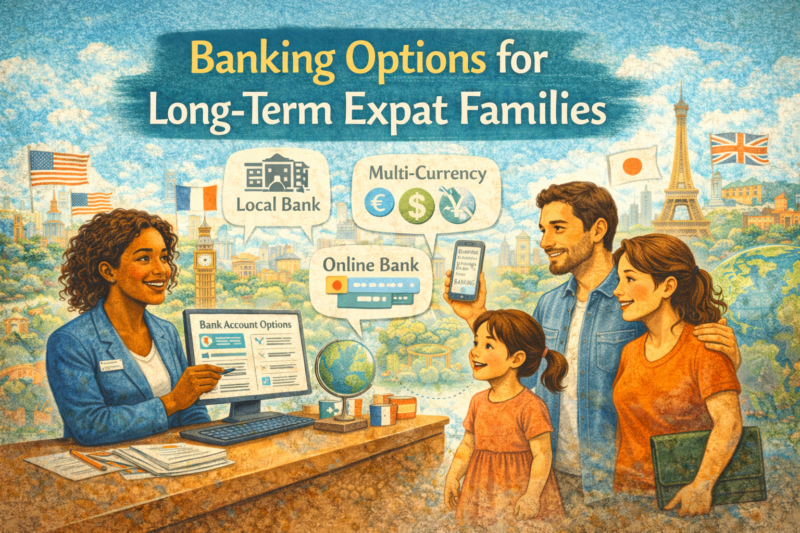
Banking Options for Long-Term Expat Families
TLDR
- Long-term expat families typically maintain a mix of local bank accounts, home-country accounts, and international or multi-currency solutions.
- Banking access depends heavily on tax residency, legal residency status, and regulatory compliance requirements.
- International reporting frameworks require banks to collect and share certain tax information across borders.
- Multi-currency accounts reduce conversion costs and help manage exchange rate exposure.
- Stability comes from building a layered banking structure that can survive future relocations.
When you move abroad alone, banking is a practical task. When you move abroad with a spouse and children, it becomes infrastructure.
School fees. Rent deposits. Immigration renewals. Insurance premiums. Cross-border transfers to grandparents. All of it flows through your banking system. If that system is fragile, your life feels fragile.
Long-term expat families quickly learn that banking is not about finding the “best” account. It’s about building a structure that works across countries, currencies, and compliance regimes.
Let’s look at what that actually means.
Understanding the Regulatory Landscape
Banking abroad is shaped by international compliance rules.
Over the past decade, automatic exchange of financial account information has become standard among many countries. Banks are required to identify customers’ tax residency and may share account information with relevant tax authorities under international agreements.
If you open an account in a country where you are resident, the bank will typically request tax identification numbers and may ask about additional tax residencies. This is not personal. It’s regulatory.
For U.S. citizens, additional global reporting obligations exist regardless of residence. Other countries determine tax obligations based primarily on residency status, which is much more logical than the ridiculous US tax system.
What matters for you is clarity. Know your tax residency. Provide accurate information. Keep your records organized.
Banks are stricter than they were twenty years ago. That’s reality. Working within the system is easier than trying to avoid it.
The Local Bank Account: Your Operational Base
If you live long term in Latin America or Asia, you will likely need a local bank account.
Landlords, utility providers, schools, and government offices often expect local transfers. In some countries, digital payment systems are tied directly to domestic bank accounts. Payroll deposits also typically require local accounts.
Opening requirements vary by country. Legal residency documentation, proof of address, and local tax identification numbers are common prerequisites.
From experience, this is the account that makes daily life smooth. It’s where your rent flows from, where tuition is paid, where grocery expenses land.
It’s not necessarily where you hold large long-term savings. It’s your operating engine.
Maintaining a Home-Country Account
Many long-term expat families keep at least one bank account in their country of citizenship or previous residence.
There are practical reasons for this. Certain investment accounts may require a domestic bank link. Pension payments or tax refunds may only be deposited locally. Credit history is often tied to domestic accounts.
However, some banks restrict services if you no longer reside in the country. Policies vary significantly. In some cases, you must update your address to your foreign residence. In others, non-resident status can limit product access.
The key is transparency. If you maintain an account, keep your contact details current and comply with any residency declarations required by the bank.
A stable home-country account adds flexibility, especially if you later return or relocate again.
International and Multi-Currency Accounts
This is where long-term planning gets interesting.
International banks and certain financial institutions offer multi-currency accounts that allow you to hold balances in several major currencies within one structure. These accounts are often designed for globally mobile clients.
The advantage is practical. You can receive income in one currency, hold it without immediate conversion, and exchange when rates are favorable or when you need liquidity in another currency.
Exchange rate movements affect real purchasing power. If you earn in U.S. dollars but spend in Thai baht or Mexican pesos, currency fluctuations matter. A multi-currency setup allows you to manage timing and reduce repeated conversion fees.
It does not eliminate currency risk. But it gives you control.
In our own case, having access to more than one currency inside a single account simplified tuition payments and international transfers considerably. It removed the friction of constant conversions.
Digital Banks and Fintech Platforms
Over the past decade, digital-first banking platforms have expanded internationally. Many provide app-based accounts, debit cards, and low-cost currency exchange features.
Availability depends on your country of residence and regulatory eligibility. In some regions, these platforms operate as fully licensed banks. In others, they partner with local institutions.
For expat families, these tools can reduce transfer costs and simplify budgeting across currencies. However, they should be evaluated carefully. Deposit protection schemes vary by jurisdiction, and account limits may apply.
Digital platforms are excellent for flexibility and short-term liquidity. For large long-term reserves, families often prefer institutions with established regulatory oversight in stable financial centers.
Balance innovation with prudence.
Deposit Insurance and Safety
When choosing a bank, understanding deposit protection matters.
Many countries operate deposit insurance schemes that protect customer funds up to a specified limit if a bank fails. The coverage amount differs by jurisdiction and may apply per depositor, per bank.
If you hold significant savings, spreading funds across institutions can keep balances within insured limits. This is not about fear. It’s about structured risk management.
Banking systems in many Latin American and Asian countries are well regulated and stable, but protections vary. Always confirm what applies where you reside.
Families planning for long-term financial independence treat this detail seriously.
Managing Transfers Across Borders
Cross-border transfers are routine for expat families.
School fees in one country. Mortgage payments in another. Support for aging parents elsewhere. International transfers come with fees and exchange rate margins that can accumulate over time.
Comparing costs between traditional banks and digital platforms is worthwhile. Even small percentage differences compound when repeated monthly or quarterly.
Some families maintain accounts in two major financial centers specifically to reduce intermediary banking fees. Others use specialized transfer services for recurring payments.
The system you build should minimize friction and cost while remaining compliant.
Joint Accounts and Family Structure
Banking structures should reflect your family structure.
In some countries, opening joint accounts is straightforward. In others, documentation requirements can be more involved. If one spouse is not a citizen or permanent resident, additional paperwork may apply.
For long-term stability, ensure both partners have access to essential accounts. Emergencies do not wait for signature formalities.
In our household, we made it a priority that both parents could operate local and international accounts independently if needed. It’s one of those decisions you hope you never need, but you’re glad you made.
Planning for Future Relocations
If you expect to relocate again, portability becomes critical.
Accounts that rely heavily on local residency status may become inconvenient if you move. International banks with a global presence can ease transitions, but they are not always necessary.
The important question is this: If you change countries in two years, will your core banking structure survive?
Families focused on long-term independence design banking layers:
- A local operational account.
- A stable home-country or international reserve account.
- A flexible multi-currency or transfer solution.
This layered approach reduces disruption when borders shift.
Teaching Financial Awareness Through Structure
One unexpected upside of international banking is the opportunity to teach your children practical financial literacy.
They see different currencies. They observe exchange rates changing. They learn that financial systems vary by country.
Instead of abstract lessons about money, they watch you compare fees, manage transfers, and plan for long-term stability. It becomes part of the family narrative.
For fathers building intentional family systems abroad, that’s powerful.
Conclusion: Build for Stability, Not Convenience
Banking options for long-term expat families are not about finding a perfect institution. They are about designing a resilient structure.
You need operational efficiency locally. You need regulatory compliance across borders. You need currency flexibility. And you need contingency planning for future moves.
When those pieces are in place, banking fades into the background. Life becomes simpler. Decisions feel grounded.
Living abroad with a family should feel intentional, not improvised. A thoughtful banking framework is one of the quiet foundations that makes that possible.
Get the structure right, and everything else becomes easier to manage.