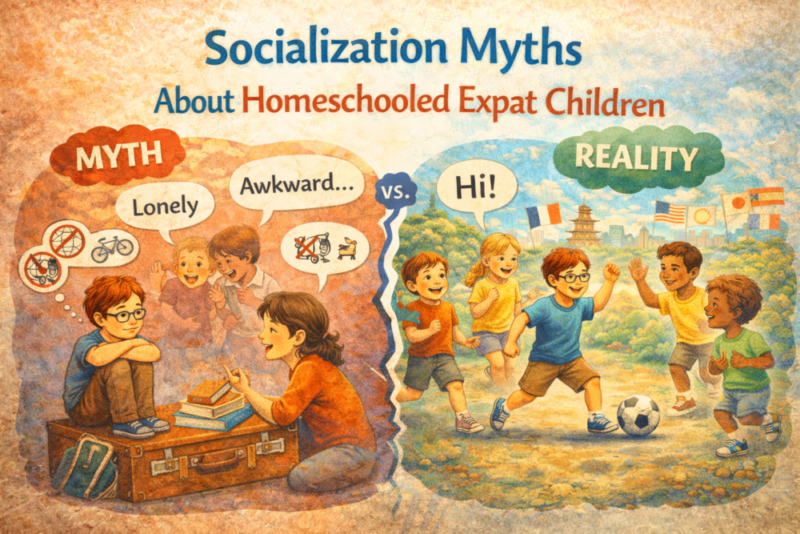
Socialization Myths About Homeschooled Expat Children
TLDR
- The idea that homeschooled children lack social skills is widely challenged by research
- Many studies find homeschooled kids perform as well as, or better than, schooled peers in social and emotional development
- Homeschoolers often socialize in diverse, multi-age settings, not just same-age classrooms
- Some limitations can arise when social opportunities are scarce – but these aren’t inherent to homeschooling itself
- Intentional social planning – activities, clubs, community groups – supports well-rounded social growth
As fathers raising families outside our home country, especially in Latin America and Asia, we’ve all heard the old chestnut: “But what about socialization?” When families first consider homeschooling, that question often tops the list of concerns, especially when we’re doing life away from familiar communities.
It’s a question rooted in assumptions about traditional schooling environments – that kids need to be packed into classrooms with dozens of peers every day to build social skills. But the research tells a more nuanced story.
And when you’re living abroad, the social world your kids navigate looks very different from a neighborhood schoolyard.
Let’s take an honest, practical look at the most common socialization myths about homeschooled children, especially in expat contexts, and what current research and real experience actually show.
Myth 1: Homeschooled Kids Don’t Interact Enough With Peers
Critics often imagine homeschooled children stuck at home, isolated from other kids. But that’s not how most families operate today. In studies that survey homeschool families, very few parents report a lack of social opportunities for their children.
In fact, homeschooled children regularly participate in structured group activities like co-ops, sports teams, church groups, arts programs, camps, field trips, and community classes. In many cases, these interactions involve mixed ages and contexts beyond the typical school environment.
Parents also intentionally seek out playdates, PE classes, and group learning experiences to complement academic work at home.
That means kids aren’t just meeting the same-age group every day – they’re interacting with people of different ages, backgrounds, and interests, which actually broadens their social experience compared to a traditional age-segregated cohort.
Myth 2: Homeschoolers Are Socially Awkward
Another common belief is that children who aren’t in a traditional school environment develop awkward or insufficient social skills. Yet research consistently debunks this.
Assessments that measure social behaviors have found homeschooled children performing as well as or better than traditionally schooled peers on indicators like cooperation, communication, leadership, empathy, and daily social competence.
Some studies even show lower rates of behavioral problems among homeschooled children compared to their classroom-educated counterparts.
These outcomes likely reflect the variety of real-world social contexts homeschoolers experience – interacting not just with same-age peers, but with adults, younger children, community members, and in activities where social roles are more varied.
Myth 3: Homeschoolers Miss Out on Teamwork and Collaboration
Schoolyard group projects and team sports are often held up as essential social experiences. But homeschoolers can and do develop teamwork and collaboration skills – usually through extracurricular and community involvement rather than mandatory classroom assignments.
Homeschool co-ops frequently involve collaborative projects, shared learning experiences, and group problem-solving – sometimes across different ages. Community groups like scouts, music ensembles, sports clubs, and service organizations also provide structured teamwork environments.
The difference is that homeschoolers often choose these interactions intentionally and align them with their interests. That leads to deeper engagement, because children participate in teams they genuinely enjoy and choose – not just the teams assigned to them by a school schedule.
Myth 4: Homeschool Kids Are Lonely and Isolated
Loneliness is sometimes cited as a risk for homeschooled children, but loneliness is a function of social quality, not educational setting. Research shows homeschooled children are less likely to exhibit social isolation when parents actively facilitate varied social contexts.
In fact, many homeschool families find their children form deeper, more meaningful friendships because social experiences are chosen rather than enforced.
Playdates, co-ops, community activities, and shared-interest groups often create lasting social bonds that go beyond superficial classroom friendships.
Of course, if a family lives in a rural area with few activities available, intentional effort is required to create those connections. But the issue isn’t homeschooling per se – it’s access to community resources and consistent opportunities for interaction.
Myth 5: Homeschoolers Struggle to Adjust in College or Work
Another fear is that homeschooled children won’t fit in when they face large groups, like in college lecture halls or workplaces. But evidence suggests many homeschooled students transition successfully into higher education and professional environments.
They often demonstrate initiative, adaptability, confidence, and persistence – traits nurtured by diverse social experiences outside traditional school settings.
Homeschooled graduates are frequently active in campus life, join clubs, and form friendships just like their peers. Their early social experiences in varied contexts, from volunteering to community engagement, prepare them to navigate social environments that rely less on age-based grouping and more on shared purpose.
Myth 6: Only Traditional School Provides “Real” Socialization
The idea that only a traditional classroom can produce social skills overlooks the many ways humans learn to interact. Socialization has less to do with being around people and more with engaging meaningfully with them.
Children raised at home often interact with neighbors, adults, younger siblings, mentors, and kids from diverse age groups. These interactions require empathy, negotiation, leadership, emotional regulation, cooperation, and conflict resolution – all key social skills that schools assume children will develop by default.
Research highlights that homeschooled children are not missing socialization – they’re just experiencing it in different, often richer, contexts that mirror real life more closely than a same-age classroom.
The Role of Parent Intention
Here’s the catch: socialization in homeschooling is not accidental. It requires intention. Parents who assume isolation will happen by default are more likely to see gaps. Parents who intentionally plan social opportunities create environments where children interact regularly and meaningfully.
This looks like:
- Joining extracurricular activities that align with a child’s interests
- Scheduling regular co-op groups or study classes
- Participating in athletic programs, scouts, or community service
- Encouraging friendships with neighborhood kids
- Involving children in family community events
These opportunities provide a breadth of interaction that traditional schools rarely offer. They also let kids build confidence across age groups and social settings.
The Expat Twist
For homeschooling expat families, the social landscape is uniquely varied. Because you’re often outside your passport culture, your children interact with diverse ethnicities, languages, and worldviews daily.
They learn to navigate intercultural communication more naturally than in a uniform local school environment.
Your children’s socialization isn’t just about quantity of peer interaction – it’s about quality of relationship across cultures, age groups, and life experiences. That richness builds adaptability, cross-cultural understanding, and comfort in diverse settings – valuable social skills in a globalized world.
Conclusion
The myth that homeschooled children lack socialization doesn’t hold up under scrutiny. Research – from multiple perspectives – shows homeschooled children tend to develop social skills at least on par with their traditionally schooled peers, and in some areas – like leadership, adaptability, and empathy – they may excel.
Social development isn’t automatic anywhere. Leaving children in a classroom doesn’t guarantee strong social skills any more than schooling them at home does. What matters is the richness of interaction, intentional opportunities for engagement, and meaningful relationships.
When families abroad embrace intentional social experiences – in co-ops, community groups, clubs, mixed-age activities, and real-world interactions – children build the kinds of social competence that serve them well into adulthood.
Socialization isn’t a myth. But the fear that homeschooling inherently deprives children of it? That’s the real myth we can leave behind.
Blog
-
Preventing Burnout While Raising Kids Abroad
Preventing burnout while raising kids abroad is about managing your responsibilities as an expat dad.
-

Managing Work, Parenting, and Travel as an Expat Dad
Living abroad with your family feels like you’re juggling three full-time roles at once.
