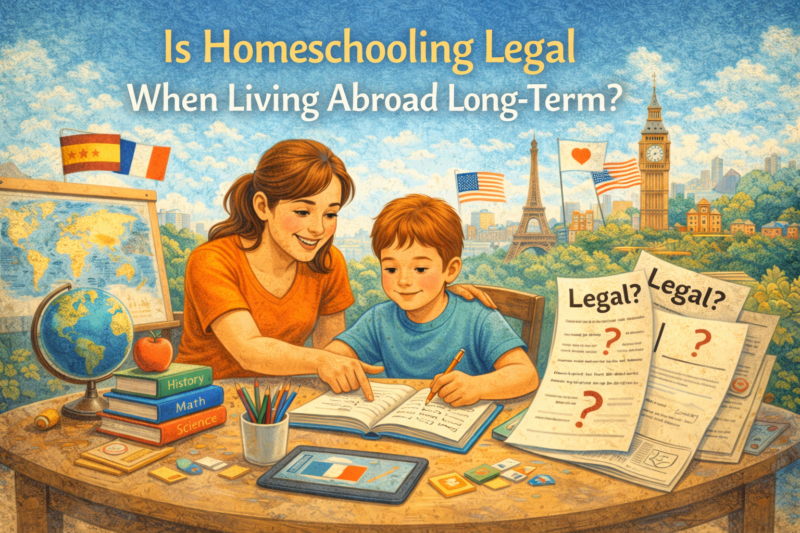
Is Homeschooling Legal When Living Abroad Long Term?
TLDR
- Homeschooling legality abroad depends primarily on the laws of your country of residence, not just your passport country
- Some countries fully permit homeschooling, others regulate it strictly, and a few prohibit it entirely
- Expat families must also consider visa status, local compulsory education laws, and reporting requirements
- Enrolling in accredited distance education programs can simplify compliance in stricter jurisdictions
- Long term success requires proactive research, documentation, and ongoing legal awareness
If you are raising your family overseas and considering homeschooling, this question surfaces quickly.
Is it actually legal to homeschool while living abroad long term?
The short answer is yes in many places, no in some, and complicated in others. The longer answer requires understanding how education law works internationally and how it applies to expatriate families.
Let’s break it down clearly and practically.
The Law of the Land Usually Applies
When you live abroad, you are generally subject to the education laws of your country of residence. Compulsory education statutes typically apply to all children residing in the country, regardless of nationality.
That means your passport does not automatically determine whether you can homeschool. If you are living long term in another country, local regulations usually govern your child’s educational obligations.
This is where many expat families get surprised.
They assume that because homeschooling is legal in their home country, they can continue the same arrangement overseas. In reality, legal permission depends on the host country’s framework.
Countries Where Homeschooling Is Permitted
Many countries allow homeschooling under varying levels of regulation.
In the United States, homeschooling is legal in all states, though requirements differ by state. Canada also permits homeschooling nationwide, with provincial oversight. The United Kingdom allows home education in England, Wales, and Northern Ireland, provided parents ensure a suitable education. Australia permits homeschooling with state registration and compliance.
Several Latin American countries, including Mexico, recognize distance education and alternative schooling pathways under certain conditions. Some families use accredited online schools to satisfy requirements.
In these jurisdictions, homeschooling is possible but often requires registration, documentation, or periodic assessments.
Permission does not mean absence of oversight.
Countries With Strict Regulation
Some European countries regulate homeschooling heavily.
Germany is widely known for enforcing compulsory school attendance, and homeschooling is generally not permitted except in rare circumstances. Sweden significantly restricted homeschooling in recent years, requiring extraordinary justification. Other countries may allow homeschooling only under medical or exceptional conditions.
In such places, long term residence while homeschooling can create legal conflict.
Expat families in these regions sometimes enroll in recognized distance schools, international schools, or relocate to jurisdictions with more flexible frameworks.
The key point is that legal feasibility varies sharply by country.
Visa Status Matters
Your immigration status can also influence educational requirements.
If you are on a temporary work visa, a digital nomad visa, or permanent residency, local authorities may expect proof of compliance with compulsory education laws. During visa renewals, authorities can request school enrollment documentation.
In some cases, enrollment in an accredited foreign online school satisfies local requirements. In others, authorities require attendance at locally recognized institutions.
This is not theoretical. Families have faced administrative complications for failing to align educational choices with visa conditions.
When in doubt, consult official government education and immigration departments.
Dual Obligations: Host Country and Passport Country
Most countries do not regulate how their citizens educate children while living permanently abroad. However, some nations require documentation for future reintegration into the national school system.
For example, if you plan to return to your passport country, your child may need transcripts, grade level documentation, or recognized qualifications to reenter public education.
In practice, this means maintaining detailed records regardless of current location.
Even when the host country has minimal oversight, future transitions may depend on what you can prove academically.
Distance Learning as a Legal Bridge
Many expat families use accredited online schools as a practical solution.
Distance education programs accredited in recognized jurisdictions can provide structured curricula, official transcripts, and diplomas. In some countries, enrollment in such programs satisfies compulsory education requirements.
However, accreditation does not automatically override local law. Some countries require physical school attendance regardless of online enrollment.
It is important to verify whether distance schooling is recognized by local education authorities.
Documentation is your strongest ally here.
Age Requirements and Compulsory Education
Compulsory education age ranges vary internationally. In some countries, formal education is required starting at age five or six. In others, compulsory schooling begins later.
If your child is below compulsory age, homeschooling legality may not yet be relevant. Once compulsory age begins, compliance requirements activate.
Additionally, some countries mandate schooling until age sixteen, others until eighteen. These distinctions affect long term planning, especially for secondary education.
Understanding the local age framework prevents accidental noncompliance.
Practical Steps Before You Decide
If you are considering long term homeschooling abroad, start with official sources.
Review the host country’s ministry of education guidelines. Confirm whether homeschooling is permitted, regulated, or restricted. Identify registration processes and reporting obligations.
Then review immigration requirements tied to your visa status. Ask whether proof of school enrollment is required.
Finally, document everything. Keep course descriptions, attendance records, reading lists, and assessment results. Even if local law is flexible, future transitions may require evidence.
Legal clarity reduces stress.
A Personal Observation From Abroad
In our own experience living overseas, the legal question often feels intimidating at first.
But once you separate emotion from administration, it becomes manageable. Most complications arise not from prohibition but from misunderstanding.
Families who proactively communicate with local authorities, keep organized records, and remain transparent rarely encounter serious problems.
Avoiding assumptions is critical.
Planning for the Long Term
If you intend to live abroad for several years as an expat dad, think beyond immediate legality.
Consider how your educational choices align with future university plans, professional credentials, and potential relocation. Secondary education documentation becomes especially important in teenage years.
If homeschooling is permitted but loosely regulated, maintain structure anyway. A casual approach might satisfy local law but complicate higher education applications later.
Legal compliance is the floor. Strategic planning is the ceiling.
When Relocation Becomes the Solution
In rare cases, families strongly committed to homeschooling choose to relocate to countries where it is clearly legal and regulated rather than prohibited.
This is a serious decision. Education philosophy becomes part of geographic strategy.
While not common, it illustrates an important reality. Educational freedom varies globally. Your family priorities may influence where you plant roots.
Mobility gives you options, but options require informed decisions.
Conclusion
So is homeschooling legal when living abroad long term?
In many countries, yes. In some, with regulation. In a few, no.
The determining factor is almost always the law of your country of residence, not your passport. Visa requirements, compulsory education statutes, and local enforcement practices all matter.
The solution is not guesswork. It is research, documentation, and forward planning.
When handled carefully, homeschooling abroad can operate fully within legal frameworks while providing flexibility, cultural immersion, and academic continuity.
Living internationally already demands initiative. Applying that same initiative to education law ensures your family builds freedom on solid ground.
Blog
-
Preventing Burnout While Raising Kids Abroad
Preventing burnout while raising kids abroad is about managing your responsibilities as an expat dad.
-
Managing Work, Parenting, and Travel as an Expat Dad
Living abroad with your family feels like you’re juggling three full-time roles at once.
