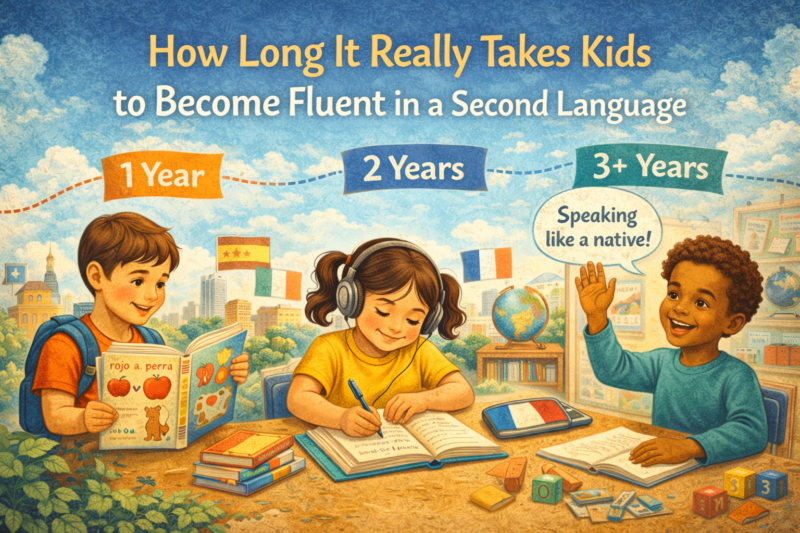
How Long It Really Takes Kids to Become Fluent in a Second Language
TLDR
- Conversational fluency in a second language often develops within 1–3 years of consistent exposure
- Academic language proficiency typically takes 5–7 years or more
- Age, exposure intensity, literacy, and emotional context strongly influence speed of acquisition
- Early immersion supports pronunciation and intuitive grammar development
- Fluency is not a single milestone but a gradual progression across speaking, comprehension, reading, and writing
If you’ve moved abroad with kids, you’ve probably asked yourself some version of this question:
How long until they’re fluent?
You hear stories of children speaking confidently within months. Then you meet families who’ve lived overseas for years and still struggle with the local language at home. The timelines feel inconsistent.
That’s because “fluency” isn’t one thing. And it doesn’t develop on a single clock.
Let’s unpack what research actually tells us about how long second-language development takes – and what that means for your family abroad.
First, Define What You Mean by Fluent
Most parents picture fluency as effortless conversation.
A child chatting on the playground. Ordering food. Joking with friends. That type of social language tends to develop relatively quickly when exposure is strong and daily.
But there’s another layer: academic language.
Understanding textbooks. Writing essays. Grasping abstract vocabulary. This level of proficiency develops more slowly and requires structured exposure and literacy.
Educational research consistently distinguishes between conversational fluency and academic language proficiency. The two develop on different timelines.
If you don’t separate them, expectations become unrealistic.
Conversational Fluency: Often 1 to 3 Years
Children immersed in a second language environment typically begin communicating socially within the first year.
In school settings with daily exposure, many children develop basic conversational competence in about one to three years. This includes understanding peers, participating in play, and handling everyday tasks.
The exact timeline depends heavily on input. A child hearing the second language for six hours a day in meaningful social contexts progresses faster than one hearing it occasionally.
The key factor is interaction, not passive listening.
Frequent, responsive conversations accelerate progress significantly.
Academic Proficiency: Often 5 to 7 Years or More
This is the part parents rarely anticipate.
While social communication may look fluent quickly, research in second-language education consistently shows that full academic proficiency often takes five to seven years – sometimes longer.
Academic language includes advanced vocabulary, complex grammar structures, and discipline-specific terminology. It develops through reading, writing, and classroom instruction.
A child who sounds fluent in casual conversation may still struggle with essays or abstract explanations.
This gap is normal. It doesn’t indicate failure.
It reflects the cognitive complexity of academic language.
Age Matters – But Not the Way You Think
Younger children often develop native-like pronunciation more easily. Early exposure supports phonological sensitivity, which helps them reproduce subtle sounds accurately.
However, older children sometimes progress faster initially because they already understand how language works. They can transfer literacy skills and grammatical awareness from their first language.
So who learns faster?
In the short term, older children may appear to advance quickly in structured settings. In the long term, younger children often achieve more native-like overall proficiency, especially in accent and intuitive grammar.
Both patterns are well documented.
Age influences how fluency develops, not whether it’s possible.
The Silent Period Is Real
Many children go through a phase where they understand much more than they speak.
This “silent period” can last weeks or several months. During this time, the brain is mapping patterns, absorbing vocabulary, and processing structure.
Parents sometimes worry that progress has stalled. In reality, comprehension usually expands rapidly during this stage.
When speaking begins, it often accelerates quickly because the internal groundwork is already laid.
Silence does not equal stagnation.
Exposure Intensity Changes Everything
The amount and quality of exposure dramatically shape timelines.
Daily immersion in school plus community interaction leads to faster development than limited exposure at home only.
Children need meaningful input. That means conversation directed at them, not just overheard language. Interactive engagement matters far more than background media.
Research in child language development consistently highlights the importance of responsive communication – the back-and-forth exchanges that build vocabulary and grammar naturally.
If you want faster progress, increase meaningful interaction.
Emotional Context Accelerates Retention
Language tied to belonging sticks.
When children need the second language to make friends, play games, or navigate daily life independently, motivation increases. Emotional relevance strengthens memory encoding and retrieval.
Conversely, if a language is associated only with correction or pressure, resistance may slow active use.
Fluency grows faster in environments where language serves real social purposes.
This is why playground immersion often outperforms formal lessons alone.
Literacy Makes a Big Difference
Spoken fluency can develop without reading. Academic fluency cannot.
Children who begin reading in their second language build vocabulary depth more efficiently. Literacy exposure reinforces grammar patterns and expands expressive capacity.
If your child attends school in the second language, literacy development is usually integrated.
If not, you may need to support reading deliberately.
Without literacy, fluency may plateau at conversational level.
Individual Differences Are Normal
Not all children follow identical timelines.
Temperament plays a role. Outgoing children may speak sooner. Cautious children may observe longer before producing language.
Prior experience matters too. Children already bilingual often acquire additional languages more efficiently because they are accustomed to managing multiple linguistic systems.
Family expectations also influence perception. Some parents define fluency as perfect grammar. Others define it as confident communication.
Be clear about your definition before measuring progress.
What Slows Progress
Certain factors can extend timelines:
- Limited exposure hours
- Inconsistent language use at home
- Frequent switching that reduces structured input
- High anxiety around mistakes
- Minimal peer interaction
None of these make fluency impossible. They simply reduce exposure density or emotional safety.
Adjust the environment, and timelines often improve.
A Realistic Expectation Framework
If your child is immersed daily in a second language environment:
- Expect comprehension growth within months
- Expect social communication within 1–3 years
- Expect academic proficiency to require 5–7 years or longer
If exposure is moderate rather than immersive, extend those timelines proportionally.
Language development is cumulative. It builds through thousands of interactions, not milestones.
My Observation Living Abroad
When families move overseas, the first year often feels slow and a challenge. Parents worry.
By year two, casual conversation flows easily. Parents relax.
By year five, academic language solidifies – and suddenly the child is correcting the parent’s grammar.
The process rarely feels dramatic while it’s happening. It unfolds quietly through daily routines.
The key is patience matched with consistent exposure.
Fluency Is a Continuum, Not a Finish Line
There isn’t a moment when a child suddenly becomes “fluent.”
Instead, fluency deepens gradually:
- Basic comprehension
- Social communication
- Complex conversation
- Academic reasoning
- Professional-level vocabulary
Each layer builds on the previous one.
If you view fluency as a long-term developmental arc rather than a deadline, the process feels far less stressful.
Conclusion
So how long does it really take?
Conversational fluency often emerges within one to three years of strong immersion. Academic fluency typically requires five to seven years or more.
Those timelines reflect cognitive reality, not failure or delay.
Children’s brains are remarkably adaptable. With consistent exposure, meaningful interaction, and literacy support, second-language fluency develops steadily over time.
Your role as an expat father is not to rush the process.
It’s to create the environment where it can unfold.
And if you’re building that environment intentionally abroad, you’re already ahead of the curve.
Blog
-
Preventing Burnout While Raising Kids Abroad
Preventing burnout while raising kids abroad is about managing your responsibilities as an expat dad.
-
Managing Work, Parenting, and Travel as an Expat Dad
Living abroad with your family feels like you’re juggling three full-time roles at once.
