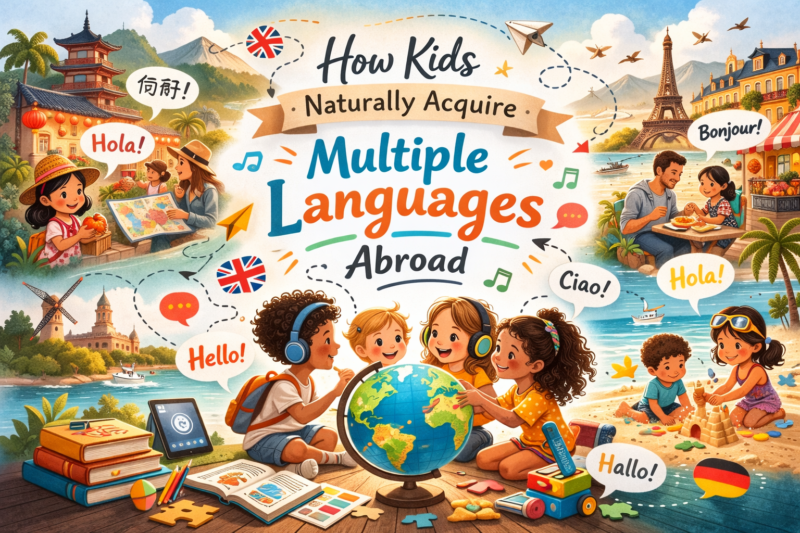
How Kids Naturally Acquire Multiple Languages Abroad
TLDR
- Kids abroad learn multiple languages mostly through daily life, not lessons
- Mixing languages early is normal and not a sign of confusion
- Social interaction drives fluency faster than classroom instruction
- Parents influence success more through habits than teaching
- Literacy develops separately from speaking and needs intentional support
One of the quiet surprises of raising children overseas is how little effort language learning actually requires from the child.
You move countries thinking you’ll need tutors, flashcards, maybe a color-coded grammar system on the fridge. Instead, six months later your four-year-old is negotiating toy trades in a language you barely understand.
It doesn’t feel like learning. Because to them, it isn’t.
Children don’t approach language as a subject. They approach it as survival, play, belonging, and status. That difference changes everything.
Let’s walk through what’s really happening under the hood when kids grow up multilingual outside their home country, and what parents actually need to do (and just as importantly, not do).
Immersion Isn’t a Teaching Method – It’s a Social Environment
Adults study languages. Children join groups.
A child on a playground is not memorizing vocabulary. He’s trying to avoid being left out of a game. That urgency activates the brain far more intensely than structured instruction ever could.
Researchers in child development consistently observe that young children acquire language fastest when communication has immediate social value. Ordering food with you doesn’t count. Convincing another kid to pass the ball does.
That’s why school matters less than environment.
You can put a child in an international school taught in English while living in Thailand, Mexico, or Poland, and they may barely learn the local language. But place them daily with neighborhood kids for two hours, and fluency accelerates quickly.
Language lives where relationships live.
The Brain Is Built for This (For a Limited Time)
Children aren’t smarter than adults at learning languages. Their brains are simply configured differently.
Early childhood brains process sounds before meaning. Adults reverse that process. We filter unfamiliar sounds out because we focus on comprehension first. Kids imitate sound patterns automatically.
This is why children often develop native pronunciation even when parents never do.
Organizations like UNESCO have repeatedly emphasized that early multilingual exposure strengthens cognitive flexibility, particularly in attention switching and problem solving. Not magically – structurally.
They’re not juggling languages consciously. Their brain is categorizing patterns.
After roughly puberty, the brain gradually loses this phonetic plasticity. You can still become fluent later in life, but accent-free pronunciation becomes far harder.
Kids don’t “study” pronunciation. They absorb it before they know they’re learning.
The Silent Period Freaks Parents Out (But It’s Normal)
Nearly every multilingual child goes through a stage where they stop talking in the new language – sometimes even stop speaking much at all.
Parents panic here.
But this stage is actually when learning accelerates most. The child is mapping grammar internally before risking social mistakes.
You’ll notice heavy observation. More listening than speaking. Sometimes weeks, sometimes months.
Then one day they start using full sentences.
No drills created that moment. Internal pattern recognition did.
Professionals cited by American Academy of Pediatrics regularly note that forcing output during this phase slows confidence and can delay spontaneous speaking. Kids talk when communication pressure becomes socially meaningful, not when adults prompt them.
Silence is processing, not failure.
Mixing Languages Is a Feature, Not a Problem
Parents often worry when children combine languages in one sentence.
“Water quiero please.”
This isn’t confusion. It’s efficiency.
The brain pulls the fastest accessible word regardless of language, especially before vocabulary depth balances out. Linguists call this code-switching, and multilingual communities worldwide do it naturally even as adults.
Over time, as vocabulary strengthens in each language, mixing decreases automatically. Not because parents corrected it, but because communication became smoother without it.
Correct gently if needed. Never panic.
Playground Beats Classroom Every Time
Here’s a slightly uncomfortable truth: language instruction helps adults more than children.
Children need exposure density, not explanations.
A child attending five hours of school in the local language but spending afternoons in English with you may remain weaker in the local language than a child attending two hours of mixed play daily with neighborhood kids.
Why? Emotional stakes.
Language tied to belonging wires deeper than language tied to performance.
I’ve watched kids ignore months of tutoring and then learn faster in two weeks after making a single close friend. Nothing else changed.
Language follows relationships.
Your Role Isn’t Teacher – It’s Architect
Parents rarely cause language learning. They create the conditions where it becomes unavoidable.
The most reliable pattern in multilingual families abroad looks like this:
- One language belongs to home
- One belongs to friends
- One belongs to school or media
You don’t need rigid rules. You need consistency.
Children naturally separate languages by context. When parents constantly switch languages randomly, kids struggle to map social boundaries. When contexts stay stable, separation happens automatically.
You are designing the ecosystem, not delivering the lessons.
Homeschooling Changes the Equation
Families outside traditional schooling often worry about language exposure.
Counterintuitively, homeschooled expat kids frequently become more multilingual because their daily routines include broader community interaction instead of same-age classroom bubbles.
Markets, neighbors, sports clubs, public transport, hobby groups – these environments contain mixed ages and natural conversation patterns.
Formal school compresses communication into academic language. Real life expands it into practical language.
Both matter, but only one produces street fluency.
Speaking and Reading Develop Separately
This catches many families off guard.
A child may sound native in a language but struggle to read or write it. That’s normal.
Speech acquisition happens unconsciously. Literacy requires instruction because writing systems are cultural inventions, not biological instincts.
Organizations like UNICEF highlight that multilingual children benefit from explicit reading exposure in each language they’re expected to write later.
If you want long-term academic competence, you must deliberately support literacy in at least one primary language. Spoken fluency alone doesn’t guarantee it.
Teenagers Don’t Lose Languages – They Prioritize Them
Families often fear that moving countries during adolescence will erase earlier languages.
It usually doesn’t.
What changes is usage frequency. The brain prunes rarely used vocabulary but keeps structural understanding. Reactivation tends to happen quickly when the language becomes socially relevant again.
You’ll see passive comprehension remain long after active speech fades.
Language isn’t deleted. It goes dormant.
Identity Matters More Than Grammar
Here’s the part no curriculum talks about.
Kids keep the language that connects to belonging.
If a language only exists in correction, homework, or pressure, it weakens. If it exists in friendships, jokes, secrets, and independence, it sticks.
I once spent months trying structured practice with my son’s second language. Minimal progress.
Then he joined a local football group.
Three weeks later he argued with the referee fluently. No lessons required.
Motivation beats methodology every time.
Practical Habits That Actually Work
Instead of teaching, adjust the environment:
- Create recurring social exposure
- Keep one stable home language
- Let media support weaker languages
- Avoid constant translation
- Encourage independent interactions
- Allow mistakes without fixing every sentence
Correct meaning only when misunderstanding matters. Overcorrection reduces risk-taking, and risk-taking drives fluency.
Common Mistakes Parents Make
The biggest obstacle to multilingual success is usually adult anxiety.
Frequent pitfalls:
- Switching languages mid-sentence constantly
- Demanding translation on command
- Forcing performance for relatives
- Comparing siblings’ timelines
- Treating language as schoolwork
Children don’t resist languages. They resist pressure.
Relaxed consistency outperforms enthusiastic control.
Conclusion
Kids growing up abroad aren’t doing something extraordinary. They’re doing what human brains evolved to do – adapt to their social environment.
Language learning feels effortless because for them it isn’t an academic task. It’s participation in life, not a challenge.
Your job isn’t to turn daily life into lessons. It’s to resist the urge to.
Provide relationships, routines, and patience. The languages tend to show up on their own schedule.
And occasionally, without warning, your child will translate a conversation for you.
That’s usually the moment parents realize the system was working the whole time.
Blog
-
Preventing Burnout While Raising Kids Abroad
Preventing burnout while raising kids abroad is about managing your responsibilities as an expat dad.
-

Managing Work, Parenting, and Travel as an Expat Dad
Living abroad with your family feels like you’re juggling three full-time roles at once.
