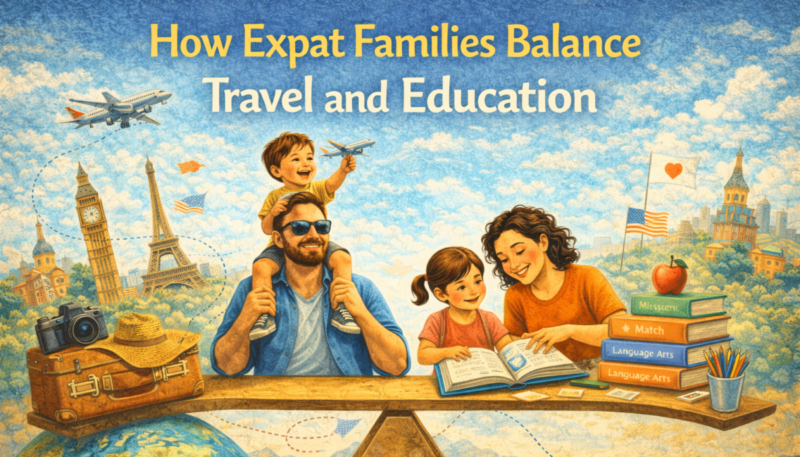
How Expat Families Balance Travel and Education
TLDR
- Expat families balance travel and education by combining structured academics with flexible learning models.
- Accredited programs such as the International Baccalaureate and recognized national curricula support university pathways worldwide.
- Travel enhances experiential learning, cultural competence, and language acquisition when paired with consistent routines.
- Homeschooling and hybrid education models offer flexibility, but require compliance with local and home-country regulations.
- Predictable academic anchors and clear long-term planning prevent travel from disrupting educational progress.
One of the biggest advantages of raising children abroad is access to the world itself. Borders feel closer. Flights are shorter. School breaks turn into cultural immersion instead of just downtime.
But here’s the honest question every expat parent eventually faces: how do you balance meaningful travel with serious education?
Freedom sounds good in theory. In practice, you still need transcripts, academic continuity, and real skills development. The good news is that travel and education are not opposites. With structure and foresight, they reinforce each other.
Let’s break down how families actually make this work.
Choosing an Educational Foundation That Travels Well
If you’re raising kids internationally, portability matters.
Globally recognized programs such as the International Baccalaureate are designed for internationally mobile families. The IB Diploma Programme, in particular, is widely accepted by universities around the world. That portability gives families flexibility to move between countries without disrupting long-term academic pathways.
Similarly, many international schools follow American, British, or other national curricula. These frameworks maintain standardized academic benchmarks, which makes transitions between schools smoother.
The key principle is alignment.
Whatever system you choose, ensure it connects to recognized qualifications. Mobility without academic recognition creates problems later.
Understanding Compulsory Education Requirements
Balancing travel with education also means respecting legal obligations.
Most countries have compulsory education laws that apply to residents. In the United States, for example, school attendance requirements are governed at the state level, and homeschooling is legal in all states but regulated differently depending on location.
Other countries have their own requirements for residents, including documentation of school enrollment or approved home education.
If you live abroad long-term, clarify both local education requirements and any obligations tied to your home-country citizenship. This avoids compliance issues and keeps your children’s education legitimate and transferable.
Travel flexibility must sit on top of legal clarity.
Using Travel as Structured Experiential Learning
Travel alone does not automatically equal education.
However, research in experiential learning consistently shows that hands-on engagement with real-world environments deepens understanding and retention. Museums, historical sites, language immersion, and exposure to different economic and political systems create context that textbooks alone cannot provide.
The difference lies in intentionality.
When you visit a historical site, connect it to your child’s current studies. If they’re learning world history, align travel destinations with that timeline. If they’re studying biology, explore ecosystems or conservation centers.
Experiential learning works best when paired with reflection.
Encourage journaling. Have discussions after visits. Ask questions that connect observation to theory.
That bridge between experience and analysis is where education actually happens.
Maintaining Academic Anchors While Traveling
Frequent travel can destabilize routines if you let it.
Research in child development consistently highlights the importance of predictable routines for cognitive performance and emotional stability. Travel disrupts sleep, schedules, and attention.
To counter this, build academic anchors.
Even during extended trips, maintain daily reading time. Keep math practice consistent. Protect quiet study windows, even if shorter than usual.
In our family, travel days are flexible, but the morning after arrival always includes a short academic session. It’s not heavy. It’s a signal. Education continues wherever we are.
That continuity prevents regression.
Leveraging Bilingual Environments
Expat families often raise children in multilingual settings. Travel can accelerate this process.
Second-language acquisition research shows that consistent exposure and meaningful interaction in the target language improve fluency over time. Immersive environments, where children must use the language for real communication, are particularly effective.
Travel within your host region strengthens this immersion.
If you live in Latin America, regional travel exposes your children to accents and dialect variations. If you’re in Southeast Asia, moving between countries expands cultural awareness and communication skills.
Language becomes functional, not theoretical.
That kind of learning is hard to replicate in a classroom alone.
Homeschooling and Hybrid Models
Many expat families choose homeschooling or hybrid approaches precisely because they allow travel flexibility.
Homeschooling is legally recognized in numerous countries, though regulations vary widely. Some require curriculum registration, periodic assessments, or documentation of progress.
Hybrid models, where children attend part-time school while completing additional coursework at home, are also increasingly common in international communities.
Flexibility comes with responsibility.
You must track academic progress, maintain records, and ensure alignment with future educational goals. That includes keeping transcripts, portfolios, and standardized test documentation where relevant.
Freedom without documentation can complicate university applications later.
Planning for University Pathways Early
Travel-focused families sometimes postpone long-term academic planning. That can create stress during the teenage years.
University admissions, particularly for internationally mobile students, often require standardized exams, recognized diplomas, and documented academic continuity. Programs such as the IB Diploma are structured specifically to meet global admission standards.
If your child is approaching secondary school, think strategically.
Which qualifications are recognized internationally? What documentation will universities expect? Are there language proficiency requirements?
Planning early allows you to travel without jeopardizing academic eligibility.
Protecting Sleep and Cognitive Performance
Travel can interfere with sleep, especially across time zones.
Research consistently links adequate sleep to improved concentration, memory consolidation, and emotional regulation in children and adolescents. Sleep disruption impairs academic performance.
When crossing time zones, gradual adjustment, exposure to natural light at appropriate times, and consistent bed routines help regulate circadian rhythms.
Academic flexibility during travel should not mean abandoning biological needs.
Rested children learn better.
Technology as a Stabilizer
Digital tools have made educational continuity far more manageable.
Online platforms allow students to access coursework, submit assignments, and communicate with teachers from virtually anywhere. During the global pandemic, many schools developed remote learning systems that remain in use today.
That infrastructure benefits traveling families.
However, technology works best as a supplement, not a replacement for structure. Screen-based learning still requires defined schedules, accountability, and limited distractions.
Used intentionally, it becomes a powerful stabilizer.
Financial and Logistical Realities
Travel-based education models carry financial considerations.
International school tuition, curriculum materials, travel expenses, and examination fees add up. Long-term planning is essential.
Budgeting for both education and mobility ensures sustainability. Unexpected financial strain can undermine both academic continuity and family stability.
Strategic families treat education as a core investment, not an afterthought.
Emotional Stability During Mobility
Children adapt remarkably well to travel when core relationships remain secure.
Research on resilience consistently shows that strong parent-child bonds and predictable home structures buffer against environmental change. Travel becomes enriching rather than destabilizing when family cohesion is intact.
That means protecting family rituals.
Shared meals. Weekly check-ins. Familiar bedtime routines, even in a hotel room.
Education thrives in emotional stability.
Conclusion: Freedom With Framework
Expat families do not have to choose between travel and education.
The families who succeed long-term combine recognized academic pathways with flexible delivery. They respect legal requirements. They use travel intentionally as experiential learning. They protect sleep, routines, and documentation.
Travel expands your children’s worldview. Structured education sharpens their tools for navigating it.
When you design both with care, you give your kids something rare: global perspective anchored in academic credibility.
That balance doesn’t happen by accident. It’s built deliberately. And when it works, it’s one of the greatest advantages of raising a family abroad.
Blog
-
Preventing Burnout While Raising Kids Abroad
Preventing burnout while raising kids abroad is about managing your responsibilities as an expat dad.
-
Managing Work, Parenting, and Travel as an Expat Dad
Living abroad with your family feels like you’re juggling three full-time roles at once.
