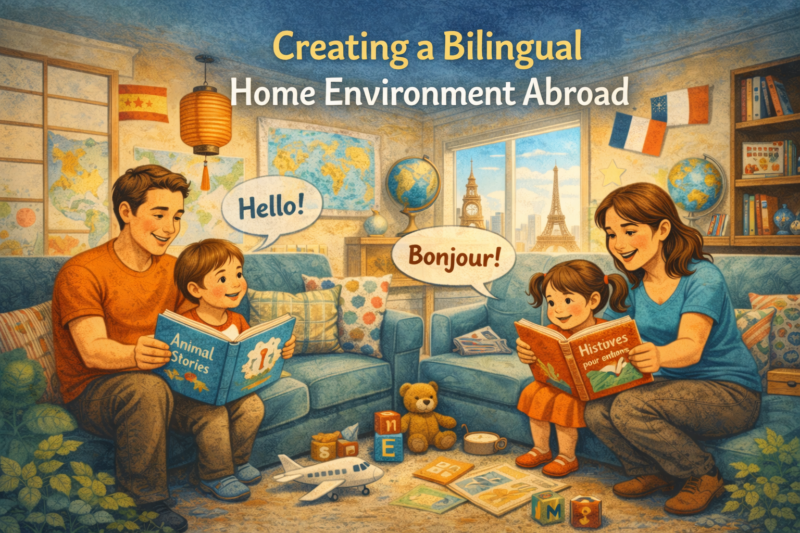
Creating a Bilingual Home Environment Abroad
TLDR
- Children develop strong bilingual skills when both languages are used consistently and meaningfully at home
- Quantity and quality of language input directly influence vocabulary and grammar development
- Emotional connection and daily routines anchor a minority language long term
- Spoken fluency develops naturally through interaction, but literacy requires intentional support
- A clear family language strategy prevents dominance of the community language abroad
Living abroad changes the language equation overnight.
One day your child is surrounded by your native language. The next, the grocery store, the playground, and eventually school all operate in something else. It can feel like your home language is slowly shrinking while the community language expands.
That shift is normal. It’s also manageable.
A bilingual home environment doesn’t happen accidentally. It grows out of deliberate but relaxed habits that shape daily life. The good news is that children are neurologically prepared to acquire more than one language from an early age. What they need is steady exposure, meaningful interaction, and emotional consistency.
Let’s break down how to build that kind of home abroad.
Start With a Clear Family Language Plan
Before anything else, decide what you want your linguistic outcome to be.
Do you want full fluency in both languages? Conversational ability in one and literacy in another? Academic competence across the board? Your strategy depends on your long-term goals.
Research in bilingual development consistently shows that children’s proficiency in each language reflects the amount and type of exposure they receive. If one language dominates daily input, it will likely dominate output as well.
Clarity helps you stay consistent when life gets busy.
Some families adopt one-parent-one-language. Others choose minority-language-at-home, where both parents use the non-community language consistently inside the house. Neither approach is universally superior. What matters most is predictability.
Children organize language through patterns.
Make Language Functional, Not Theoretical
Children do not retain languages because they are told they are important. They retain them because they use them.
If your home language exists only in corrections or instructions, it weakens emotionally. If it exists in jokes, stories, arguments, and daily conversation, it strengthens naturally.
Talk about real things. Discuss the day. Tell stories from your childhood. Cook together and name ingredients. Ask for opinions. Language grows through interaction, not performance.
When language becomes part of family life rather than a lesson, children internalize it without resistance.
Protect the Minority Language Early
In many expat contexts, the community language quickly becomes dominant. School, neighbors, media, and friendships reinforce it constantly.
The minority language – often the home language – can slowly lose ground unless it has protected space.
This is especially true once formal schooling begins. Research shows that school language often accelerates vocabulary growth in that language due to academic exposure.
If the home language doesn’t maintain daily conversational depth, children may shift toward the community language in replies.
A simple principle helps: if the outside world supplies one language, your home should consistently supply the other.
Consistency beats intensity.
Understand That Mixing Is Normal
If your child blends languages in a sentence, that’s typical bilingual development.
Young bilingual children often draw from whichever language provides the fastest word retrieval. This reflects vocabulary distribution across languages, not confusion.
Over time, as exposure balances and vocabulary grows, children separate systems more cleanly. Pressuring them to “choose one” mid-sentence rarely helps. Continued modeling does.
Language systems mature gradually.
Prioritize Quality Interaction Over Screen Exposure
Media can support language exposure, but it cannot replace live conversation.
Studies in early language development consistently emphasize the importance of responsive interaction – the back-and-forth exchange between child and caregiver. Passive listening contributes far less than interactive communication.
That doesn’t mean eliminate media. It means use it intentionally. Watch together. Discuss what happened. Ask questions. Turn passive input into active conversation.
Language thrives in dialogue.
Build Literacy Deliberately
Spoken language emerges naturally through exposure. Reading and writing do not.
Literacy requires repeated exposure to print, phonological awareness, and practice. If you want your child to read and write in your home language, you must create opportunities for that skill to develop.
Simple routines work well:
- Bedtime reading in the minority language
- Family reading time once a week
- Audiobooks paired with printed text
- Writing short letters to relatives
Even modest but consistent literacy exposure significantly improves long-term retention.
Without it, children may remain fluent speakers but limited readers.
Use Extended Family Strategically
Grandparents, cousins, and relatives can be powerful anchors for a minority language.
When children associate a language with meaningful relationships outside the nuclear family, motivation increases. Video calls, visits, shared traditions, and storytelling strengthen emotional ties.
Language tied to identity tends to last.
This doesn’t require pressure. It requires connection.
Expect Shifts During Developmental Stages
Language balance is not static.
Toddlers may favor the home language. Preschoolers often shift toward the community language once social interaction increases. Teenagers sometimes experiment with identity through language choice.
These fluctuations are typical.
Research shows that early bilingual exposure builds lasting receptive skills even if active use declines temporarily. Continued exposure keeps neural pathways accessible.
Stay steady during shifts. Avoid reacting emotionally to temporary preference changes.
Create Real Reasons to Use Both Languages
If one language becomes optional, children will often choose the easier or more socially dominant one.
Practical reasons encourage maintenance:
- Travel where the language is needed
- Friendships in both languages
- Hobbies or clubs using the minority language
- Cultural traditions celebrated consistently
The goal is not to force use but to make both languages valuable.
Children invest effort when communication serves a purpose.
Keep Correction Gentle and Sparse
Overcorrection discourages risk-taking.
Bilingual children refine grammar and vocabulary over time through repeated exposure. Constantly interrupting to fix minor errors can reduce willingness to speak.
Model correct usage naturally instead. If your child says a sentence imperfectly, respond with the correct structure embedded in your reply.
Language grows through confidence.
Align Language With Long-Term Vision
As fathers building lives abroad, we tend to think long term. Education, financial stability, cultural identity – these matter.
Language plays a strategic role in all three.
Bilingual competence expands educational options. It preserves cultural heritage. It increases mobility later in life. Research consistently links bilingualism to cognitive flexibility and enhanced executive control due to managing multiple language systems.
But those outcomes depend on sustained exposure, not early enthusiasm alone.
A bilingual home is not built in a year. It is built in thousands of small conversations.
My Observation Living Abroad
Watching families here, the difference between bilingual and semi-bilingual kids isn’t intelligence. It’s environment.
In homes where language rules are calm, consistent, and integrated into daily life, children speak both languages naturally.
In homes where language becomes a battleground, it weakens quickly.
The most successful families treat bilingualism as normal. Not impressive. Not pressured. Just part of who they are.
That mindset changes everything.
Conclusion
Creating a bilingual home environment abroad is less about complex strategies and more about steady structure.
Children are fully capable of acquiring multiple languages from early childhood. Their proficiency in each reflects the exposure and emotional relevance they experience daily.
If you provide consistent interaction, meaningful conversation, literacy support, and real-life use, both languages can thrive – even when one dominates outside your door.
You don’t need perfect grammar. You need stable patterns.
Over time, those patterns shape not just language ability, but identity, confidence, and opportunity.
Blog
-
Preventing Burnout While Raising Kids Abroad
Preventing burnout while raising kids abroad is about managing your responsibilities as an expat dad.
-

Managing Work, Parenting, and Travel as an Expat Dad
Living abroad with your family feels like you’re juggling three full-time roles at once.
