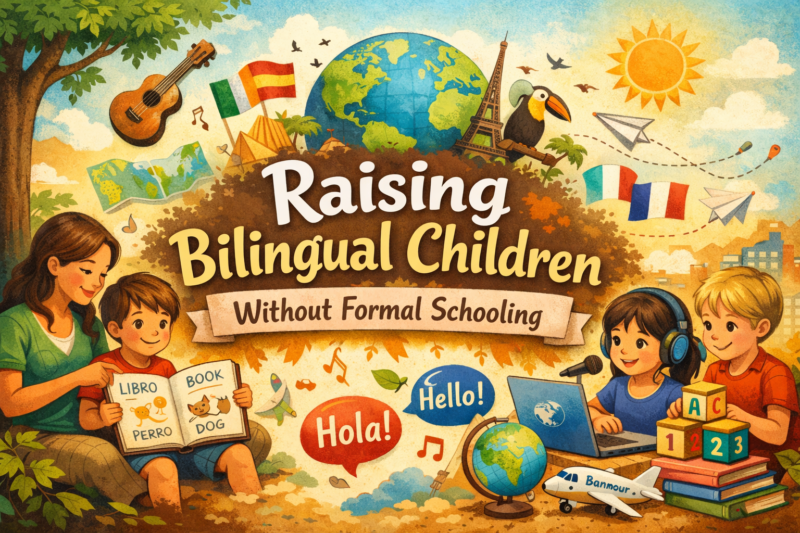
Raising Bilingual Children Without Formal Schooling
TLDR
- Children can become fully bilingual without attending formal school if they receive consistent, meaningful exposure to both languages
- Daily routines, not lessons, are the strongest driver of language development in early and middle childhood
- Literacy requires deliberate teaching even when spoken fluency develops naturally
- Community interaction is essential so the second language becomes socially useful, not just academic
- Long term success depends on structure and consistency, not intensity or complicated curricula
For many families living abroad, formal schooling stops feeling like the automatic path. You may be traveling, building a location-independent income, or simply choosing a different rhythm of family life. Then a practical question shows up quickly: can kids truly become bilingual without school?
Short answer, yes. But not accidentally.
Children do not become bilingual because their parents want it. They become bilingual because their environment requires it, day after day, in ways that feel normal rather than instructional. When formal schooling is removed, parents are not replacing teachers. They are replacing the structure that guarantees exposure.
That distinction changes everything.
How Children Actually Learn Languages
Young children learn language through interaction, not instruction. Conversation, play, storytelling, and real communication drive vocabulary and grammar development. Structured lessons help older learners, but early fluency grows from use.
This is why children in multilingual households can naturally speak multiple languages long before they can read. Their brains categorize sounds, patterns, and meanings based on repetition across meaningful situations. Asking for water, negotiating toys, listening to stories, helping cook. Those moments build language faster than flashcards.
Without school, you must recreate exposure density. Not through intensity, but through frequency. Five minutes every day beats an hour once a week.
One thing surprises many parents. Understanding comes before speaking, often by months. A child may follow instructions in a language long before answering back in it. That silent period is normal and not a delay.
The Role of the Home Language
Most expat families underestimate how quickly the surrounding language dominates. If your child plays daily with neighborhood kids in the local language, that language becomes emotionally primary, even if you speak another language at home.
Without deliberate effort, the family language weakens. Not suddenly, but gradually. Shorter sentences, mixed grammar, avoidance of complex topics.
The solution is not formal lessons. It is functional use.
You need regular situations where the home language is the only effective tool. Family discussions, bedtime reading, problem solving conversations, planning trips, even arguments. Emotional conversations especially strengthen language retention because the brain links language to meaning, not memorization.
In our house, I noticed the shift when my child could explain a complicated game strategy in one language but not the other. That was the moment I understood vocabulary follows lived experience. So we changed which language we used during collaborative tasks. The gap closed within months.
Literacy Does Not Develop Automatically
Spoken fluency often develops naturally. Reading and writing do not.
Schools normally handle literacy progression through systematic exposure to print, guided reading, and correction. Without that structure, parents must intentionally introduce reading in both languages.
Start with consistent reading aloud. Children exposed to daily reading develop phonemic awareness earlier, which supports later independent reading. The language of literacy does not have to match the dominant spoken language, but it must be regular.
Writing comes later. Early writing benefits from simple, purposeful tasks rather than worksheets. Grocery lists, journaling, labeling drawings, writing letters to relatives. Real communication again outperforms drills.
One practical insight: literacy requires separate time for each language. If reading only happens in one language, literacy will concentrate there even if speaking remains bilingual.
Community Is Not Optional
A language without peers becomes academic. A language with peers becomes alive.
Children need relationships that exist only in the second language. Playgroups, sports, neighborhood games, hobby clubs. Without these, the language stays tied to parents and authority rather than identity.
This matters more as children age. Younger kids accept parental structure. Older kids choose social efficiency. They will use the language that lets them belong.
For traveling families, temporary communities still work. What matters is regular interaction, not permanence. Three months of daily play in one language outweighs a year of occasional lessons.
Managing Language Mixing
Parents often worry when children mix languages in a sentence. In bilingual development, this is normal. It reflects vocabulary availability, not confusion.
Children choose the word that comes fastest. Over time, as vocabulary grows in both languages, mixing decreases naturally when contexts separate. For example, one language at home, another with friends.
Correct gently by modeling, not interrupting. Repeat the sentence naturally using the appropriate words. This preserves communication while reinforcing structure.
Strict correction often reduces willingness to speak, which slows progress more than mixing ever does.
Structuring a Week Without School
Without formal schooling, language exposure must be planned lightly but consistently. Think rhythm, not schedule.
Daily conversations in one language with a specific parent
Reading aloud in both languages across the week
Regular social interaction in at least one non-home language
Independent play media limited to a chosen language intentionally
Writing activities tied to real tasks
Notice none of these resemble classroom lessons. They resemble life, but directed life.
The goal is to attach each language to a domain. One for emotional connection, one for community interaction, one for literacy tasks. When languages have roles, children keep them.
Adolescence Changes the Equation
Teenagers prioritize efficiency and identity. If a language does not serve social or future goals, they gradually abandon active use.
At this stage, purpose matters. Travel planning, part-time work, volunteering, or managing real responsibilities in the second language helps maintain it. Abstract importance rarely motivates teenagers, but usefulness does.
The earlier habits you built now protect the language later. If reading, discussing ideas, and solving problems in both languages already feel normal, retention is far easier.
What Success Actually Looks Like
Bilingualism is not symmetrical perfection. One language usually becomes dominant depending on environment. That is normal worldwide, even in multilingual societies.
Success means your child can live life fully in both languages. Hold conversations, understand media, read independently, and express complex thoughts with some effort.
Perfection is not the goal. Functional independence is.
Parents often expect identical vocabulary across languages. Real bilingual adults rarely have that. They have domain-specific strengths, shaped by how they use each language.
The Quiet Advantage of the No-School Path
Without formal schooling, language learning becomes integrated instead of segmented. Children do not separate “learning time” from life. The language becomes the medium of living.
I have noticed kids educated this way often switch languages based on topic rather than instruction. They naturally use the language tied to experience. Cooking discussions in one language, technical topics in another.
That flexibility reflects true bilingual competence. It develops slowly, almost invisibly, then becomes obvious all at once.
Conclusion
Raising bilingual children without formal schooling is less about teaching and more about designing an environment. Exposure, usefulness, relationships, and literacy habits form the foundation.
You are not recreating school at home. You are shaping daily life so both languages are necessary and meaningful. Consistency matters more than intensity. Interaction matters more than curriculum.
If both languages live inside real experiences, children keep them. Not because you insisted, but because they belong to them.
Blog
-
Preventing Burnout While Raising Kids Abroad
Preventing burnout while raising kids abroad is about managing your responsibilities as an expat dad.
-

Managing Work, Parenting, and Travel as an Expat Dad
Living abroad with your family feels like you’re juggling three full-time roles at once.
