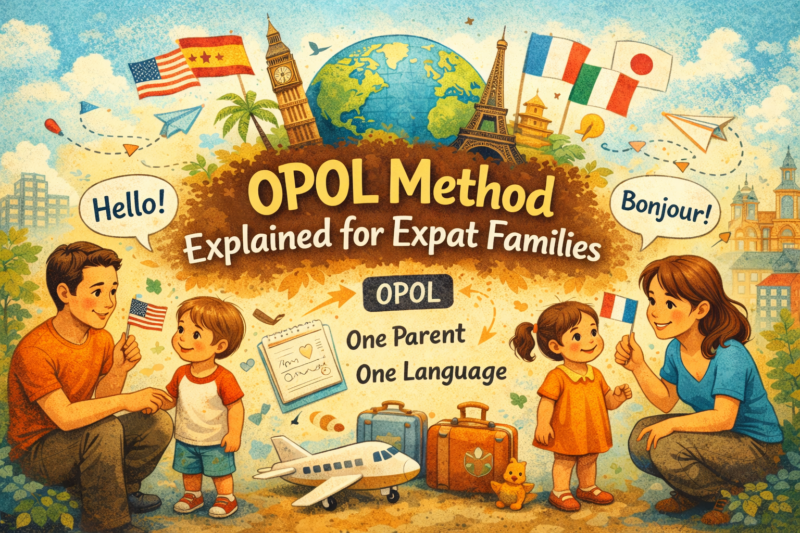
OPOL Method Explained for Expat Families
TLDR
- OPOL means each parent consistently speaks one specific language with the child
- Consistency matters more than perfection or strict rules
- It works best when each language has real emotional context and daily use
- Mixing languages early is normal and not harmful
- Literacy still needs separate, intentional support later
Move abroad with kids and language questions start immediately.
Which language should we speak at home?
Will English fall behind?
Should we correct them?
Are we confusing them?
At some point you’ll run into the term OPOL – One Parent, One Language. It sounds structured, almost clinical. In practice, it’s surprisingly simple, and also frequently misunderstood.
Used well, it becomes less of a teaching strategy and more of a lifestyle rhythm. Used poorly, it turns into a stressful household rule nobody enjoys.
Let’s break down what OPOL actually is, why it works, and how expat families can make it sustainable long term.
What OPOL Really Means
OPOL is not about forcing bilingualism. It’s about predictable communication patterns.
Each parent consistently speaks a different language to the child. Not sometimes. Not when convenient. Consistently enough that the child associates that language with that person.
Dad always Spanish
Mom always English
Or French and German
Or Japanese and Portuguese
The specific languages don’t matter. The stability does.
Children naturally categorize language by social context. They don’t memorize vocabulary lists – they map people to communication systems. Over time, they stop translating and start switching automatically.
That shift is the entire goal.
Why Consistency Beats Volume
Parents often assume exposure hours determine fluency. More language equals better language.
But young children organize language primarily by relationship, not by quantity.
If you speak two languages randomly, the child hears more words but receives weaker structure. If you consistently attach a language to a person, the brain builds a clear mental boundary.
Think of it like operating systems. A device runs smoothly when programs know which system they belong to. Random switching slows everything down.
OPOL gives the brain sorting rules.
The Early Mixing Phase Is Normal
Every OPOL household goes through the same stage.
The child responds in one language regardless of which parent spoke. Or mixes both in a single sentence.
Parents interpret this as failure.
It isn’t.
Early bilingual development often shows “dominant comprehension, selective production.” The child understands both languages but uses whichever requires less effort at the moment.
Eventually social awareness kicks in. The child realizes certain people expect certain languages and adapts without being told.
Correction rarely speeds this up. Interaction does.
The Emotional Anchor Matters More Than Grammar
Children maintain languages tied to emotional connection.
A language used only for lessons weakens quickly. A language used for comfort, jokes, and daily routines sticks deeply.
This is why OPOL works particularly well for expats. Parents naturally create separate worlds:
Home routines
Community interaction
School environment
Each language becomes a functional tool, not an academic subject.
When Dad reads bedtime stories in one language and Mom handles morning routines in another, children associate language with security and belonging, not performance.
That emotional link is what preserves the minority language long term.
You Don’t Need Perfect Native Fluency
A common hesitation: “My accent isn’t perfect.”
Children don’t need perfect pronunciation models from every speaker. They need stable patterns. If a parent comfortably uses a language daily, that input remains valuable.
Fluency grows through combined exposure – parents, friends, media, environment. One imperfect speaker does not damage acquisition.
In many multilingual societies, children routinely hear varying accents and still develop strong competence.
The real risk isn’t imperfection. It’s inconsistency.
What Happens When You Break the Rule
Real life interferes. Stressful mornings. Family visits. Emergencies. You’ll occasionally switch languages.
Nothing collapses.
Problems arise only when switching becomes unpredictable. If today Dad speaks English, tomorrow Spanish, and next week both randomly, the brain loses sorting cues.
A good practical guideline: consistency over 80 percent of interactions is enough.
OPOL is a pattern, not a contract.
The Role of the Outside Environment
OPOL functions best when each language has real-world usefulness.
If the community language differs from both parents’ languages, children often become comfortably trilingual. The outside world supplies motivation parents cannot simulate.
If one parent’s language exists only inside the house, you’ll need reinforcement:
Regular calls with relatives
Books and audiobooks
Media in that language
Visits to places where it’s spoken
Without functional need, passive understanding remains but active speaking fades over time.
Children keep languages they need socially.
School Doesn’t Replace the Minority Language
International school parents often assume English education will maintain English automatically.
Not always.
School language becomes academic language – structured, formal, context-specific. Home language remains emotional and spontaneous. Remove home use, and conversational ability weakens despite academic proficiency.
OPOL protects the natural register of a language, the version used for real life rather than assignments.
That difference becomes noticeable in teenage years when kids can write essays but struggle with casual conversation in the weaker home language.
Literacy Is a Separate Skill
Speaking does not guarantee reading or writing.
Human brains evolved for speech. Writing systems require instruction. Children raised with OPOL often become fluent speakers in multiple languages but literate in only the school language unless parents actively support the others.
This doesn’t require formal homeschooling. Short, consistent reading habits work well:
Bedtime reading in the minority language
Comics and magazines
Journaling
Audiobooks paired with text
Ten minutes daily over years matters more than occasional intensive study.
What to Do When Kids Refuse a Language
Around ages five to eight many children temporarily reject the minority language.
Usually the community language feels socially easier. Friends don’t use the home language, so motivation dips.
Forcing responses rarely helps. Continue speaking your language anyway. Comprehension remains even when responses switch.
Most children return to active use once they recognize practical value – travel, friendships, or independence. The foundation stays intact if exposure continues calmly.
Think long timeline, not daily compliance.
OPOL in Single-Parent or Same-Language Families
You don’t need two native languages at home.
Some families adapt OPOL by assigning languages to routines instead of parents:
Breakfast language
Bedtime language
Weekend language
This is less powerful than person-based OPOL but still effective when consistent. The brain still maps context to communication.
The core principle remains unchanged: predictable boundaries create clarity.
What I Learned the Hard Way
The biggest mistake I made early was treating OPOL like training.
I corrected constantly, requested translations, and monitored progress. The result was hesitation.
Once I stopped reacting to errors and simply maintained my language naturally, conversation increased almost immediately. Kids prioritize ease over accuracy, and accuracy follows usage.
OPOL works best when it fades into normal life.
Practical Rules That Keep It Sustainable
Speak your language naturally, not slower or simplified forever
Don’t demand replies in your language every time
Keep emotional conversations in your assigned language
Let siblings develop their own mix between them
Support literacy gradually, not through heavy lessons
And most importantly, avoid turning language into performance for visitors.
Nothing shuts down participation faster than being asked to “say something in Spanish for grandma.”
Conclusion
OPOL isn’t a curriculum. It’s a structure that helps children organize the linguistic world around them.
When each language has a person, a place, and a purpose, kids rarely resist learning it. They simply absorb it as part of daily life.
Perfection doesn’t matter. Stability does.
If you maintain calm consistency, provide meaningful exposure, and stay patient through phases of resistance, the system quietly does its job. Years later, you realize your child didn’t just learn two languages.
They learned when each one belongs.
And that’s the real skill multilingual adults use every day.
Blog
-
Preventing Burnout While Raising Kids Abroad
Preventing burnout while raising kids abroad is about managing your responsibilities as an expat dad.
-

Managing Work, Parenting, and Travel as an Expat Dad
Living abroad with your family feels like you’re juggling three full-time roles at once.
